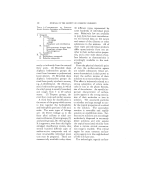
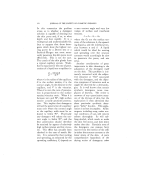
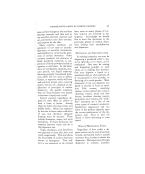
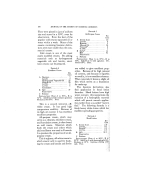
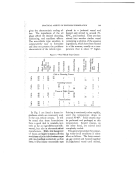
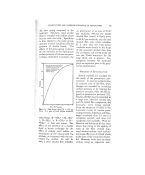
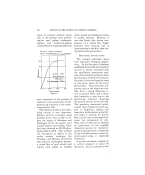
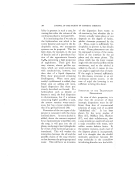
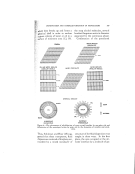
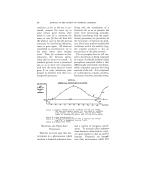
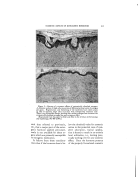
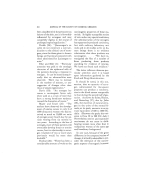
PENETRATION AND COMPLEX-FORMATION IN MONOLAYERS 383 the ester group compared to the hydroxyl. Similarly, oleyl alcohol forms a comple3c with sodium oleate but not with oleic acid. Specificity is thus related to the polar group, and also to steric hindrance and the presence of double bonds. The effects of the polar group is shown by the variation in the equilibrium surface pressure of substances pene- trating a cholesterol monolayer, the 30 o i •. 3 4 5 6 3.3 x 10⁻⁷ g./c.c. Figure 2.--This shows that F.-/ = RT log C•/c2. z/= area of cetyl sulfate molecule. order being: R--NHa+ R--SO4- R--SOa- R--CO2- R-- NMea + bile salt artion. The effect of the presence of a double bond is shown strikingly by the effect of sodium cetyl sulfate on monolayers of the unsaturated alcohols, as compared with the sat- urated C•8 alcohol. As will be seen, acetyl alcohol film solidifies on penetration at an area of 78 A. 2 per molecule, whereas the elaidyl alcohol film (trans) is liquid down to 60 A. 2 per molecule, and the oleyl alcohol film (cis) never solidifies. It is clear that the trans-isomer conforms more closely to the shape of the saturated alcohol than does the cis-isomer, and consequently the van der Waals attraction for the long chain salt is greater. Iso- morphism between the molecules plays an important part in the pene- tration phenomenon. METHODS 0•' INVESTIOATIOl• Several methods are available for the study of the penetration phe- nomenon. It may be studied either at constant area of the film, when changes are revealed by increasing surface pressure, or by keeping the pressure constant, when the film ex- pands as penetration proceeds (21). Finally, the film may be expanded to a large area, injection carried out, and the mixed film compressed, the force-area curve being plotted. From the existence of kinks in the force-area curves of various pene- trating systems, Schulman and Sten- .hagen concluded that 1:1 and 1:3 complexes existed, and that 1:2 complexes were unstable. Work by Matalon and Schulman (6) has since shown that owing to the rigidity of some of the films studied (e.g., cetyl alcohol-sodium cetyl sulfate) hysteresis effects are involved which make some of the conclusions doubt- ful. However, work done by these authors using an expansion tech-

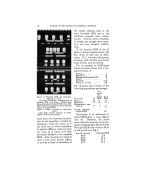
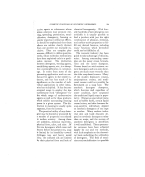
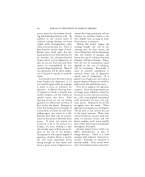
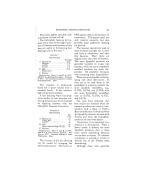
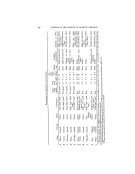
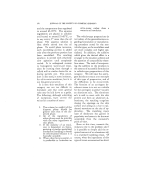
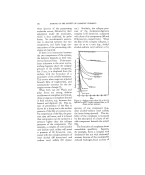
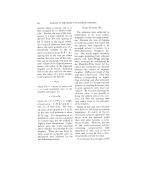
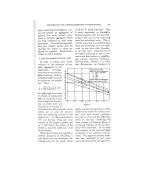
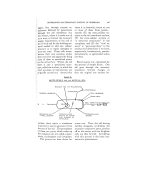
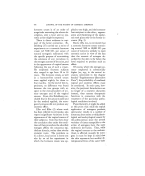
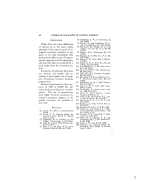
384 JOURNAL OF THE SOCIETY OF COSMETIC CHEMISTS nique at constant pressure shows that in the sys. tems cetyl alcohol- sodium cetyl sulfate, cholesterol- sapchin and cholesterol-sodium cetyl sulfate, 1:1 complexes definitely Interaction I½odmcj to Complexes b•tw•n HAEMOGLOBIN and C225ULPHAToe pH =10 20øC $urfac• Pressure = 2 8,1yn½s/cm 9 I'lc• mø•Tn/700co 2('3 40 6• 1oo 80 ._• •J O•4o Time in minut• Figure 3. exist irrespective of the pressure of expansion and concentration of the penetrating substance in the under- lying solution (22). The influence of salts in the under- lying solution is very important. Harkins and his co-workers, using distilled water, were unable to re- peat the results of Schulman and Stenhagen (2) for the system cetyl alcohol-sodium cetyl sulfate, w•ich had been obtained on M/S00 phos- phate buffer at pH 8. They ascribed the discrepancy to defects in the earlier workers' technique, but Schulman and Matalon (6) showed that injection of phosphate beneath a mixed film of cetyl alcohol and sodium cetyl sulfate on distilled water caused an immediate increase in surface pressure. However, it was also found that during com- pression of a mixed film, higher pressures were attained, due to closer packing in the film, than dur- ing spontaneous penetration. BIOLOGICAL APPLICATIONS The concepts described above have important biological applica- tions. In the first place, Schulman andRideal showed (1) that hemolytic activity is closely associated with the equilibrium penetration pres- sure of the dissolved substance when penetrating a cholesterol monolayer, the order of activity being the same as that given above for the latter phenomenon. Some hemolytic sub- stances, such as the long-chain alco- hols, have a strong dispersing ac- tion on protein films, and it seems that hemolysis is also due to the penetrating substance displacing the protein portion of the cell wall. The specificity mentioned earlier, namely that of cholesterol with sap- chin or long-chain sulfates, and long-chain hydrocarbons polyethyl- ene oxides or alcohols for protein films can be used to distinguish be- tween the components of cells. Thus, lysis of cells can be obtained by penetration of the available cholesterol portion by cholesterol- penetrating substances or dispersion of the. available protein portion by protein-penetrating or -dispersing : substances. A protein monolayer collapses at a surface pressure of about 16 dynes/cm., and so substances that
Purchased for the exclusive use of nofirst nolast (unknown)
From: SCC Media Library & Resource Center (library.scconline.org)