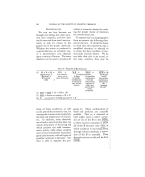
lower the sin-face tensoin by about i•i•!i::•: 20 dynes/cm. will lyse cells if pro- rein is available and if the agent is in su•cient concentration to lower !i'll •':the surface tension to that extent. The cholesterol-active substances are effective in concentrations below 10 -a per cent and so, are active at concentrations which lower the sur- face tension approximately 5 dynes/ cm. or less. Substances which adsorb on to protein monolayers, and do not penetrate, are all agglutinating agents, as they render the hydro- philic surfaces of the cells hydro- phobic. The chemistry of the cell sin'- faces can thus be established by the nature of the substances which at- tack them. Further, some cells can be shown to be resistant to both these types of agent, and conse- quently to be composed of chitin or other polysaccharide material. It is also of interest that active sub- stances in sublytic doses can induce a permeability of .the cell to mate- rials which are not normally taken up or given out by the cell. PENETRATION AND COMPLEX-FORMATION IN MONOLAYERS 385 SUMMARY The penetration and adsorption phenomena may be summarized under the following headings: (a) constant area, (b) variable area and pressure, (c) constant pressure. 1. kFeak _ nteraction. (a) If the surface pressure of the soluble agent is •r•, and the collapse surface pres- sure of the film-forming molecules is *rv, then if •r• •rv, displacement of the film material will take place, if there is no association by polar forces between the two molecules. The resultant surface pressure will be •r 8. (b) Ejection of a compound in a mixed film will take place at its collapse pressure if there is no polar interaction. 2. Strong Interaction. (a) If there is strong association by van der Waals forces between the film- forming molecules and the soluble molecules in the underlying solu- tion, the resultant surface pressure of the mixed film will approach •rs q- •rv, well above the collapse pressure of either of the compo- nents. (b) No ejection occurs from a mixed monolayer of the two asso- ciated molecules, but a 1:1 com- plex of very high collapse pressure is formed. Ejection of the excess of dissolved molecules from the 1:1 complex monolayer can be followed experimentally. Phase diagrams obeying a two-dimensional phase rule can be plotted for these mixed monolayers. 1 and 2 (c). The percentage in- crease in area of a monolayer on penetration by soluble molecules from the underlying solution, at constant pressure and below the re- sultant equilibrium surface pressure of the monolayer at constant area, is directly related to the ratio of the molecular areas of the interacting species at their collapse pressures. Thus, a cholesterol monolayer with an area of 40 A.2 per molecule on being penetrated by sodium cetyl sulfate (20 A.2) will expand by half

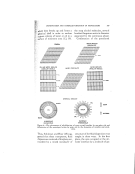
386 JOURNAL OF THE SOCIETY the original area. This can be shown to be independent of the sur- face pressure or concentration of the penetrating molecules in the under- lying solution (2). Similarly, a cholesterol monolayer expands to double its area on penetration by saponin, showing that the area per molecule of saponin is also •,0 A. •- Surface solution effects shown at low surface pressures by excess of pene- trating agent (above the amount required to form the 1:1 complex) can be taken into account by extra- polation of the expansion-time curve to the starting time (7, 22). ADSOP. PTIOS AND TANNINO If in the underlying solution the soluble interacting molecule has two or more appropriately spaced polar groups, the penetration of the non-polar portion of the mole- cule is prevented, and adsorption in the form of a double layer takes place.This results in the film-form- ing molecules becoming spaced on the lattice of the polar groups of the adsorbed molecules, producing a solid film of the insoluble film- forming molecules at very large areas, usually at least twice the nor- mal area of solidification of the monolayer alone [e.g., tanning of an amine film (4:, 23)]. Should the area of the film-form- ing molecule be greater than the area taken up by two of the spaced polar groups in the adsorbed mole- cule, no expansion of the insoluble film takes place, but a marked in- crease in rigidity is observed, due to OF COSMETIC CHEMISTS intermolecular interlacing by the ad- sorbed molecules [e.g., tanning of protein• (1)]. Adsorption results in big changes of surface potential of the insoluble monolayer, either a rise or a fall according to the nature of the ad- sorbed dipole. REVERSlSlLITY OF ADSOP.?TION Proteins may adsorb on to lipold monolayers, either at the air-water or at the oil-water interface, in the latter case as protein-stabilized emulsions. Since this adsorption is pH-conditioned, it can be easily reversed. The structural changes of the protein molecule before ad- sorption, as an adsorbed monolayer and after desorption are very inter- esting, especially in relation to the biological activity of protein mole- cules in the three structural forms (7-9). THE OIL-WATER INTERFACE Analogous molecular interactions to those at the air-water interface can be shown by an emulsion tech- nique to exist at the oil-water inter- face. The stability and ease of formation of emulsions are related to complex-formation, surface viscosity and rigidity and surface charge. As has been shown, complex-forma- tion at the interface between an oil- soluble agent in the oil phase and a water-soluble agent in the aqueous phase can radically alter all these factors (10). ".'Since the resultant interfacial tension depends on the
Purchased for the exclusive use of nofirst nolast (unknown)
From: SCC Media Library & Resource Center (library.scconline.org)