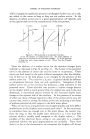
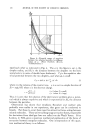
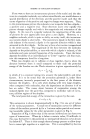
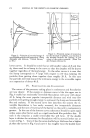
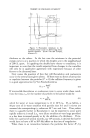
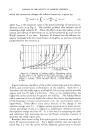
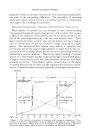
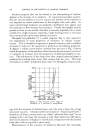
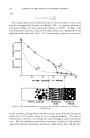
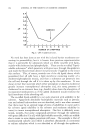
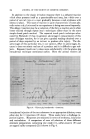
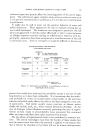
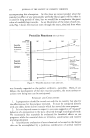
176 JOURNAL OF THE SOCIETY OF COSMETIC CHEMISTS In Fig. 3b it was seen that the absorption of emulsifying agent at the oil- water interface is the primary factor in determining the charge on the oil drop and its surface potential. Thus by equation 7 it is the major source of the repulsive potential between particles. Here the droplet radius is a factor as it is in the force of attraction given by equation 8. Although its evaluation is obscure the van der Waals constant .4 in equation 8 depends on properties of the atoms and molecules interacting so will be dependent in considerable measure on the interfacial film. The value of A//in Fig. 3 will also be influenced by the presence of the emulsifier since the surface active ion will normally be much more soluble in the oil phase than are other ions. The bump in the total potential energy curve was predicated on a surface potential which was not a function of H0, the distance between the particles. This, it seems to me, is where the picture breaks down somewhat. Early work by Harkins (4) and others indicated that emulsion stability is a func- tion of the rigidity and film viscosity of interfacial films. Recent work by Cockbain and McRoberts (5) offers evidence that under some conditions the ease of displacement of the interfacial film into the discontinuous phase is of primary importance in stability. Some commercial emulsifiers specifically tailored for use in hard water yield emulsions which are more stable in the presence of calcium ion than in sodium ion solutions of the same concentration--apparently violating the Schulze-Hardy rule. It also was difficult for Van den Tempel (3) to explain rates of flocculation and coalescence in terms of his estimates of the surface potential. His high values for •k0 would lead to very low rates of crossing of the barrier. It seems to me that the next development in the theory must take into account that the surface charge is borne by surface active ions. When two droplets approach there will be forces acting on these ions tending to drive them from the proximate region on the droplets. If the ion concentration on the droplet surface in the collision region is decreased in this way the surface potential will also go down and the potential energy (//)-distance (H0) curve will correspond to a path which crosses over from one constant •k0 line to another in Fig. 6. In this picture the ability of surface active ions to move along the interface to a distant region on the droplet will be of importance in some cases, in others the displacement of these ions into the droplet will be energetically easier and in still others neither will readily happen. These possibilities then enable the theory to explain the observa- tions of Harkins, Cockbain, Van den Tempel, and others. REFERENCES (1) Simha, R., )t. Arpplied Phys., 23, 1020 (1952). (2) Mooney, M., •. Colloid Sci., 6, 162 (1951). Maron, S. H., and Fok, S., Ibid., 8, 540 (1953). (3) Verwey, E. S. W., and Overbeek, J. Th. G., "Theory of the Stability of Lyophobic Col- loids," Amsterdam, Holland, Elsevier Publishing Co. (1948). Van den Tempel, M., "Stability of Oil-in-Water Emulsions," Delft, Holland, Communication of Ruber- Stichting (1953).

THEORY OF EMULSION STABILITY 177 (4) Harkins, W. D., "The Physical Chemistry of Surface Films," New York, Reinhold Pub- lishing Co. (1952). (5) Cockbain, E.G., and McRoberts, T. S., 5 t. Colloid Sci., 8, 440 (1953). CREDITS Figure 1 Weiser, "Colloid Chemistry," 1ohn Wiley & Sons, Inc., New York, N.Y., 1953. Figures 5 and 5. Alexander, A. E., anal Johnson, P., "Colloid Science," The Clarendon Press, Oxford, England, 1949. Figures 3, 6 and 7. Van den Tempel, M., "Stability of Oil-in-Water Emulsions," Rubber Stichting, Delft, Holland, 1953. Figures 4 and 8. Kruyt, H. R., Ed., "Colloid Science," Vol. I, Elsevier Publishing Co., Amsterdam, Holland, 1952. COSMETIC SEMINAR SEPTEMBER 15 AND 16, 1955 THE BARBIZON PLAZA HOTEL Three half-day symposia will be presented with three or four papers each, on topics of current interest to the cosmetic in- dustry. On Thursday, September 15th, the program will consist of four papers on The Use of Radioactive Isotopes in Cosmetic Re- search. During the afternoon of the same day, three papers will be given on Mechanism of Antiperspirant and Deodorant Ac- tivity. The third symposium will take place on Friday, September 16th with papers on Aerosols in the Cosmetic Industry. Trips to the following plants may be made during the afternoon. Mennen Bristol- Myers Shulton Avon Helena Rubinstein Reservations may be made by contacting Mr. William R. Giese, Society of Cosmetic Chemists, 2 East 63rd Street, New York City.
Purchased for the exclusive use of nofirst nolast (unknown)
From: SCC Media Library & Resource Center (library.scconline.org)