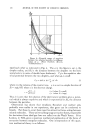
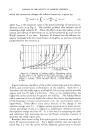
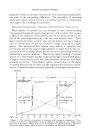
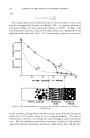
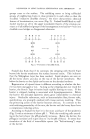
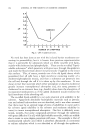
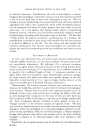
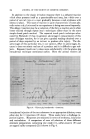
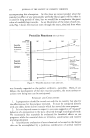
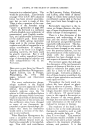
174 JOURNAL OF THE SOCIETY OF COSMETIC CHEMISTS which the interaction changes the collision frequency, is given by: Gr_-o __ 14 / = 2r eV,/k T dHo 1 eVm•/KT (12) Gv -- r Ho 2 • where//,•,, is the maximum value in the potential energy of interaction rs. distance curve as in Fig. 6. The stability problem then becomes one of obtaining a high value for/4/. Thus, the effects of particle radius, concen- tration and valence of electrolyte (as ,), surface potential •k0, and van der Waals' constant d are seen. Equation 10 showed that the collision fre- quency increased with the concentration of droplets, no, and was inversely proportional to the viscosity, v. o ooof oof 002 0.05 o.1 02 0.5 I 2 $ Io 20 50 1oo IOOO ---• co•tcenfrafJon Jn mmø•fer Figure 8.--Conditions of limiting stability (flocculation values) for two values of the London-van der Waals constant a/ and the valencies z = 1, z = 2, and z = 3. Left and top = stable, right and bottom = unstable. (From Overbeek (Kruyt), "Colloid Science," p. 304.) Figure 8 indicates the effects of the surface potential •0 and of the valence, Z here, and concentration of electrolytes on the stability. Each line is a boundary with the stable region, with high/gz, left and top, and the unstable region, with low//F, right and bottom. Thus, as was implied before, the higher the surface potential the greater the stability. The Schulze-Hardy rule is seen here in that the higher the valence the further the displacement of the boundary to lower concentrations (n.b. the concentration scale is logarithmic). These effects came about because of the change in the repulsive energy term//•e. A higher surface potential and a lower concen- tration and charge of ions (i.e., higher l/K, double layer thickness) increase the repulsive energy and thus//F. It is also seen by comparing the dash and solid lines that increasing the van der Waals' attraction constant A decreases the stable region area. Boundary lines drawn in Fig. 8 are quite typical of those for any stability factor//F and any particle size. For a higher stability than the value for which Fig. 8 is true the curves will be displaced upward and to the left

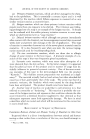
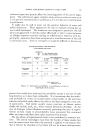
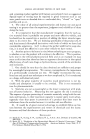
THEORY OF EMULSION STABILITY 175 (very little for large particles). To predict effects of particle size on sta- bility would require a higher order of approximation of Fn and FA than can easily be made. When the particles are very small increasing the particle size r increases the stability but for particles in the usual emulsion range theoretical predictions are difficult. V. Co•ci•us•o• Up to now hardly any mention has been made of specific effects due to emulsifying agents. Starting again from the beginning, equation 2 tells us that for a given energy input in making the emulsion the particle radius is proportional to the interfacial tension. Thus an emulsifier which decreases the interfacial tension decreases the average particle size under these condi- tions. Since equation 5 tells us that the mass rate of creaming depends strongly on the radius, this can be a very important effect. At ordinary concentration the amount of emulsifier present is enough to make but small changes in the density of either phase or in the viscosity of the discontinuous phase. High polymer water soluble materials may have an appreciable influence on the viscosity of quite concentrated emulsions. In striving to get a low creaming rate, one often uses a colloid mill to get a very small particle size. If the stability to flocculation and coalescence is dependent on the emulsifier layer on the droplets the use of the mill will not give the expected result in all cases. Assuming an emulsifier of molec- ular weight 300 which covers 30 square angstroms per molecule at an inter- face, the weight per cent of emulsifier required to give a continuous inter- facial film in a 10 per cent emulsion is given in the accompanying table: Radius, % Emulsifier Creaming, Microns Required cm./mo. 1 0.05 150 0.1 0.5 1.5 0.01 5 0.015 0.001 50 0.00015 Oil density = 0.8 emulsifier M.W. = 300 area = 30 •.2/molecule. For stability over a very long term the 0.01 micron size with roughly 5 per cent emulsifier would seem to meet most requirements. If the particle size distribution is wide it should be noted that the mass creaming rate will be governed by an average particle size very strongly influenced by the radius, as in equation 5, whereas the emulsifier requirement will depend on the surface average particle size. The former will be larger than the latter with the disparity increasing with the coarseness of the distribution. Thus to be sure that there are no droplets as !arge as 0.1 micron it may be necessary to have a surface average size smaller than 0.01 micron in which case the emulsifier requirement could become quite high.
Purchased for the exclusive use of nofirst nolast (unknown)
From: SCC Media Library & Resource Center (library.scconline.org)