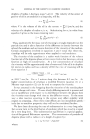
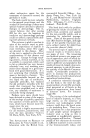
TOWARD EMULSION CONTROL 185 and the droplet size all affect the ease of formation and the subsequent stability of emulsions. We must find methods and instruments to inves- tigate those factors, or phenomena related to them. What is desired are physical properties that are chiefly or solely dependent on a single variable, so that by direct measurement one can obtain information about the extent or the effects of one parameter at a time. SURFACE TENSION AND SURFACE FREE ENERGY AT THE INTERFACE There exists at the surface of every pure liquid a thin layer that has a lower density than that of the bulk liquid. This condition is caused by the unbalance of the intermolecular forces of attraction at the surface, which exert a net inward force on every molecule in the surface layer. At equilib- rium, this force is balanced by the outward diffusion potential that is called into being by the lack of molecules near the surface. The presence of a less dense film at the surface of a pure liquid, itself gives rise to observable phenomena, of which the most significant is the state of tension that must exist in the surface layer as long as equilibrium is maintained. Another effect is the reduced cohesion that exists in the surface layer, since the mole- cules are further apart than in their normal liquid arrangement. Here we see the origin of Rayleigh's dictum that pure liquids do not foam the sur- face layers lack the normal cohesion by means of which they can support themselves in the form of thin films. Surface tension is a readily observable phenomenon, since the tendency of the surface to resist extension can be made to manifest itself by a variety of means: a soap film can support a weight the surface of water supports small, dense objects, such as certain water bugs, or hydrophobic powders, or an oiled needle. In measuring surface tension one can make use of this property by finding what force is required to pull a platinum ring out of the surface of a liquid. Since surface tension manifestly exists, and it is therefore necessary to perform work (i.e., expend energy) in order to extend a surface, the new surface thus created contains the energy expended. From this argument it follows that surfaces contain a "surface energy" over and above other forms of intrinsic energy already present. From the viewpoint of thermodynamics, the surface energy is numerically equal to the function called Gibbs' free energy, which, by definition, at constant temperature, is: 1 where q• is the surface tension and z/is the surface area. Free energy per unit area and surface tension per unit length in a liquid surface are there- fore mathematically equivalent. These rather abstract arguments have an application to the practical questions of emulsion fortnation and stability. The equation AF =

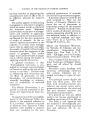
186 JOURNAL OF THE SOCIETY OF COSMETIC CHEMISTS tells us that there is a positive increase in Gibbs' free energy when new sur- face is created, and a decrease in free energy when surfaces diminish in area. Since an increase in this function denotes a nonspontaneous proc- ess, and a decrease a spontaneous process, we are led to conclude that emulsions must be created by expenditure of energy, and that once formed they will spontaneously coalesce. Both conclusions are not necessarily always true. Spontaneous emulsification is now well known (2), and some emulsions, such as those of crude oil containing emulsified brine, have lasted indefinitely (3). Before losing faith in thermodynamics, we should consider that the equation we are using may not include every pertinent factor. When two emulsion droplets coalesce it is necessary to have motion in the plastic interfacial film that coats both droplets. This requires ex- penditure of work which may offset the loss in surface free energy caused by reduction of total surface area. The work required depends on the yield point and on the plastic viscosity of the interfacial film. That these are pertinent factors in emulsion stability is well known. The question of emulsion formation also merits a little closer attention. When two liquids are mixed, one of them is usually spread out as a thin layer or drawn out into a thin oblate spheroid within the other. It can be demonstrated by the use of simple geometry that if the degree of attenua- tion becomes sufficiently pronounced, the thin geometrical figures can re- duce their total surface area by drawing up spontaneously into a series of small spheres (4). The formation of a plastic film during the aging of the interface would then prevent the coalescence of small droplets to the form of a single large drop of minimum surface area. The emulsion is stabilized. There are other common situations where the principle of minimum sur- face energy leads to emulsion formation. In detergency, an oil coated fiber is placed in an aqueous solution of surfactant. The preferential wet- ting of the fiber by surfactant causes the displacement of the oil, which then rolls up into isolated droplets. A series of remarkable photomicro- graphs showing the step-by-step development of these events has been published (5). They are culminated by shaking the fiber, thus displacing the oil droplets and leaving it "clean" the oil becomes emulsified in the aqueous solution. Other series of photographs from the same laboratory show the effect of foam in furthering detergent action. Small portions of oil are suspended in the foam, particularly at the "Gibbs' angles" where foam laminae intersect. In this way the foam is instrumental in dispersing oily liquid, which is later removed as emulsified droplets. Although studied in the first place as factors in detergent action, these phenomena also illustrate the ready formation of emulsions after one liquid phase has been attenuated in the presence of another. The seat of our studies of surface energies should be at the oil-water interface. In a recent review, Hutchinson (6) admits that data on the
Purchased for the exclusive use of nofirst nolast (unknown)
From: SCC Media Library & Resource Center (library.scconline.org)