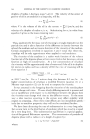
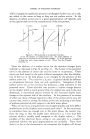
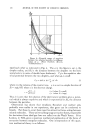
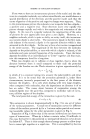
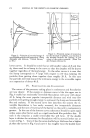
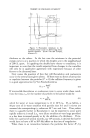
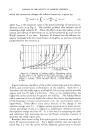
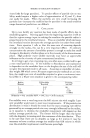
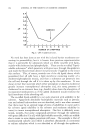
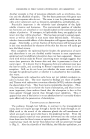
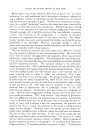
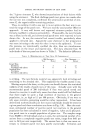
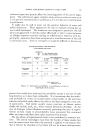
TOWARD EMULSION CONTROL 189 Figure 2 shows the data of Richardson (8) for both o/w and w/o types. The significant factor is the enormous increase in the viscosity of the o/w emulsion at concentrations above about seventy per cent. The other type of emulsion showed evidence of inversion at higher concentrations, with a consequent discontinuity in the observed property. It would be misleading, however, to leave the subject of the viscosity of emulsions with the implication that viscosity depends only on volume con- centration. The nature of the emulsifying agent also plays a large role it is possible to get emulsions of the same materials in the same volume con- centrations that differ hugely depending on the nature of the oil/water interface. The most stable or easily formed emulsions are generally the least viscous, and it may be interpreted as a danger sign about future sta- bility when an emulsifying agent produces an abnormally viscous emulsion. The size of the emulsion drops also has not been mentioned as having an effect on viscosity. At low volume concentrations, the size of the drop actually has little effect but as we appraoch the "polyhedral-foam" type of emulsion a wide distribution of drop sizes makes it possible to include larger volume concentrations before structural viscosity becomes marked. Homogenization of such an emulsion would then result in an increase of viscosity. Another and completely different physical property enables us to follow changes in emulsion composition. The electrical conductivity of an emul- sion is independent of particle size and is affected only slightly by nonionic emulsifying agents it varies chiefly, and in some cases solely, with the emulsion composition. Let us denote the specific electrical conductivity of an emulsion by L, that of the outer phase by L• and of the inner phase by L2. The specific electrical conductivity of the emulsion will depend only on the values of L•, L2, and F, the volume fraction of the inner phase, ac- cording to the following equation, developed originally by Clerk Maxwell (9): 2L• + L2 - 2(L• - L = L• ß 2L• 4- L2 q- (L• -- Le)F which is sometimes written in its equivalent form: L1 -- L L q- 2L• Since this equation specifies the inner phase and the outer phase, it yields two equations for any pair of liquids, one for the o/w type and another for the w/o type of emulsion that they can form between them. For example, if the liquids have values of L that are 2 X 10 -a and 2 X 10 -4 ohm -• cm -•, respectively, then the conductivity of the w/o type (low conductivity) emulsion is: 44-6t 2' Lw/o= 2X 10 -4-- 4-- 3V

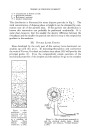
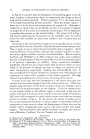
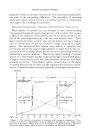
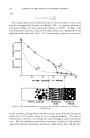
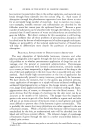
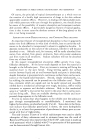
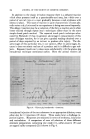
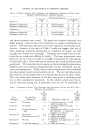
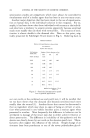
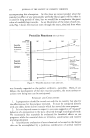
190 JOURNAL OF THE SOCIETY OF COSMETIC CHEMISTS and 7 -- 6k' Lo/w = 2 X 10 a__ 7+3// The values chosen here as illustration are not far from those of two actual liquids investigated by Eucken and Becker (10): an aqueous solution of potassium iodide and water-saturated phenol, at 19.6øC. In Fig. 3 the two theoretical equations, indicated by dotted lines, are compared with the experimentally observed values. It is interesting to observe an inversion 0.0020 0.0015 0.0010 • 0.000 5 20 40 I 60 80 I00 i i VOLUI•!E PERCENT OF PHENOL I • I I I ß PHENOL IN WATER • INVERSION •, WATER IN ZONE PHENOL Figure &--The specific conductivity of aqueous KI and phenol emulsions as a function of composition. of the emulsion, during which the observations move from the theoretical values for an o/w type to those for a w/o type of emulsion. It is also of interest that inversion is not abrupt but exists through a zone of concentra- tion. But the significant result from our present viewpoint is the excellent agreement between experiment and theory which shows how well the elec-
Purchased for the exclusive use of nofirst nolast (unknown)
From: SCC Media Library & Resource Center (library.scconline.org)