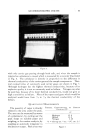
GAS CHROMATCGRAPHIC ANALYSIS 93 (80 lb./sq. in.) but the receiver, in order to condense the low boiling material, must be kept below -21.6øF. Furthermore, enough sample is required to fill not only the distillation flask but the fractionating column. The fractions must then be weighed and identified either by infrared or mass spectrometry. For one or another of these reasons this technique is not being carried out by many people. The analysis of not only the liquid phase but also the gaseous phase would be desirable. Also, it would be of great value to be able to deter- mine the amount of air present in both the gaseous and liquid phases. All of these previously difficult operations can now be carried out readily and easily with an instrument which will take a small gaseous or liquid sample, separate it into its components, measure the amount of each, complete the operation in a few minutes with an accuracy of 0.25 per cent, permit the recovery of each component, require no further attention once the sample is introduced and be ready to receive another sample without delay. Now that we have such an instrument, it is being called the greatest analytical advance in the last decade. The instrument that will do this is called a gas chromatograph and the process is called gas chromatography. Chromatography had its beginning when the Russian botanist, Tswett (1), in 1906 observed that a mixture of colored solutes could be separated by selective adsorption during passage through a tube containing a suitable adsorbent. Since this discovery, many advances have been made, •and this principle with modifications successfully applied to many fields requiring the separation and purification of complex organic and inorganic compounds. The prefix, chroma-, soon lost its significance since noncolored solutes were also hav_dled by chromatography. Perhaps a more descriptive name for this technique would be vapor distillatic)n or vapor fractionation. The earliest application of the techniques of chromatography to the separation of gases and vapors by using stationary solid adsorbents and a i moving gas (gas adsorption chromatography) dates from 1942 (2). Gas- I liquid partition chromatography with which we are concerned here, was first used in 1951 by James and Martin (3) for the separation and analysis of mixtures of volatile fatty acids in tissues. The popularity of this method is testified to by the publication of more than 100 papers on the subject in the last four years and the appearance of eight commercially available chromatographs in fourteen models. Gas-liquid partition chromatography is the separation and measurement of the components of a mixture by passing the mixture through a column in a stream of gas. The column, made of copper, glass or stainless steel tubing, is filled with an inert material called the support. The inert sup- port, Celite, Dicalite or firebrick, is coated with a high boiling organic liquid such as hexadecane, di-n-butyl maleate or silicone. Because differ- ent equilibria exist between the mobile phase (carrier gas and sample) and

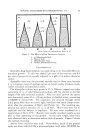
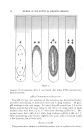
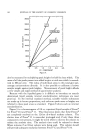
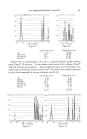
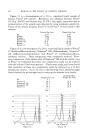
94 JOURNAL OF THE SOCIETY OF COSMETIC CHEMISTS the stationary phase (liquid coated support), the components will separate according to their individual equilibrium constants. More simply, each component in a mixture has its own affinity for a given column material. Therefore, it will cling to that material for a time characteristic to it alone and to no other component. The time during which it clings to the column before it is driven out by the carrier gas is called its retention time. With a given temperature, carrier gas, flow rate, column material and length, a component will always have the same reten- tion time. Since each component has a unique "clingability" or retention coefficient for a given column material, it will stay a longer or shorter time in the column than other components in the mixture. Eventually, all components will be driven out by the carriers gas, one by one. And as each emerges, a sensing device, usually a thermal conductivity cell, meas- ures its concentration. The result is a series of symmetrical peaks on a recorder. The position of the peak along the ordinate or time axis is the qualitative value--the time the component first appeared at the detec- tor and how long it took to come out. The area of the peak, or its height, is a measure of its concentration in the mixture. The support material should have the following characteristics: (1) Inert chemically. (2) Stable at column temperatures and drying temperatures. (3) High surface area per unit volume. (4) Low pressure drop. ($) Hard and not break under compaction. The resolution and pressure drop increases as the particle size decreases. A compromise, therefore, must be made between these two factors, and it is found that -42 +60 mesh material is optimum. Requirements for the liquid partitioning agent are as follows: (1) Boiling point at least 200øC., above the column temperature. (2) Low vapor pressure. (3) Should give adequate resolution of components. (4) Low viscosity. There are three factors that affect the resolving properties of the liquid partitioning material, polarity, hydrogen bonding and specific or chemical interactions. If the sample components have a low polarity, they will be more soluble in a partition liquid which has a low polarity. If the partition liquid has a low polarity and the sample components have a relatively high polarity, they will move through the column somewhat faster than might be expected on the basis of boiling points. Hexadecane gives good resolution for the chloromethanes, fiuorochloromethanes and fiuorochloroethanes. If the sample components have a low polarity and the partition liquid a high polarity, they will again move through the column faster than might be expected.
Purchased for the exclusive use of nofirst nolast (unknown)
From: SCC Media Library & Resource Center (library.scconline.org)