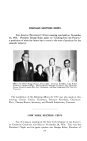
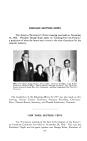
SOCIETY OF COSMETIC CHEMISTS OF GREAT BRITAIN 109 the National Society of Cosmetic Chemists. After duly installing the newly elected officers, namely, Warren B. Dennis as Chairman, Harry Isacoff as Chairman-elect, Vincent DeFeo as Treasurer and Maria V. Wiener as Secretary, Mr. Kolar spoke on "Looking Into the Future" of the cosmetic industry. He predicted enormous growth and improved changes in the cosmetic industry for the next twenty years. THE SOCIETY OF COSMETIC CHEMISTS OF GREAT BRITAIN AT A MEETING of the Society of Cosmetic Chemists of Great Britain held on November 2, 1956, at the Royal Society of Arts the subject of "Silicones in the Cosmetic Industry" was introduced by T. W. Watson, B.Sc. The President R. T. Dobson opened the proceedings by greeting Dr. P. H. Witjens, a member visiting from Hilversum, who was warmly applauded by the members. Mr. Watson declared it his aim to present an account of the many special properties of the silicones which had proved of unique value in many industries and to invite cosmetic chemists to examine these properties in the light of their special requirements, so that, by selecting the appropriate type of silicone, advantages might accrue to the cosmetic industry as they had already done in many others. As a general introduction showing the methods of manufacture of different types of silicones, their exceptional properties and the remarkable services they perform in many industries, the lecturer provided a 30-minute talking colour film entitled "What's a Silicone?" After the film Mr. Watson discussed the synthesis of different types and outlined their special properties which might suit them for application in the cosmetic industry. The liquids, for example, are water-white oily substances with viscosities ranging from values less than that of water to extremely viscous fluids. They have low volatility and their relatively low surface tension enables them to spread well on the skin to form a thin invisible continuous film which is water repellent. Thus protection may be afforded against contact with soap and other detergents, acids, alkalis and organic solvents and protective properties may be given to emollient creams, ointment bases and so on. In later developments the original dimethylpolysiloxane structure has been modified, for example, by introducing terminal salicyl or fatty alcohol groups and these influence solubility and other properties depending upon the number of siloxane units in the molecule. The salicyl derivatives ab-

110 JOURNAL OF THE SOCIETY OF COSMETIC CHEMISTS sorb the more harmful of the actinic rays of sunlight and allow the less harmful tanning rays to pass through. They have therefore been used in the preparation of sun-tan lotions. Mr. Dobson introduced a discussion by suggesting that cost must be an important factor and it would seem that only small percentages of the sili- cone could be employed. It would be necessary to examine the efficiency at this low level of concentration and compare it with that of the conven- tional materials. One promising use would be for the treatment of moulds to prevent sticking of the moulded material. An interesting discussion followed. Dr. Matalon expressed anxiety lest the application of silicones to the skin might interfere with metabolism as a result of penetration, or, by blocking interfaces, interfere with the remedial action of antibiotics. Mr. Watson was of opinion that the many publications which described the silicones as innocuous would clear away this objection. Dr. Posner asked whether water repellency could be given to the skin when it was not possible to heat or bake the surface and whether the sili- cones were more effective than the conventional organic materials. Mr. Watson agreed that a chemical or physical binding to the skin was not in evidence but a film of silicone might behave in the same way as it did when applied to a fibre of cellulose acetate. After a time the acetate can be dis- solved out with acetone and an exoskeleton of silicone is left as a result of a polymerisation of some kind.
Purchased for the exclusive use of nofirst nolast (unknown)
From: SCC Media Library & Resource Center (library.scconline.org)