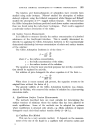
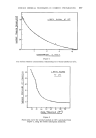
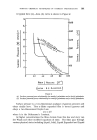
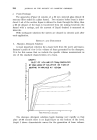
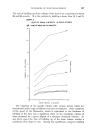
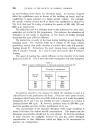
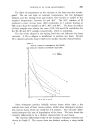
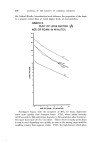
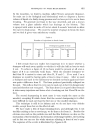
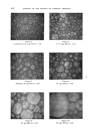
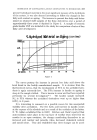
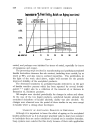
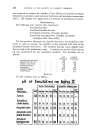
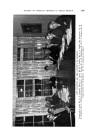
SURFACE CHEMICAL TECHNIQUES IN COSMETIC PREPARATIONS 379 Because of the very high resistance involved at the Air/Water and Oil/Water interfaces, specialized techniques have to be used. The pioneers in the work at the Air/Water interface were Rideal and Schulman 7, who used a radio-active source (mesothorium or polonium) to irradiate the air gap between the surface and the electrode and hence increase its conductivity. The potential was then measured, using a valve electrometer. Much useful information has since been gained regarding the orientation of adsorbed and spread mono-layers using this technique. Posner and Alexander s measured the surface potential along the surface of a cylindrical jet of fast-moving solution. They then related this measurement to surface tension by interpolation on a previously determined surface potential--surface tension curve obtained on an equilibrium surface. Examples of their results are shown on Figure 3. z LU IO I. 0'O•% EQUILII•RI U H SURFRCE TENSION Figure $ Surface tension plotted against surface age for solutions of sec-octyl alcohol.

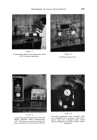
380 JOURNAL OF THE SOCIETY OF COSMETIC CHEMISTS 3. Hanging Plate Method Padday 9 has attempted to measure dynamic surface tensions by flowing solutions at various speeds upwards through a funnel, so that it overflows the top. This continuously generates a new surface and the tension is measured using a hanging plate. The surfaces studied are generally older than those studied by the techniques described earlier. All the dynamic methods of studying surface tension suffer from the fact that the ages of the surfaces are uncertain because the hydrodynamic conditions at the surface are complex. The methods are therefore best used for making comparisons between different surface active agents and the effect of concentration. The results should therefore always be quoted back to the method used. INSOLUBLE FILMS Surface Pressure Measurements at the Gas/Liquid Interface Surface pressure is defined as the interfacial tension lowering produced by the spreading or adsorption of a material at the particular interface. Thus the measurement of surface tension described above also measures surface pressure. The Langmuir trough is used to measure the surface pressure of insoluble monolayers spread at the Air/Water interface. A simple form of this apparatus has been described at Alexander •ø. It consists of a glass trough filled with the substrate (usually water). Lying in the surface of the water is a mica barrier, suspended from a torsion strip. The mica barrier extends to within 1 mm. of each edge of the trough and is sited about • of the way along its length. The barrier is joined to the edge of the trough by silk or nylon threads coated with petroleum jelly. These joints must be care- fully made to avoid leakage of the film past the barrier. The apparatus must be scrupulously cleaned before use and the barrier and edges of the trough coated with paraffin wax to facilitate manipulation of the film. Immediately before use, the surface of the trough, both behind and in front of the barrier is swept clean using waxed glass slides. The cleansing may be facilitated by sprinkling ignited talc on the surface. Any dirt is then sucked off the surface. The material to be studied is dissolved in a suitable volatile solvent and about 0.02-0.05 cc spread from a micro-syringe. The surface film is then compressed with a glass barrier and the force read off on an optical lever system attached to the torsion strip. The strip should have previously been calibrated by the application of weights to a balance pan attached to a lever on the torsion head.
Purchased for the exclusive use of nofirst nolast (unknown)
From: SCC Media Library & Resource Center (library.scconline.org)