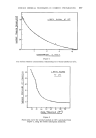
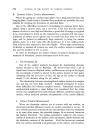
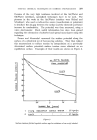
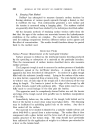
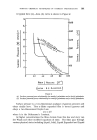
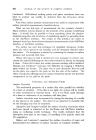
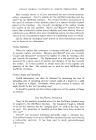
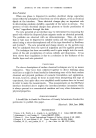
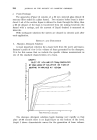
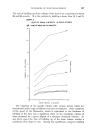
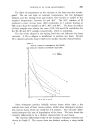
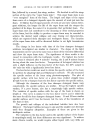
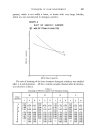
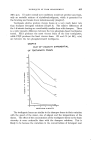
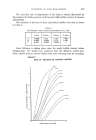
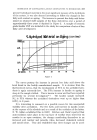
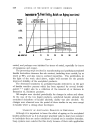
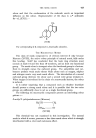
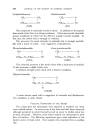
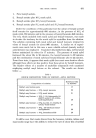
SURFACE CHEMICAL TECHNIQUES IN COSMETIC PREPARATIONS 381 A typical force (•)--Area (A) curve is shown in Figure 4. - &oo •oo •- •oo • •oo IfiFTER : fl. E. RLtXFtNDoeR.) Figure 4 (a) Surface pressure/area relationship for methyl palmirate and n-butyl palmitate. (b) Surface potential/area relationship for methyl palmitate and n-butyl palmitate. Surface pressure is a two-dimensional analogue of gaseous pressure and obeys similar laws. Thus a dilute expanded film is termed gaseous and obeys a two-dimensional Boyles Law. •A -- kT where k is the Boltzmann's Constant. At higher concentrations the films deviate from this law and obey van der Waals and other modified equations of state. The films pass through various physical states including Liquid, Solid, Liquid Expanded and Liquid

382 JOURNAL OF THE SOCIETY OF COSMETIC CHEMISTS Condensed. Well-defined melting points and phase transitions from one form to another can readily be detected from the force-area curves (Figure 4). Very often surface pressure measurements are made in conjunction with surface potential measurements described above. What use has this type of measurement for the cosmetic chemist ? Many emulsion systems depend on the structure of the primary emulsifying layer it should thus be possible to learn something about the physico- chemical properties and structures of emulsifying agents by spreading them at the Air/Water interface. The results at this interface are easier to interpret than those derived from adsorption measurements at the Oil/Water interface or Air/Water interface. The author has used this technique for simplified detergency studies where the soil is spread at the interface and the detergent injected under the surface. The detergency is studied by examining the changes in surface pressure and potential with time. Where this type of work is carried out, it is necessary to remove con- stantly the material diffusing into the surface behind the barrier by sweeping it clean. Unless this is done, low surface pressure readings will be obtained. Matalon and Schulman TM overcame this difficulty by hanging a Wilhelmy plate behind the barrier. The plate was of such dimension that the pull on the plate was equal to the push on the free side of the barrier. The effect of molecules diffusing into the surface behind the barrier was therefore compensated by the pull on the plate. INSOLUBLE AND ADSORBED FILMS Surface Viscosities The mechanical properties of a surface film often parallel the stability of a foam or emulsion. If the film is too rigid, the system will be unable to resist mechanical or thermal shock. If it is too fluid, rapid drainage of a foam or coalescence of an emulsion will take place. Surface viscosities may be measured by timing the damping of a needle or disc placed in the surface. The effect of an adsorbed or insoluble film on the damping may thus be measured. Alexander and Cumper • studied the surface viscosity of proteins which had been spread or adsorbed at the Air/Water and Oil/Water interface using an oscillating needle technique. The results indicated that the adsorption took place in two stages, (1) unrolling of the peptide chain and (2) coagulation. Blakey and Lawrence •a examined the surface viscosities of soaps and demonstrated the influence of surface viscosity on emulsion stability.
Purchased for the exclusive use of nofirst nolast (unknown)
From: SCC Media Library & Resource Center (library.scconline.org)