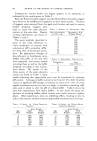
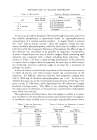
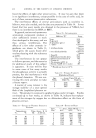
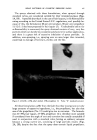
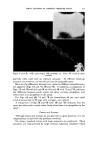
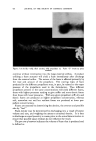
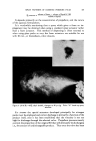
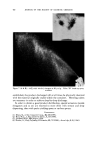
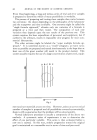
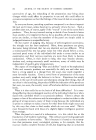
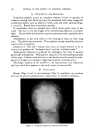
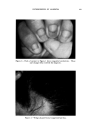
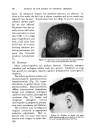
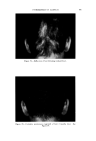
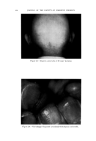
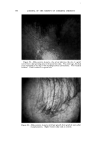
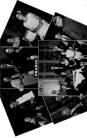
456 JOURNAL OF THE SOCIETY OF COSMETIC CHEMISTS If sprayed into a flame, a flame extension of 23 inches results and the drum tests are positive (4). If, on the other hand, a break-up spray actuator is employed then a wide angled soft spray with much smaller particles results, (Figs. 3A, 3B) which is acceptable, and which has also a better flammability rating. • •.• ..4,•.•.: • .v-:.:...•v ..... : '%4-..•.e • .. • • :.-• ..• 2 • .-9 .• . . • • • ...... • . . .•. •:... •..• '•. :. :• ?:: •-• •, ? • .... •.. •= } •-:'•.•:• {•½•:• •' :':•', •-. •.,•.X ½'•.•:* ' z.- • ' ':'.• "")*•" :•" ' ::.•:' ""' }-&• :" ' .... '": ....... •'.. '•-'.':.. .:.• .•:•. .., -.:m•. • 4 • .: x a ß ..•(::?•..,,,:., .... j:r. .. *•-.. ..•. Figure 3 (A & B).--65% ethyl alcohol, 35% propellant 12. Valve "A" break-up spray actuator. Variation in spray patterns are, however, obtained not only by changing from an ordinary actuator to a break-up spray actuator in any given proprietary valve, but also by using a different valve altogether. This is illustrated by comparing Figs. 4A and 5A, with 3A all spraying a mixture of 65 per cent alcohol and 35 per cent propellant 12. The changes in spray pattern effected by changing the valves applies to every formulation, but is particularly noticeable when the valve design itself has a bearing on the resultant spray, as occurs with the formulations mentioned above, or when using butane or chlorofiuorohydrocarbons with an aqueous product (3-phase systems), or when nitrogen is used as the propellant. With nitrogen, as with the 3-phase systems, there is no propellant at all in the emerging spray, which is very narrow and contains very coarse

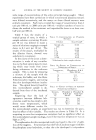
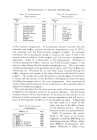
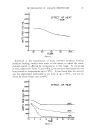
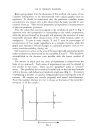
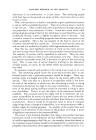
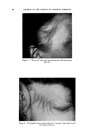
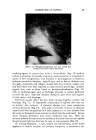
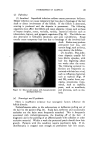
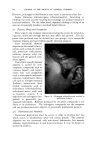
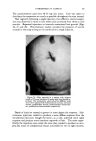
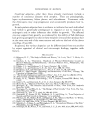
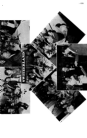
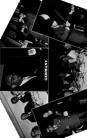
SPRAY PATTERNS OF COSMETIC PRESSURE PACKS 457 Figure 4 (A & B).--65% ethyl alcohol, 35% propellant 12. Valve "B" break-up spray actuator. particles when used with an ordinary actuator. An efficient break-up actuator can, however, convert this jet into an acceptable spray. Here too the differences between two valves by different manufacturers, are apparent (Figs. 6A and 7A, 6B and 7B). In addition, a comparison of Figs. 3A and 3B with 6A and 6B and 4A and 4B with 7A and 7B, indicates the difference between packs where the spray contains propellant, and where there is no propellant in the spray. For Figs. 6A and 6B, 7A and 7B the formulation 66 per cent ethyl alcohol pressurized to 90 psig. with nitrogen, was utilized. A comparison of Figs 3B and 6B (also 4B and 7B) indicates that the spray particles tend to settle rather faster when there is no propellant in the spray. Foams and Streams Although foams and streams do not give rise to spray patterns, it is not inappropriate to deal with the problems involved. For foams, standard valves with foam actuators are employed. These actuators are characterized by large internal expansion chambers which
Purchased for the exclusive use of nofirst nolast (unknown)
From: SCC Media Library & Resource Center (library.scconline.org)