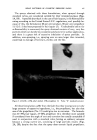
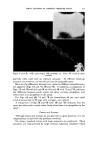
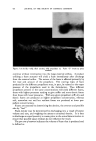
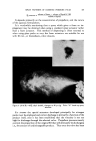
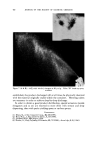
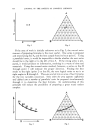
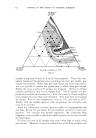
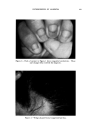
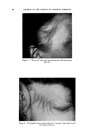
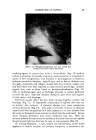
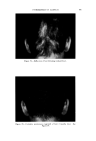
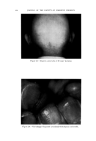
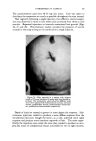
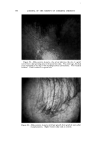
460 JOURNAL OF THE SOCIETY OF COSMETIC CHEMISTS Figure 7 (A & B).--66% ethyl alcohol, nitrogen at 90 p.s.i.g. Valve "B" break-up spray actuator. established, the product discharged will at all times be physically identical with the material originally sealed within the container. Metering valves are necessary in order to achieve drop-by-drop discharge. In order to obtain a good p•:oduct distribution, special actuators (nozzle elongators and so on) are resorted to more often with stream and drop dispensing, than with packs yielding space or surface sprays. REFERENCES (1) Dixon, K., J. Soc. Cosra•TIC C•E•., 10, 220 (1959). (2) Root, M. J., J. Soc. COSMETIC C•E•., 7, 153 (1956). (3) $chimmel Briefs, 233 (August 1954). (4) Herzka, A., Soap, Perfumery, & Cosmetics, 33, 712 (1960) .,Ierosol dge, 5, 30, (1960).

THE USE OF TERNARY DIAGRAMS IN COSMETIC FORMULATION By R. J. JAMES and R. L. GOLDEMBERG* Presented May I2, I960, New York City FORMULATING NEW PRODUCTS for the cosmetic industry has always been a relatively slow and tedious task. On the other hand, due to con- stant competitive pressure, the sales and advertising departments of a cosmetic company must constantly demand new products in a hurry. In the final analysis, the success of a company is measured in terms of both the number and quality of successful products brought to the market. To satisfy these pressures for both quality and quantity requires either a large laboratory staff or an efficient smaller one. It is not generally realized in sales and marketing circles how severely the formulating chemist is limited by the time allowed him for developing a new product. Unfortunately, the surest (and sometimes only) test of a product's shelf life is to wait out the desired period of time. Accelerated shelf-life procedures such as the use of warm ovens, hot and cold alternating cycles or special vibrators, etc., are only an indication of the product's ultimate shelf life. Blind acceptance of such test procedures has occasion- ally led to unexpected and embarrassing product failures. Since all com- mercial laboratories necessarily work under pressure of time limitations, a crucial ability needed is the one to make the "right" series of variations in the hope that one of them will eventually turn out to have sufficient shelf-life stability as well as other desirable properties such as appearance, feel, color, etc. In this paper we offer a new method to increase the productivity of the formulating chemist and to help him turn out a product having desired characteristics more quickly and with greater assurance. It combines a concept of approach with an improved method of recording information. Let us first analyze the present methods of developing formulations so that we can then move on to logical improvements. What are the steps involved in developing new products? First, there must be an idea or a goal toward which the laboratory work will be pointed. Second, there is usually some conception of how to start toward this goal. Shulton, Inc., Clifton, N.J. 461
Purchased for the exclusive use of nofirst nolast (unknown)
From: SCC Media Library & Resource Center (library.scconline.org)