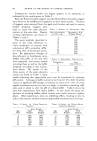
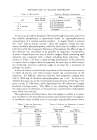
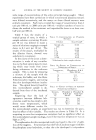
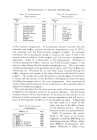
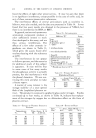
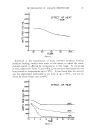
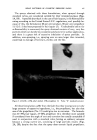
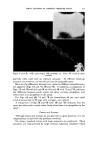
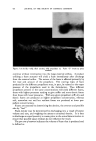
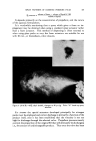
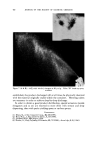
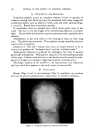
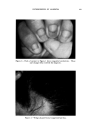
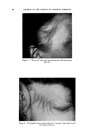
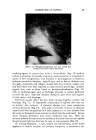
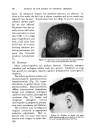
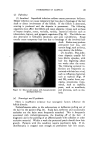
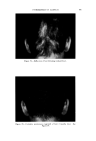
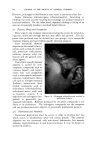
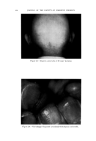
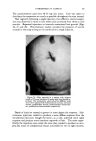
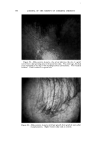
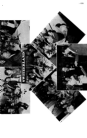
PATHOGENESIS OF ALOPECIA 499 ½icatricial alopecias, other than those already mentioned, include a number of cutaneous diseases with atrophy. They are pseudopelade, lupus erythematosus, lichen planus and scleroderma. Treatment with the chloroquins may stop progression and occasionally produces hair re- growth. In male-pattern alopecia there is evidence to indicate that each individual hair tbllicle is genetically predisposed to respond or not to respond to androgenic and/or other influences that inhibit its growth. The affected site may support hair growth, as evidenced by the ability of full-thickness hair-growing autografts to take in these recipient sites and then produce hair at the same rate and of the same texture and color as the hair of the donor site (Figs. 29 and 30). In general, the various alopecias can be differentiated from one another by expert appraisal of clinical and microscopic findings, together with history. BIBLIOGRAPHY I1) Behrman, H. T., "The Scalp in Health and Disease," St. I,ouis, The C. V. MGsby Co. (1952). (2) Cipollaro, A. C., "Electrolysis. Handbook of Physical Rehabilitation Council on Physical Medicine and Rehabilitation," American Medical Assoc., Philadelphia, The Blakiston Co. (1950). (3) Dillaha, C. J., and Rothman, S., 7. Invesl. Derrnatol., 19, 5 (1952). (4) Dillaha, C. J., and Rothman, S., 7. Am. Med. Assoc., 150, 546 (1952). (5) Dougherty, T. F., and Schneebeli, G. L., Ann. N.Y. Acad. Sci., 61,328 (1955). (6) Flesch, P., "Hair Growth. Physiology and Biochemistry of the Skin," Chicago, The University of Chicago Press (1954). (7) "The Growth, Replacement and Types of Hair," Ann. N.Y. Acad. Sci., 53, 461 (1951). (8) "Hair Growth and Hair Regeneration," Ibid., 83, 359 (1959). (9) Harry, R. G., "Modern Cosmeticology," Vol. 1, London, Leonard Hill (Books) Ltd., (1955). (10) Kopf, A. W., and Orentreich, N., A.M. A. Arch. Dermalol., 76, 288 (1957). (11) McCarthy, L., "Diseases of the Hair," St. Louis, The C. V. Mosby Co. (1960). (12) Montagna, W., "The Structure and Function of Skin," New York, The Academic Press, Inc. (1958). (13) Montagna, W., and Ellis, R. A., "The Biology of Hair Growth," New York, The Aca- demic Press, Inc. (1958). (14) Orentreich, N., Ann. N.Y. Acad. Sci., 83, 463 (1959). (15) Orentreich, N., Sturm, H. M., Weidman, A. I., and Pelzig, A., "Local Injection of Steroids and Hair Growth in Alopecias," to be published. (16) Pillsbury, D. M., Shelley, W. B., and Kligman, A.M., "Disease of the Hair," in "Derma- tology," Philadelphia, W. B. Saunders Co., 984-1010 (1956). (17) Rony, J. R., and Cohen, D. M., 7. Ynvest. Dermatol., 25, 285 (1955). (18) Schwartz, L., Tulipan, L., and Birmingham, D. J., "Occupational Diseases of the Skin," Philadelphia, Lea and Febiger (1957). (19) Sulzberger, M. B., Witten, V. H., and Smith, C. C., 7. Am. Med. Assoc., 151,468 (1953).

SOCIETY OF COSMETIC CHEMISTS 1960 EUROPEAN TOUR AND CONFERENCE August 19-September 11 THE U.S. SOCIETY attended four scientific conferences on their tour of nine European cities. The first conference was held in London at the Royal Society of Arts in conjunction with the Society of Cosmetic Chemists of Great Britain where a series of eight papers were presented. In Geneva the group met with the Soci•t• des Chimistes Cosmeticlens in the Aula of the Institut Physique of the University of Geneva. Six lectures were given at this seminar. Mr. M. G. deNavarre of the U.S. Society was presented an Honorary Membership in the Swiss Society of Cosmetic Chemists. The Society of German Cosmetic Chemists held the First Congress of Cosmetic Chemistry sponsored by the International Federation of Societies of Cosmetic Chemists (IFSCC) in Munich from August 31st to September 3rd. President H. J. Amsterdam of the U.S. Society greeted the IFSCC with the following message: "The primary aims of the International Federation of Societies of Cosmetic Chemists are to promote the professional status of cosmetic chemists, encourage fundamental research work and facilitate an inter- change of information on the work and efforts of the member societies. The spirit of cooperation displayed by the member societies for these aims and the 1960 meetings and conference, make for a firm foundation for the building of a successful International Federation of Societies of Cosmetic Chemists. On September 6th a conference was held at the University of Barcelona with the Asociacion Nacional de Quimicos de Espafia. Six papers were presented by members of both Societies. A full description of the tour and conferences will be published elsewhere. 500
Purchased for the exclusive use of nofirst nolast (unknown)
From: SCC Media Library & Resource Center (library.scconline.org)