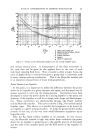
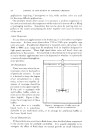
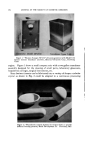
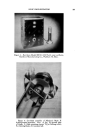
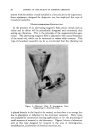
APPLICATION OF THE TWIN SHELL BLENDER 25l It is a precision dry solids blender. It is relatively easy to clean and to maintain. A double-cone blender can be used for adding liquids to solids. How- ever, we run into problems of accessibility when we put a really so- phisticated liquid dispersing device into such a vessel. The V-shaped tumble blender we call the twin-shell takes care of the accessibility problem very well. We can install and service a rotating shaft device inside the vessel. Such a device can do either or both of two things. It can break up agglom- erates and it can disperse liquids. We call it an intensifier bar when its only job is to break up agglomerates. Then it is merely a shaft with pins or small knife-like blades on it. As it rotates at high speed, high-velocity impact breaks agglomerates ef- fectively and rapidly. It also serves to aerate the particle mass. Because the intensifier bar can be started and stopped independently of the tumbling action, it does its job without unnecessary dissipation of work and energy in the particle mass. As has been observed in connection with gentle- ness, too much work or violent scrubbing can make some mixtures virtually unblendable. When we use this shaft inside the twin-shell blender to disperse liquids, it is made as a hollow tube. It still has intensifier blades that impinge on the particle mass. The liquid goes in through a rotary joint and is dis- persed as a mist or fog by centrifugal force through annular orifices. The easiest way to defeat good liquid-solid blending is to let any of the liquid spray or fog touch the vessel wall before it reaches a particle. Once the liquid wets that inner wall, your have lost part of it. So, we create a hole in the middle of the tumbling particle mass and we spray from the inside outward toward the surrounding particles. Those whirling blades, that we used primarily for breaking up agglomerates on the intensifier bar, create this empty space inside the particle mass. They make the particles keep their distance while being sprayed. This has a great practical advantage in preventing the annular nozzle from clogging with solids. Easy accessibility is gained by having big covers on the ends of those two intersecting cylinders of a twin-shell blender. It is not hard to reach in through one of these openings with the cover off and remove an intensifier bar or liquid feed unit for cleaning. Also, the job of inspecting and taking care of rotary seals is simplified tremendously. There are some other features that can be built into a twin-shell blender. It can have a filtered exhaust connection for blending or processing under a partial vacuum. The vessel itself can be jacketed. That permits heating with steam to work at higher temperatures, or circulation of cooling water to reduce temperatures. These modifications transform what was merely a blending device into something more•actually it becomes a processing vessel.

252 JOURNAL OF THE SOCIETY OF COSMETIC CHEMISTS Solids, liquids and gases can be brought together under controlled condi- tions of mobility, attrition, pressure cycles and temperature cycles--all with precise timing. As regards materials of construction, small laboratory equipment is usually built of clear plastic. We can see what is going on when we use these blenders. Most of the units we build for cosmetic manufacturers are all stainless steel. Internal corners are carefully rounded and polished, because easy cleanability is a must if you are running batches of different shades or compositions. Now, what can we do with equipment like this? What good might it do in your plant? We often tackle jobs we do not know how to do at the outset. Gratifyingly often, we have found ways to do them. The difficult blends are usually the ones that require extremely high uniformity and which involve particles that tend to segregate--not to blend. By judicious use of tumbling and attrition of any agglomerates, using the intensifier bar, we can usually get good results. When this fails, we may have to introduce a small amount of another agent, such as water or alcohol. After the blend is achieved, the wetting agent can be removed again by drying. All this can be done in a twin-shell blender provided with the proper facilities. Many jobs that tumble-type equipment does satisfactorily can also be done other ways. We often furnish equipment to supplement or replace such units as ribbon blenders, pulverizers, hammer •nills, screening devices, mullers and the like. Here, even if the precision equipment is able to do a better job, that fact is not so important as time saving and process simpli- fication. It only takes a few minutes to make a good blend. It only takes a few minutes to break up agglomerates into individual particles. A mass of mobile particles can be dried or granulated more rapidly than pan drying them. The key to speed is to do everything while the batch is where it can be controlled. The twin-shell and its modification almost always yield substantial production cost savings just by being fast, versatile and cleanable. We are fortunate in one aspect of this business. Any performance claims we make can be checked in a hurry. Whenever there is the slightest doubt whether a shade of color can be matched uniformly, whether desired flow characteristics can be achieved, whether a delicate mixture can be handled gently enough, or whether components of a mixture can be blended at all, it is a simple matter to run a few trials in the pretesting laboratory. Scale-up has not posed any difficulties that have been hard to overcome. As a matter of fact, the bigger you make a tumble blender, generally the more efficient it seems to get. This is not true of the rotating attrition device we call the intensifier bar. However, it is usually possible to
Purchased for the exclusive use of nofirst nolast (unknown)
From: SCC Media Library & Resource Center (library.scconline.org)