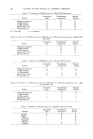
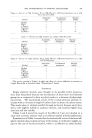
SONIC EMULSIFICATION 301 CONCLUSIONS 1. It would appear that the ultrasonic generator can well take its place among other equipment for the reduction of globule size in liquid disper- sions. The hydrodynamic generator, as represented by the Minisonic, is adapted for production use. Recent design changes in this generator will further increase the emulsification efficiency of the unit. 2. Although not too much has been investigated as to the chemical effects of ultrasonic waves upon emulsion components, that work which has been reported indicates that the effects are not significant in the time of exposure required for emulsification. Fixed oils require rather long exposure at high power for chemical effects on the oils and emulsifying agents do not seem to be changed with normal treatment. REFERENCES (1) Yaeger, E., 5 e. Soc. Cosmetic Chemists, 6, 139 (1957). (2) Curie, P., and Curie, J., Compt. rend., 91,294 (1880) Ibid., 92, 186 (1881). (3) Singiser, R. E., and Beal, H. M., 2 t. ,,lm. Pharm. ,,lssoc. Sci. Ed., 49, 478, 482 (1960). (4) Jackson, G. J., Master of Science Thesis, School of Pharmacy, Univ. of Connecticut, Storrs (1960).

302 JOURNAL OF THE SOCIETY OF COSMETIC CHEMISTS CHICAGO CHAPTER NEWS TVlE MEETING Of March 14th was an enlightening and informative one. Dr. Joseph B. Jerome discussed "Activities and Interests of the Committee on Cosmetics of the American Medical Association." Dr. Jerome has recently become associated with the American Medical Association, where he is secretary of the Committee on Cosmetics and assistant to the secretary, Council on Drugs. Currently he is a physical science instructor on the TV College (WTTW, Channel 11). In addition to his A.M.A. and teaching duties, Dr. Jerome is an advisor to the World Health Organization, Subcommittee on Nonproprietary Nomenclature. Dr. Jerome has a broad background in the fields of both chemistry and pharmacy. He holds a B.S. in pharmacy from the University of Illinois and has been a registered pharmacist since 1938. He received a Ph.D. degree in organic chemistry from the University of Chicago in 1950. Dr. Jerome has worked in organic synthesis of fine chemicals. As chemist and research co-ordinator for John A. Hinckley and Associates, Inc., he has participated in research and development on government research con- tracts. For the past fourteen years Dr. Jerome has been an instructor in physical science and organic chemistry at the Chicago City Junior Colleges. He is a member ofRho Chi and Sigma Xi. Dr. Alfred E. Brown, President and Director of Research at Harris Research Laboratories in Washington, D.C., and a member of the Society of Cosmetic Chemists, spoke at the April 1 lth meeting. There has been much concern lately with the so-called lag in scientific creativity in this country. Dr. Brown discussed the methods of selection and identification of creative scientists, particularly chemists and the means which can be used in research laboratories to stimulate them to achieve their maximum potential. Dr. Brown received the degree of B.S. in chemistry from Rutgers Um- versity in 1938, and the M.Sc. and Ph.D. degrees from Ohio State Uni- versity in 1940 and 1942, respectively. Prior to joining Harris Research Laboratories in 1945, Dr. Brown was associated with the Eastern Regional Research Laboratory, United States Department of Agriculture, and the Office of Scientific Research and Development. Dr. Brown's research has been concerned mainly with carbohydrate and protein chemistry, especially as related to textile materials. His major in- terest has been in the field ofkeratin chemistry, specifically wool and human hair and its practical applications to textile and cosmetic problems. He is the author of approximately 16 publications and 13 patents related to the cos- metic industry and allied fields. Dr. Brown is a member of the American Association for the Advancement of Science, the American Chemical
Purchased for the exclusive use of nofirst nolast (unknown)
From: SCC Media Library & Resource Center (library.scconline.org)