SYSTEMIC EFFECT OF TOPICALLY APPLIED COSMETICS 285 METHODS Ninety male guinea pigs weighing 300-350 gr. were divided into three groups. The first group was treated with black hair dye containing paraphenylenediamine. The second group was treated with commercial cold wave lotion containing ammonium thioglycolate. The third group served as a control. One milliliter of each lotion was applied weekly according to the instructions attached to the bottles, alternating right and left flank. The animals were maintained on standard Purina diet. Food intake and gross local effects were recorded weekly. Blood examinations were made every four weeks. After four months, all animals were sacri- ficed. PATHOLOGY All the thioglycolate (cold wave lotion) treated animals showed a mild erythema of the skin, but no evidence of any obvious inflammatory process was found miscroscopically. Three animals treated with paraphenylene- diamine (black hair dye) developed an inflammatory reaction after the second week with subsequent loss of hair. All recovered at the end of the fourth week. There was no microscopic evidence of a residual inflamma- tion of the skin at the end of the experiment. Microscopic examination was also performed from the heart, large blood vessels, lung, spleen, liver and adrenal. In none of the animals was there microscopic evidence of pathology in any of the parenchymatous organs, of which occasionally two specimens were submitted for histological ex- amination. HEMATOLOGY Blood counts were performed before the experimental period and there- after each month. An occasional rise of white cells was observed which was generally associated with some infectious process, with either subsequent recovery or death. The hemoglobin level did not show any appreciable fluctua- tions, nor did the thrombocyte count fall below the normal level. Kurloff bodies were observed in all three groups which is considered a nonpathogenic phenomenon in guinea pigs. D•set•ss•os The present study confirms earlier animal investigations and observa- tions made by Draize (3) and Lehman (4, 5). Our previous experiments conducted on rabbits and pigs also revealed a notable difference of the local effect produced by an 0.6 M aqueous sodium thioglycolate solution of pH 9.6-9.7 (6). Whereas a thirty-minute exposure in rubber cups to this solution produced necrosis in rabbits skin, it caused hardly any visible

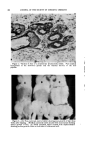
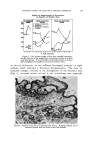
286 JOURNAL OF THE SOCIETY OF COSMETIC CHEMISTS effect on the pig's skin, except moderate hyperemia. The latter effect resembles more or less to the reaction produced on human skin. Clinical observations were made by Friederich (7), who treated 30 patients daily during three successive days over a 50 X 50 cm. area with 8 per cent ammonium thioglycolate solution. No changes could be ob- served in the blood pressure, sedimentation rate blood count, urine and liver function. Similar is the clinical observation of Behrman and Combes (8). It is of interest to note that 2 per cent thioglycolate has been used until recently to stabilize calcium gluconate solutions, without ever producing toxic effects. Although it is impossible to draw a final conclusion to humans from these observations, it is significant that Sulzberger and Rostenberg (9), as well as Ishikawa (10), were successful in sensitizing guinea pigs only with such substances which cause allergic reactions in humans. Thus Ishikawa was unsuccessful in producing hypersensitivity with nonsensitizing sub- stance, such as boric acid, and only with great difficulty' with bismuth which causes allergic reactions in rare instances. By analogy, one could postulate from our experiments that thrombocytopenic purpura, or periafter- iris nodosa is unlikely to be caused by either a commercial cold wave lotion, or a black hair dye. The failure to produce experimental thrombo- cytopenic purpura, or periarteritis nodosa, could also be explained by the well-known fact that sensitizing processes are relatively rarely proved in the etiology of both these diseases. It is just as illogical to link up leukemia with cosmetics, as it is without any firm foundation to consider the thioglycolates or paraphenylenedi- amine as a potential etiological factor of other blood dyscrasias. Millions use hair dyes and cold wave lotions without developing these diseases with measured frequency. Contrariwise, patients with this disease only rarely give the history of contact with the aforementioned cosmetics. In this connection, it is of particular interest to note that Bohrod (11) found this disease in an American deer and Stunzi (10) in 36 pigs. In the latter animals in five instances, erysipelas was considered a possible etological agent, and in 18 cases prophylactic vaccination against erysipelas. No other medicinal agent, either external or internal, has been used. Loc^L AND SvS'rEMtC ErrEc, or SEx HORMONES The second part of our presentation deals with the effect of percutaneous application of estrogens and androgens, on the sebaceous glands and hair growth in rabbits, as well as changes observed in the adrenal glands, most of which was published previously (13). It seems to me of interest to review the data together with some unpublished observations which might be of special interest to you. It should be briefly mentioned that 2 grams
Purchased for the exclusive use of nofirst nolast (unknown)
From: SCC Media Library & Resource Center (library.scconline.org)