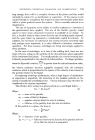
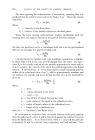
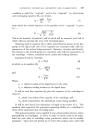
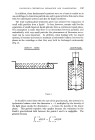
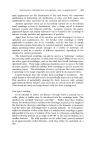
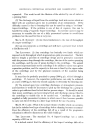
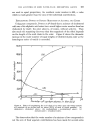
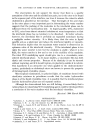
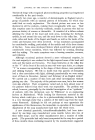
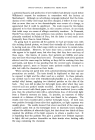
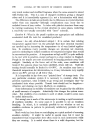
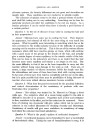
CONTINUOUS CENTRIFUGAL SEPARATION AND CLASSIFICATION 155 condition is called the "cutpoint", and at the "cutpoint", by substituting and rearranging equation (6), one obtains A•D • Q = 9[• S (7) from which the critical diameter of the particles at the "cutpoint" is given by:-- D = /9•9 s N/ Ap ' Vro2r (8) This is the diameter of particles, half of which will be removed, and half of which will pass through the rotor with the liquid phase. Referring back to equation (7), it will be noted that the factors in the first group of the right hand side of the equation are concerned only with the parameters of the system being processed: diameter, viscosity and density. The factors in the second group are concerned only with the parameters of the centrifuge: volume, rotational speed, radius and settling distance. Equation 8 may be rewritten 9 : 2VgZ (9) in which, as in equation (5), and Where ApD'2g (10) Vg -- 18•z geo2re z - g S• re = effective radius of the liquid layer in the rotor, Se = effective settling distance in the liquid layer. It will be seen that equation (9) gives the capacity of the centrifuge in terms of Y, , which is an index of the capacity of the centrifuge, and Vg, which characterizes the solid/liquid system being handled. It will be seen that Y, has dimension of length to the power of 2. This equation thus represents the potential separating ability of a centrifuge in terms of the equivalent area of settling pond. This general equation can be applied to any sedimentation process, either gravitational or centrifugal. In order to make it usable it has to be calcu- lated for each class of centrifuge using parameters which can be readily measured. Space does not permit me to derive this analysis here, and I will

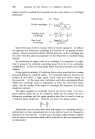
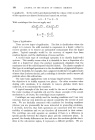
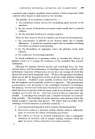
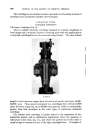
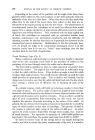
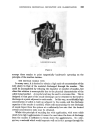
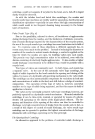
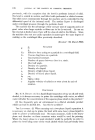
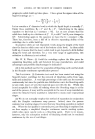
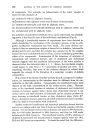
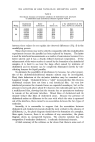
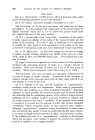
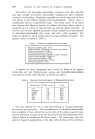
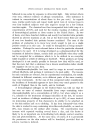
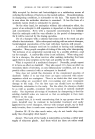
156 JOURNAL OF THE SOCIETY OF COSMETIC CHEMISTS confine myself to quoting the Z equation for the main classes of centrifugal sedimentor. General case Bottle centrifuge Z = •o•V 4'61øg (.r• 2r• h Tubular bowl xl•o•(3 • 1 •) centrifuge 2 = -- g •r• •- Disc bowl 2xmo•(r•-- rl a) centrifuge 2 • 3g tan 0 Some of the uses of the Z concept will now become apparent. It reflects the capacity of a continuous centrifuge as a function of two groups of para- meters. One is concerned entirely with the geometry of the centrifuge, and the other with the physical progenities of the dispersion or emulsion being treated. In considering the sigma value of a centrifuge, it is important to realise that it presents the potential separating power in terms of an equivalent settling pond. It does not necessarily follow that this potential can be fully realised. Using a gravity analogy, it is obvious that a water reservoir has a certain potential ability to sediment solids. The potential will not, however, be realised if one takes a high speed motor boat and drives about on the reservoir. In the same way, turbulence and other mechanical effects within the centrifuge make it impossible to meet the theoretical sigma value but for similar basic types of centrifuge the departure for theory should be constant. The sigma equation is commonly used in one of two ways. In a two- phase system which has to be separated, trials can be carried out on a laboratory centrifuge and the sigma equation may then be used to scale up to full size plant equipment. Thus for any given two-phase system. Q• Q• -- Alternately one may determine what will happen if a centrifuge which is performing a certain separational job on one system, has to be changed to operation on a new system. In that event, the sigma value remains constant and the degree of separation which will be achieved on the new matehal can be determined.
Purchased for the exclusive use of nofirst nolast (unknown)
From: SCC Media Library & Resource Center (library.scconline.org)