CONTINUOUS CENTRIFUGAL SEPARATION AND CLASSIFICATION 171 separated. This would avoid the dilution of the alcohol by use of water as a priming fluid. (2) The discharge of liquid from the centrifuge bowl into covers which arc filled with air sometimes gives rise to problems of air entrainment. If the difficulty caused is due to foaming this can be eased by using a "no foam" Super-Centrifuge. If the problem is one of loss of vapours, this can be handled by using a Vaportire Super-Centrifuge. In extreme cases it may be necessary to consider the use of a fully pressurized system to avoid these problems but the need for this is very rare. MR. G. H. BURNETT: (1) Are there limitations to the rate of throughput of a super centrifuge ? (2) Can one pump into a centrifuge and still have a pressure head to feed a distillation unit ? THE LECTURER: (1) Any centrifuge has basically two limits which are imposed on its throughput which in general are quite unconnected. The first limit is simply a question of centrifuge design and in general is concerned with the pressure drop through the centrifuge, the size of the motor operating the centrifuge, and the size of pump feeding to the centrifuge. The second and more important limit on the centrifuge is its ability to carry out a given separation problem, and the capacity in this case is fixed by the sigma value of the centrifuge and by the physical constants of the material being separated. It may thus be perfectly practical to pump 2000 g.p.h. of feed through a centrifuge. If, however, the separation performance can only be achieved at a rate of 200 g.p.h. then the second capacity is obviously the limiting one. (2) The normal open type centrifuge discharges at atmospheric pressure and therefore it would be necessary to pick up the discharge by a pump in order to get sufficient head to feed further process stages. It should be noted that many centrifuges can have integral feed and discharge pmnps fitted to the centrifuge to enable this to be carried out. Centrifuges can also be supplied as fully pressurized systems, in which case it then becomes possible to carry out direct feeding to a later stage without the use of a pump. MR. E. W. CLARK: What is the actual volume of solids which can accumu- late in the tubular bowl type of centrifuge before cleaning becomes necessary? Does the efficiency of the centrifuge fall off as a result of the progressive reduction in effective diameter as the solids build up ? THE LECTURER: The standard No. 6 Super-Centrifuge has a solids capacity of 210 cu. in. It is indeed correct that the efficiency of the Super-Centrifuge falls off as

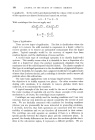
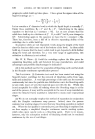
172 JOURNAL OF THE SOCIETY OF COSMETIC CHEMISTS progressive solids build up takes place. I have given the sigma value of the Super-Centrifuge as :-- -- g r• q- 5 r• Let us consider a 4" diameter bowl in which the liquid depth is normally 1". Under these conditions R• = 1" and R.•: 2". Substituting in the sigma equation we find that Z: constant x 6•. Let us now assume that the solids have built up to a thickness of •". R• is still 1" but R• now changes to 1•" Substituting again in the equation we have the Z constant x 5•. There has, therefore, been a fall off in effective separating ability of the centrifuge due to solids build up. In practice solids are not deposited eveMy Mong the len•h of the bowl since the heavier solids come out of the bottom of the bowl. As these solids build up, it means that the heavy solids tend to get deposited a little further along the bowl and therefore, for a very wide range of applications, this reduction in efficiency is not critical. M•. W. R. WEBB: (1) Could the centrifuge replace the filter press for separating bleaching earth and fat-stock for soap manufacture, and could advantages and possible disadvantages be indicated ? {2) Is this method used for the separation of bleaching earth and fat-stock in the Sharples continuous saponification process ? THE LECTURER: (1) Extensive test work has been carried out using the Super-D-Canter centrifuge for the removal of bleaching earths from vege- table and animM fats. A very high percentage of the earth can be recovered continuously but since the particle size distribution curve for bleaching earth is very wide, traces of very fine material pass out with the fat. •ilst this is not acceptable for edible oil refining where the bleaching stage is at the end of the process, it may well be acceptable in the case of soap manufacture where the bleached fatty material is subjected to many more separational stages. (2) We do not normally employ this method of separation in conjunction with the Sharples continuous soap process. Indeed, since the process contains four washing stages it is rare that any bleaching operation is ca•ied out. •ere the fat quality is extremely poor, pre-bleaching is employed but we then employ a simplified Sharples cont•uous caustic washing system which relies upon caustic soda as a bleaching agent. There is no reason, however, why the adsorption method of bleaching should not be rendered continuous by the use of centrifuges.
Purchased for the exclusive use of nofirst nolast (unknown)
From: SCC Media Library & Resource Center (library.scconline.org)