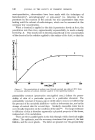
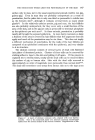
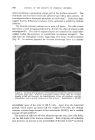
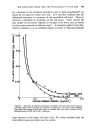
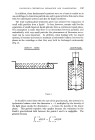
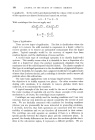
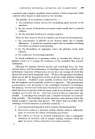
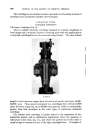
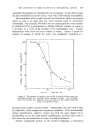
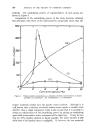
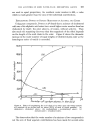
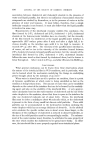
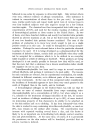
THE STRUCTURES WHICH LIMIT THE PENETRABILIT¾ OF THE SKIN 149 by a decrease in the electrical impedance) and to local anaesthetics •5 (as shown by the speed at which they act). It is therefore unlikely that the diffusional resistance is a property of one specialised cell layer. There is, however, a gradation in properties of the cell layers. Those nearest the skin surface do not adhere together as strongly as the lower ones, as shown by their easier removal on adhesive tape •. A chemical applied to the skin, either in solution or as an undiluted liquid, is found in disproportionately r-• 0'20 @ o.s o o.o i I '- 0'0.5 INTACT WITH 0 SKIN I 0 0'5 1.0 1'5 2'0 $TRATUH CORNEUIq REIqOVED (:::m•j/om2::) Fig•r• •. The mass of trinbutyl phosphate associated with particles of the stratum comeurn which were removed by successive strippings of the skin with adhesive tape after the organic liquid had been in contact with the dorsal surface of the human forearm for 80 (x) or 90 {') minutes. large amounts in the upper cell layers (Fig. 4) •a, which indicates that the intercellular spaces are wider near the surface.

150 JOURNAL OF THE SOCIETY OF COSMETIC CHEMISTS Which components of this dead cell layer could produce a large diffusional resistance ? The two obvious possibilities are lipid, forcing the penetrant to change phase, and insoluble protein, restricting the area for diffusion within the one phase. The direct relationship between the permeability of rabbit skin to an applied solute and the ether-water partition of that solute 9 indicates that there are lipid membranes through which the penetrant has to pass, and this is supported by the higher permeability of skin to drugs in the free base form rather than the salt form •5'2•, and the increase in insensible water loss when the skin is washed with lipid solvents 2. On the other hand, the low permeability of isolated membranes of stratum corneum even after prolonged immersion in petroleum ether •7 shows that the protein framework alone has a large diffusional resistance. The relatively high permeability of skin to water • and ions (unpublished observations) is not consistent with the presence of a complete lipid barrier. It is probable that both components, the fat and the protein, combine to produce the observed resistance. Penetration could be through the ceils of the stratum corneum or around them. If entry were through the cells, the amount of an applied chemical recovered from unit mass of the cells (Fig. 4) would be a measure of the concentration of the penerrant as it diffused through them. On this hypo- thesis the results show that much the largest concentration gradient, and hence the largest diffusional resistance, is in the surface layers of the stratum. This is improbable, as the membrane formed from the lower layers is very impermeable and the upper layers are comparatively friable. It follows that entry is between the cells in the upper layers. Ions probably penetrate the entire system in this way, for the electrical impedance of the skin is of the "polarisation impedance" form •5, characteristic of passage by direct current (equivalent to ionic penetration) around obstructions, presumably the ceils. Covalent compounds may pass through the ceil membranes and hence the ceils. This subdivision is, however, highly speculative. In conclusion, it appears that the route of entry of extraneous chemicals is through the epidermis itself rather than through its accessory structures, and that the resistance to this entry is a physical property of dead ceils, complicated by "active processes". The resistance does not seem to be a function of a specialised membrane, nor is it entirely dependent on any one component of the structure. It is a property of the keratinised ceil matrix, effective against all molecules so far studied, and not easily destroyed save by actual removal of the cells. (Received: 12th February 1962) REFERENCES • Pinson, E.A. Am. J. Physiol. 137 492 (1942) • Berenson, G. S. and Burch, G.E. Am. J. Trop. Med. 311842 (1951) 8 Buettner, K. J.K. f. Appl. Physiol. 14 269 (1959)
Purchased for the exclusive use of nofirst nolast (unknown)
From: SCC Media Library & Resource Center (library.scconline.org)