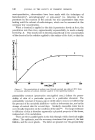
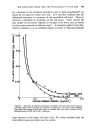
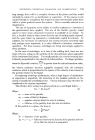
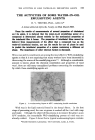
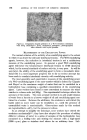
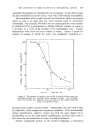
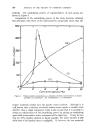
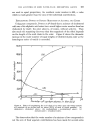
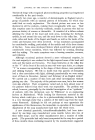
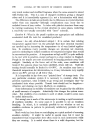
THE ACTIVITIES OF SOME WATER-IN-OIL EMULSIFYING AGENTS 181 are used in equal proportions, the resultant water number is 650, a value which is much greater than the sum of the individual contributions. EMULSIFYING POWER OF BINARY MIXTURES OF ALCOHOL AND ESTER Using pure compounds, Powers et al a found that a mixture of cholesterol with one of its aliphatic acid esters has a much higher water number than has cholesterol by itself the ester alone is, of course, without activity. They also made the surprising discovery that the magnitude of the effect depends on the length of the acid chain in the ester. Figure 6 shows the dramatic increase in the water number of equal weights of cholesterol plus ester as the homologous series of nacids is ascended. 7000 800 600 1200 ! I • •(.•- -/, 20 o (6) • • [ I ] 4 8 12 16 20 Number oF car•on o•orn$ /• the •cl'd 2• Figure 6. Effect of lengthening the acid chain of an ester upon the water number of a mixture of an alcohol and its esters (2.5% of each in liquid paraffin). (a) cholesterol + cholesteryl esters (b) isocholesterol + isocholesteryl esters (c) noctadecanol + octadecyl esters. The observation that the water number of a mixture of two compounds is not the sum of their separate contributions has been made for several series

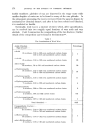
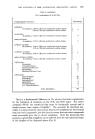
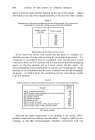
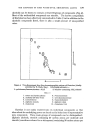
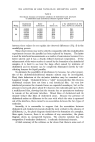
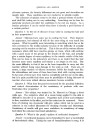
182 JOURNAL OF THE SOCIETY OF COSMETIC CHEMISTS of compounds. For example, an enhancement of the water number is observed with mixtures of (a) cholesterol with its aliphatic di-esters, (b)•cholesterol with aliphatic esters and di-esters of hexadecanol, (c) cholesten-3-carboxylic acid with its aliphatic esters, (d) 3-homocholesterol (3-methylol-cholestene) with its aliphatic esters, and (e) noctadecanol with its aliphatic esters. For mixtures of isocholesterol with its esters, on the other hand, the emulsify- ing power is less than the sum of the individual contributions (Fig. 6). Although a considerable number of experiments have been directed to- wards elucidating the mechanism of the synergistic process, so far no alto- gether satisfactory explanation has been found. The most obvious con- clusion is than an association complex is formed at the interface, between the alcohol and its ester, and that the complex has a greater (or for the complex formed between isocholesterol and its esters, a lower) emulsifying power than either of its components. Examination of the behaviour of mixtures of octadecanol and octadecyl laurate, and of cholesterol and cholesteryl stearate suggests that the maximum enhancement of the water number is observed when the molecular ratio is 1: 1. Hence, the interfacial complex would appear to arise from a 1: 1 association of alcohol and ester. It is surprising, therefore, that none of the evidence obtained in related fields supports the concept of the formation of a molecular complex of definite composition. It is a tenet of the theory of surface activity that, if a compound is surface- active, its concentration in the interface must be different from its con- centration in the bulk solution. Consequently, the interfacial tension must depend on the bulk concentration of the surface-active solute. Measure- ment of the interfacial tensions of solutions of cholesterol and cholesteryl stearate in benzene against water, shows that cholesteryl stearate is not surface active and that mixtures of cholesterol and its stearate produce the same lowering in interfacial tension as does cholesterol alone (Table Hence, cholesteryl stearate cannot be adsorbed at the benzene/water interface either by itself or in association with cholesterol. Similar results for hexadecanol and hexadecyl palmitate showed that the ester is not surface-active nor does it form an interfacial complex with the alcohol. The interfacial tension between benzene and water is 34.4 dynes/cm, that for 0.03 molar lanostenol is 28.9 dynes/cm, and that for 0.03 molar hexadecanol is 32.0 dynes/cm. The interfacial tensions of 2'5}/0 solutions of cholesterol, lanostenol and hexadecanol in benzene against water are 19-2, 23.5 and 28.2 dynes/cm respectively. It should be noted that the differences
Purchased for the exclusive use of nofirst nolast (unknown)
From: SCC Media Library & Resource Center (library.scconline.org)