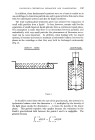
CONTINUOUS CENTRIFUGAL SEPARATION AND CLASSIFICATION 153 long enough, there will be a complete division of the phases and this would normally be referred to as clarification or separation. If the process is not carried through to completion but stopped at some intermediate point there will be a phase gradient across the system. This is normally referred to as classification. The rate of separation or the ability to resolve emulsions is a function of the gravitational force applied. The use of the Earth's gravity would appear to have many attractions because it is available at no charge. In fact, a detailed analysis often shows that the size of settling tanks required, and the space taken up represents a considerable capital investment. In addition, the inventory of material in this system becomes extremely high and, perhaps more important, it is often difficult to introduce continuous operation. For these reasons, centrifuges are being increasingly applied to these problems. In the case of centrifuges, as is true of the settling tank, there are two types of forces, acting on the particles of the discontinuous phase suspended in the continuous fluid phase. For small particles, the viscous resisting force is directly proportional to the velocity of sedimentation. For larger particles, DVp,. when the Reynolds' number, •s greater than the critical transition value, the viscous resistance becomes negligible compared with the turbulent resistance which is proportional to the square of the velocity of movement of the particle relative to the liquid. In analysing centrifuge performance, when a high degree of clarification or separation is important, the behaviour of the smallest particles in the system is usually the controlling factor. Viscous resistance may therefore be considered to be of prime importance. The effective force acting on a given particle in a centrifugal field is :-- FCF = (m-m,)•o•r (1) Where m = mass of the particle m•: mass of fluid it displaces to : angular velocity about the axis of rotation, r = distance of the particle from the axis of rotation. If the particle is a sphere, the force is FCF = •Da/•p•o•r (2) Where D = diameter of the particle, •p = • m p• •_ difference between the density of the particle and that of the fluid in which it is suspended.

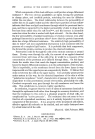
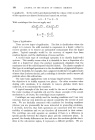
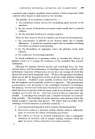
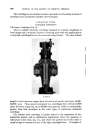
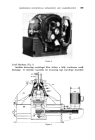
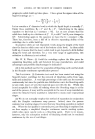
154 JOURNAL OF THE SOCIETY OF COSMETIC CHEMISTS The force opposing the sedimentation of the particle, assuming that it is small and that its velocity is low, is given by Stokes' Law. This is the viscous drag force. Fr• ---- 3•[•DVr (3) Where •, -- viscosity of the fluid phase, Vp = velocity of the particle relative to the fluid phase. When the force causing sedimentation reaches equilibrium with the resisting force, the relative velocity of the particle becomes constant. Vr = .a•D•to••r (4) 18• Or when the particle is not in a centrifugal field, but is in the gravitational field, as, for example, in a gravity settling tank ApD•g Vg: 1S'•- (5) Consider firsfly the tubular bowl type centrifuge, operated as a clarifier, in which fluid is fed in one end, and discharged from the other. In such a rotor Vp is the velocity with which the particle approaches the rotor wall, or if Ap is negative, the velocity with which the particle approaches the liquid surface. If the thickness "S" of the liquid layer is small compared with the radius of the cylindrical rotor, then V r will be approximately constant, and the distance the particle will move during the time it is in the bowl will be given by x = Vrt ApD%oar V = (6) Where t = time V -- volume of liquid in the bowl, : r 1 (r• •-- rl •) Q = rate of flow of liquid through the bowl, r• = outer radius of the liquid in the cylindrical rotor, r• = radius of liquid surface in the cylindrical rotor, 1 = length of the cylindrical rotor Also, let S : thickness of the liquid layer. If x is as great as, or greater than, the initial distance of the given particle from the wall of such a rotor, it will be deposited against the wall and removed from the liquid phase. In an ideal system, when x = S/2, half the particles of diameter D will be removed from suspension, and half will not. This
Purchased for the exclusive use of nofirst nolast (unknown)
From: SCC Media Library & Resource Center (library.scconline.org)