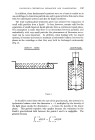
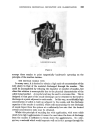
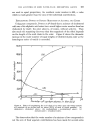
CONTINUOUS CENTRIFUGAL SEPARATION AND CLASSIFICATION 161 such applications are the clarification of fats and waxes, the continuous purification of lubricating oil, clarification of cider and fruit juices, and multitudinous other operations in the chemical and process industries. Another operation which can be successfully carried out on the tubular bowl centrifuge is that of classification, since a sharp cut-off is obtained between oversize and undersize particles. Lacquers, enamels, dye-pastes, pigmented liquors and similar substances can be treated in the centrifuge to remove oversize particles and agglomerates of particles. Apart from the low cost of the machine per unit throughput, its ease of operation and maintenance, etc., the tubular bowl centrifuge is widely applicable in industry due to its versatility, and the fact that its simple construction permits fabrication in corrosion-resistant materials. In many plants producing small annual tonnages of a variety of materials, one machine is used for a number of different operations, depending on the chemical in current production. The tubular bowl centrifuge can also be used as a "polishing" machine for removing small quantities of solids from the liquid effluent from one of the other types of centrifuges, such as the solid bowl scroll discharge type, described below. These large continuous machines serve to remove the bulk of coarse particles, whilst the tubular bow! centrifuge is used to remove the remaining traces. The advantages of such a system are that each machine is operating on the range of particle sizes most suited to its characteristics. Liquid discharge from the tubular bowl centrifuge is continuous. The solids remain in the bowl and have to be periodically removed as a bowl cake. This operation of periodically cleaning the bowl, however, only occupies approximately fifteen minutes, and can in fact be carried out in five minutes if two bowls are used, one being cleaned while the other is being used. Disc-type Centrifuge In an attempt to reduce the distance through which a particle has to settle, plates or baffles may be introduced into the centrifuge bowl. This produces the so-called "disc-type centrifuge". Whilst these discs could in theory be introduced into a tubular bowl centrifuge, in practice the height of the bowl in the disc-type centrifuge is reduced as the diameter is increased, and the speed and centrifugal force is greatly reduced. In consequence, whilst the direction of flow of the fluid in a tubular bowl centrifuge is gener- ally parallel to the axis of rotation of the bowl, in a disc-type centrifuge the liquid is flowing inwards at an angle of 35ø-45 ø to the axis of rotation, to a smaller diameter. The solid particles, on the other hand, proceed outward in an approximately radial direction, until they strike the underside of a disc.

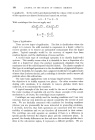
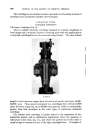
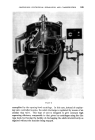
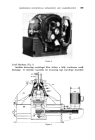
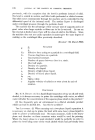
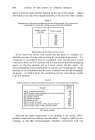
162 JOURNAL OF THE SOCIETY OF COSMETIC CHEMISTS Depending on the nature of the particles and the angie of the discs, these particles either collect on this under-surface, or else slide outwards down the underside of the discs in a thin layer. When they leave the disc stack they either flow to the wall of the bowl where they collect or else they are re- entrained by the liquid passing up into the disc stack. The phenomenon of re-entrainment causes disc centrifuges to be much less efficient than would appear from a simple calculation of separational efficiencies based on centri- fugal force and settling distance. This, combined with the high capital cost of batch disc centrifuges as compared with an equivalent tubular bowl machine, maintenance cost, mechanical complexity, and the difficulty of cleaning, accounts for the fact that their use is generally less favoured in the chemical and process industries. Modifications to the disc principle, how- ever, do permit the solids to be continuously discharged, and it is in this function, rather than in its use as a "batch" type centrifuge, that the disc machine finds its best field of application. Nozzle Discharge Type (Fig. $) Where continuous solid discharge is required, the low length to diameter ratio of the disc centrifuge lends itself to the provision of orifices in the periphery of the bowl through which the solids can be discharged. The bowl shell is modified so that the solids deposited are guided down towards the nozzles. The angle of this bowl wall must be sufficiently steep so that the solids will flow down. If too shallow an angle is used for solids having a high angle of repose, then small mounds will build up until the solid itself provides an appropriate angle. This in itself is not harmful, but the danger exists in such a case that the solids will build back into the disc stack, thus causing a serious loss of efficiency due to blanking off part of the stack. In a similar manner, solids will build up in between nozzles to form their own angle of repose. For a given angle of repose the height of such accumu- lations of solids will depend on the distance between adjacent nozzles and, for a given bowl diameter, on the number of nozzles. Thus, in order to avoid the apex of such accumulation from penetrating the disc stack, one has to regulate the number of nozzles according to the nature of the solids. In general, the use of from 4 to 12 nozzles is found to be desirable for most of the types of solids handled on this class of centrifuge. The pressure of fluid at the nozzles is relatively high, being of the order of 1,000 p.s.i. In conse- quence, to avoid excessive liquid flow through these nozzles, they must be of small diameter. For operation at capacities of 1,000-10,000 gallons per hour feed to the centrifuge, the nozzles used range from 0.030" to 0-070'. In order to recover some of the energy lost in the liquid leaving the nozzles, and thus to reduce the power requirements of the unit, it is usual to
Purchased for the exclusive use of nofirst nolast (unknown)
From: SCC Media Library & Resource Center (library.scconline.org)