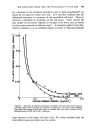
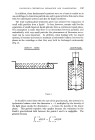
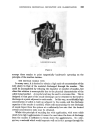
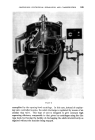
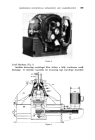
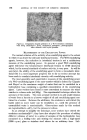
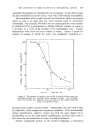
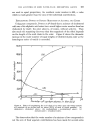
CONTINUOUS CENTRIFUGAL SEPARATION AND CLASSIFICATION 16• Figure arrange these nozzles to point tangentially backwards operating on the principle of the reaction turbine. TX•r. •v.C¾CZ• NOZZZ• TYP• In many cases, it is desired to obtain a high ratio of concentration of the inlet slurry to that of the material discharged through the nozzles. This could be accomplished by reducing the diameter or number of nozzles, but often this solution is unacceptable due to the physical characteristics of the solids being handled. A recycle bowl may be used to overcome this. This is designed so that part of the nozzle discharge can be returned to the bowl to discharge at a point adjacent to each nozzle. In this way, an artificially high concentration of solids is built up adjacent to the nozzle, and the discharge capacity of the nozzles is satisfied, whilst still maintaining the net discharge of nozzle liquor from the system at a sufficiently low rate that the desired overall concentration ratio may be obtained. Whilst this principle of recycling has wide application, with some solids which form light agglomerates it cannot be used since the force of discharge from the nozzles is sufficient to break down the agglomerates. In conse- quence, a material which would separate well on its first passage through the

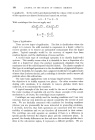
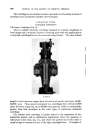
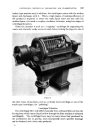
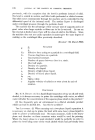
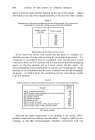
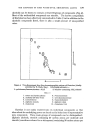
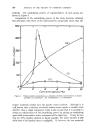
164 JOURNAL OF THE SOCIETY OF COSMETIC CHEMISIS centrifuge would not separate if recycled to the bowl, and a fall-off in liquid clarity would be observed. As with the tubular bowl and batch disc centrifuges, the nozzles and recycle nozzle type machines are widely used for separation, clarification and classification operations--especially in cases where the high concentration of solids would result in too frequent cleaning being necessary in the former types of machines. Valve Nozzle Type (Fig. 4) Due to the possibility, referred to above, of breakdown of agglomerates during discharge from the nozzles, and the limitation of ultimate concentra- tion of nozzle discharge imposed by the characteristics of the recycle system, the use of the recycle nozzle type centrifuge has some limitations in its field of use. To overcome some of these objections a different approach has, in recent years, been made to the problem. Instead of reducing the diameter or number of the nozzles to restrict nozzle discharge, a control is applied on the time for which the nozzles are open, by building valves into each nozzle. This permits very high concentration ratios to be achieved, even with the slurries consisting of relatively fragile agglomerates. It also enables a higher nozzle discharge concentration to be ultilised than would be possible with a recycle bowl. Two types of valves are commonly used. In both types, each nozzle has a separate valve. In the case of the automatic valve type centrifuge, the depth of solids deposited in the bowl controls the opening and closing of the valves, by means of a hydraulic self-operating mechanism in the valve itself. The centrifuge can thus automatically compensate for variations in feed rate and concentrations of solids in the feed, and still deliver a sludge of constant- composition. The operation of this type of valve is, however, somewhat sensitive to the type of solids being separated, and for this reason its field of application is limited. The valves in the externally actuated valve type centrifuge, however, are positively operated by a hydraulic control mechanism. Mounted outside the centrifuge, it can be time-cycle, manual, or operated by means of a photo- electric cell operating on the clarity of the liquid phase effluent. The fre- quency and duration of the opening of the valves can thus be controlled to discharge very high concentrations of sludge from the nozzles and, in fact, as a result of this degree of control of nozzle discharge, the valve nozzle type centrifuge can be operated to produce the highest concentration of discharge obtainable with centrifuges operating on the disc principle. The Opening-Bowl Centrifuge An alternative approach to the problem of controlled solids discharge is
Purchased for the exclusive use of nofirst nolast (unknown)
From: SCC Media Library & Resource Center (library.scconline.org)