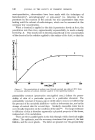
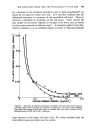
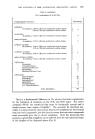
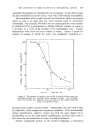
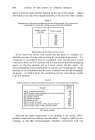
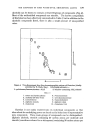
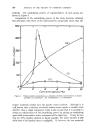
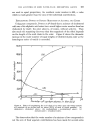
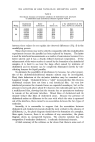
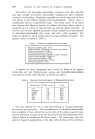
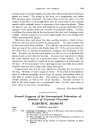
THE ACTIVITIES OF SOME WATER-IN-OIL EMULSIFYING AGENTS 18• Table 4 Interfacial tensions of benzene solutions of cholesterol and mixtures of cholesterol and cholesteryl stearate against water? Cholesterol Ester y y for cholesterol at the Temp. moles/litre moles/litre dynes/cm. conc. shown in column 2 ._ 20 0.0300 0.0100 25.9 26-1 0.0200 0.0200 29.6 29.4 0.0100 0.0300 32-7 32.5 40 0.0300 0-0100 29.6 29.3 0.0200 0.0200 31.1 30.8 0.0100 0.0300 31.9 31.7 between these values do not explain the observed differences (Fig. $) in the emulsifying powers. These observations may not be strictly comparable with the emulsification experiments because the paraffin has been replaced by benzene. The latter is used for interfacial measurements as a matter of convenience because it is a be.tter solvent and it has a clearly defined chemical composition. If the enhancement of the water number is caused by the formation of an interfacial complex, it is hard to see how the large effect caused by mixtures of cholesterol and its stearate can be completely eliminated merely by sub- stituting benzene for liquid paraffin. To eliminate the possibility of interference by benzene, two other proper- ties of the cholesterol/cholesteryl stearate system may be investigated. First, their behaviour at the air/water interface may be examined on a Langmuir trough. Cholesterol forms a "solid" monomolecular film whereas cholesteryl stearate does not form a real interfacial film. At very low interfacial pressures the stearate forms an expanded monolayer, but as the pressure is increased above about 0.1 dyne/cm the molecules pile up to form a multilayered film, showing that the stearate has no spontaneous tendency to remain at the air/water interface. Mixed films of cholesterol and its stearate behave like films of cholesterol alone. Because the presence of cholesterol makes no difference to the ease with which the ester is squeezed out of the interface, there cannot be an association between the two types of molecules. Secondly, it is reasonable to suppose that the association between cholesterol and cholesteryl stearate should be most evident in the absence of all diluents, i.e., the phase diagram should show the formation of a complex. Once again, however, there is no evidence of any association the phase diagram shows no unexpected features. The eutectic mixture has the composition 3 molecules cholesterol: 1 molecule cholesteryl stearate. A brief summary of the evidence so far shows that there is some sort of

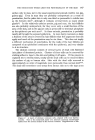
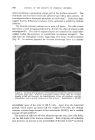
184 JOURNAL OF THE SOCIETY OF COSMETIC CHEMISTS association between cholesterol and cholesteryl stearate in the presence of water and liquid paraffin, but there is no indication of association when the compounds are studied by themselves, or in the presence of water or in the presence of water and benzene. It must follow, therefore, that a simple molecular complex is not formed it must also follow that the liquid paraffin is involved in some way. Measurements of the interfacial viscosity confirm this conclusion the films formed by 2.5% cholesterol and 2-5% cholesterol q- 2.5% cholesteryl stearate at the benzene/water interface have no viscosity, but the viscosity of the film formed by cholesterol at the liquid paraffin/water interface is appreciable (42-7 surface poises after 3 min) and after a slight fall, it in- creases steadily as the interface ages until it is too high to measure it exceeds 10 • s.p. after 16 h. The viscosity of the paraffin/water interface is, of course, nil and so too is the viscosity of the interface formed between 2.5% cholesteryl stearate in liquid paraffin and water, but the viscosity of the interfacial film formed by 2-5% cholesterol •- 2.5% cholesteryl stearate follows the same trend as that formed by cholesterol alone, but the former is lower throughout. After 1 min it is 3.5 s.p., and after 16 hours it is 53,000 s.p• CONCLUSIONS What general conclusions can be drawn from these observations about the nature of the interfacial film in W/O emulsions, and in particular, what can be learned about the mechanism underlying the change in emulsifying power brought about by the inclusion of an ester ? When water is stirred into an oil to produce an emulsion, there is a point of dynamic equilibrium at which water is being emulsified as fast as the emulsion is being broken down. The amount of water that can be emulsified depends on the extent of the interface that can be be formed by the emulsify- ing agent and also on the stability of the interfacial film. A very approxi- mate calculation based on the water number of cholesterol and the size of the water droplets in the emulsion, shows that there is space in the interface for only one cholesterol molecule out of about forty. Hence, the interfacial film must be either a multilayer about 40 molecules thick, or the cholesterol is present in the form of very small but discrete solid particles. These solid particles can be accommodated in the hydrocarbon medium enclosing the water droplets which has an average thickness of about 6•. In the alcohol/ ester emulsion the specific surface area is about seven times larger, so the thickness of the multilayer of cholesterol is reduced to about 6 molecules, or the size of the solid particles must be correspondingly smaller. The enhance- ment of the water number must, therefore, be attributed to some property of the ester which enables the cholesterol to be spread more thinly. In either case, the interfacial film is more properly regarded as an interfacial phase.
Purchased for the exclusive use of nofirst nolast (unknown)
From: SCC Media Library & Resource Center (library.scconline.org)