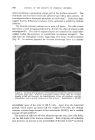
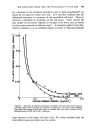
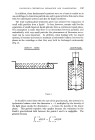
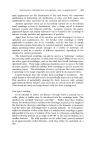
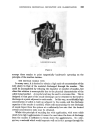
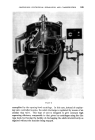
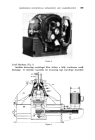
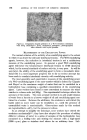
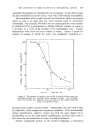
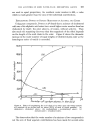
CONTINUOUS CENTRIFUGAL SEPARATION AND CLASSIFICATION 165 ::.":::::'"" .,.v •'• S l ":.?:. ....... '-? •' :½ •½:' ".': ..•...... "" ':?'77 '""'-.• '" "7 .. '"' ' • •.' ." : . ...'":" : •.'• "::: .. . . •': =. .. Figure 4 exemplified by the opening-bo•vl centrifuge. In this case, instead of employ- ing valve controlled nozzles, the solids discharge is regulated by means of an annular ring valve. This type of unit is designed to give constant high separating efficiency comparable to that given by centrifuges using the disc type bowl, but having the facility of discharging the solids intermittently as required without the machine being stopped.

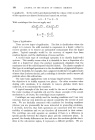
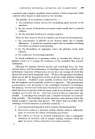
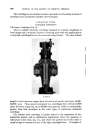
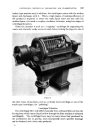
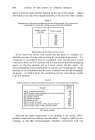
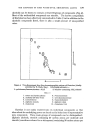
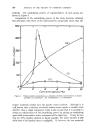
166 JOURNAL OF THE SOCIETY OF COSMETIC CHEMISTS The bowl of the machine is constructed with a conical sludge space, the angle of which ensures complete discharge of all solid matter. It is designed for long running periods, having a sludge space of the largest possible volume and is opened and shut hydraulically. The method of operation ensures that the sludge discharged contains the minimum quantity of liquid. Solid Bowl Scroll Discharge Type (Fig. 5) In the solid bowl scroll discharge, or "decanter" type of continuous centrifuge, a combination of centrifugal settling and centrifugal filtration is taking place. The decanter type consists of a cylindrical or conical solid bowl rotating about a horizontal axis between two fixed bearings. Inside the bowl, and rotating about the same axis is a helical scroll conveyor which, however, rotates at a differential speed as compared with the bowl. This speed differential is achieved by means of an epicyclic gearbox operating between the bowl and the conveyor drive. A centrifugal separating force of up to approximately 3,000 times the force of gravity is generated in the bowl of the centrifuge. The slurry to be separated is fed to the inside of the bowl. The centri- fugal force deposits solids on the bowl wall. These are moved up the bowl by means of the scroll conveyor, and are discharged through circumferential ports at one end of the bowl. The clarified liquid passes to the other end of the bowl, and is discharged over an adjustable weir which regulates the depth of the "pond" in the bowl, thus controlling the liquid residence time and thereby the degree of clarification obtained. In the conical bowl version, the solids are moved up the bowl and pass across a dry section above the liquid level, known as a "beach", before being discharged. In this section of the bowl the liquid trapped in the solids is given the opportunity to drain away. In the cylindrical bowl version the solids move to the solids discharge end of the bowl below the liquid level, and extrusion plays a part in the mechanism of discharge. The conical type decanter is to be favoured where the solids separated are fairly firm, and where dryness of the solids rather than liquor clarity is of primary importance. For plastic solids and in cases where good liquid clarity is essential, the cylindrical decanter is preferred. In both types, the decanter can either be used as a clarifier to remove all the solids, or as a centrifugal classifier to discharge large particles as a solid phase, whilst allowing fine particles to remain in suspension. By careful selection of throughput and operating conditions, a reasonably good "cut" can be obtained at the desired particle size. By using a special design of double feed tube, wash liquor can be deposited on the solids beach and a degree of wash thus effected. This is not as thorough as that obtained in a perforated
Purchased for the exclusive use of nofirst nolast (unknown)
From: SCC Media Library & Resource Center (library.scconline.org)