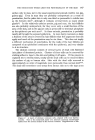
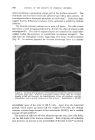
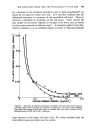
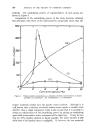
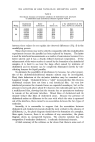
THE ACTIVITIES OF SOME WATER-IN-OIL EMULSIFYING AGENTS 185 The observations do not support the theory that there is a specific association of the ester and the alcohol into pairs, nor is the ester to be found in the aqueous part of the interface, nor does it increase the extent to which cholesterol is adsorbed at the interface. That the length of the acid chain in the ester plays a very important part in determining the water number suggests that the packing of the molecules in the interfacial phase can be influenced from the hydrocarbon side. In liquid paraffin, 2.5% cholesterol or 2.5% ester form almost saturated solutions at room temperature so that the interfacial phase has no tendency to be dissolved. In better solvents, however, the interfacial film is probably an expanded monolayer having a negligible surface viscosity. It is likely then, that the ester in liquid paraffin acts as a plasticizer and reduces the interfacial rigidity or viscosity. This deduction implies that the maximum water number is observed at an optimum value of the interfacial viscosity. If the interfacial phase is too rigid, the water number is low but the emulsion is stable when it is too fluid, the water number is low and so too is the stability of the emulsion. The ideal W/O emulsifying agent should give rise to a viscoelastic, semi- ordered interfacial phase. As its name implies, a viscoelastic film has both elastic and viscous properties. Because of its elasticity it can be stressed without rupturing, and if it should rupture, its plasticity enables it to reform. This hypothesis is an attractive one when applied to the cholesterol/ester system, particularly as cholesteryl esters are known to possess the property of forming liquid crystalline phases. Microscopical examination, in polarised light, of emulsions formed with sterol/ester mixtures in petrolatum reveals that the entire hydrocarbon phase is of the liquid crystalline type it is possible that the interfacial phase and the hydrocarbon phase are not separate entities. Although the observational data are still lacking, it seems likely that a rational basis for classifying W/O emulsifying agents could be developed from a correlation of the water numbers with the interfacial viscosities. (Received: 30th March 1962) REFERENCES Lifschiitz, I. Z. physiol. Chem. Hoppe-Seyler's 11t 108 (1921) Bertram, S. H. J. Am. Oil Chemists' Soc. 26 454 (1949) Powers, J. L., Leask, H. B. and Warner, R.S. J. Am. Pharm. Assoc. Sci. Ed. 29 14 (1940) Tiedt, J. and Truter, E.V. J. Appl. Chem. London 2 633 (1952) Truter, E.V. Wool Wax (1956) (Cleaver-Hume Press Ltd., London) Downing, D. T., Kranz, Z. H. and Murray, K.E. Australian J. Chem. 13 80 (1960} Schulman, J. H. and Cockbain, E.G. Trans. Faraday Soc. 36 661 (1940) Casparis, P. and Meyer, E.W. Pharm. Acta Helv. 10 163 (1935) Worrell, L. and Sinsheimer, J.E. J. Am. Pharm. Assoc. Sci. Ed. 43 562 (1954) Anderson, C. A. and Truter, E.V. unpublished results.

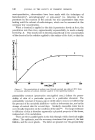
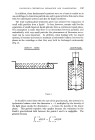
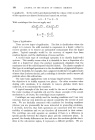
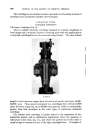
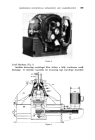
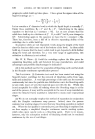
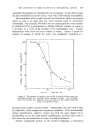
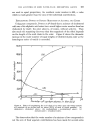
186 JOURNAL OF THE SOCIETY OF COSMETIC CHEMISTS •)ISCUSSION DR. E. L. NEUSTADTER: (1) What is the effect of branched chain esters on the emulsifying properties of wool wax alcohols ? (2) Is the surface viscometer actually a flat plate or a cone ? THE LECTURER: (1) So far as I am aware, this point has not been investigated. It seems unlikely that replacement of the normal chains by slightly branched chains such as iso- or anteiso-end groups would make any marked difference to the water number. (2) It is a circular plate about 3 mm thick. Calculation of the surface viscosity requires knowledge of the radius of the viscometer plate and the radius of the container. If a cone is used, it would have to be immersed to exactly the same depth in each experiment or the radius of the cone at the level of immersion would have to be determined in each experiment. DR. ilk. W. MIDDLETON : (1) You have referred to the rate of change of surface viscosity reading, sometimes say 50,000 surface poise in a short while, whilst in other cases 500,000 surface poise. How reproducible is the rate of change ? (2) Figure $ showed us a sigmoid curve of the number of stable emulsions produced with increasing amounts of water to a constant amount of emulsifier. With some amounts of water, say 3 out of 20 tests given an emulsion. What chance occurrence caused these three to be stable ? TI•E LECTURER: (1) I have not made any systematic measurements of the rate of change of surface viscosity. Comparison of the viscosities of replicate samples of the same age shows that the high values referred to are reproducible to about 20 per cent. (2) It is difficult to be sure, but the formation of "superhydrated" emulsions would provide one explanation. When water is progressively stirred into some emulsions (e.g., those containing cholesterol q- cholesteryl caprylate in liquid paraffin) the normal end-point may be passed without any indication that the emulsifying capacity of the system is being exceeded. Suddenly, the next addition of water causes the emulsion to collapse, and the system separates into water q- emulsion. If the quantity of free water is measured, it is found that the amount of water that remains emulsified corresponds, within acceptable limits, to the expected water number. Although "superhydrated" emulsions cannot be produced to order, when they are formed, they appear to break at a fairly reproducible water content, i.e. it seems as though some systems have a higher, secondary water number. If the addition of water to a "superhydrated" emulsion is discontinued before the secondary water number is reached, the product has sufficient short-term stability to be wrongly classified.
Purchased for the exclusive use of nofirst nolast (unknown)
From: SCC Media Library & Resource Center (library.scconline.org)