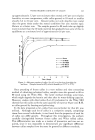
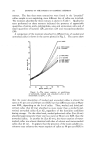
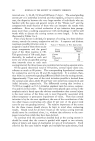
WATER HOLDING CAPACITY OF CALLUS 265 up approximately 5.3 per cent moisture when stored at 45 per cent relative humidity at room temperature, while callus ground to 10 mesh or smaller absorbs 6.2 to 6.6 per cent. Ground callus not only absorbs more water than the gross tissue under the stated conditions but also reaches equi- librium at a faster rate. The samples ground to 80 mesh take up slightly more moisture than the 10 mesh material but gradually lose some of this to equilibrate at a moisture level of approximately 6.6 per cent. o o Gross x. ........... x I0 Mesh a-------,• 20 Mesh •-.e 40 Mesh o-.-.--• 80 Mesh I 2 3 4 5 6 7 8 Time (Doys) Figure l.--Moisture sorption of callus (Lot #l) as a function of particle size and time. (Samples stored at 45% relative humidity at 23øC. q- 2øC.) Since pounding of frozen callus is a very tedious and time consuming method of obtaining pulverized callus, samples were also ground to 60 to 80 mesh using the Wiley Mill. The latter method develops some heat, which might degrade the keratin and thus alter its water-holding capacity. However, studies with dried callus (Lot #1) pulverized in the Wiley Mill showed that this callus sorbs the same quantity of water at 45 per cent as callus ground by freezing and pulverizing. In the data presented so far, callus from one particular lot (Lot #1) was utilized. Although each lot of callus is a composite sample, comprising tissue from several individuals, it was found that the properties of each lot of callus can differ greatly. Throughout this investigation, the authors carefully distinguished between frozen callus and Wiley milled callus. This differentiation was made as a matter of precaution and was not re- quired, since it was impossible to demonstrate any significant difference between callus samples from the same lot ground by different methods.

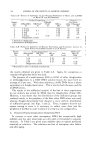
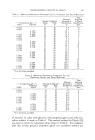
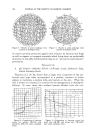
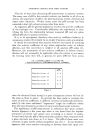
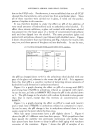
266 JOURNAL OF THE SOCIETY OF COSMETIC CHEMISTS B. Effect of ztdded Humectants on Moisture of Pulverized Callus The hygroscopicity of a substance depends inter alia on the rate of diffusion of water across the vapor-liquid interface. This rate is a function of temperature, concentration, relative humidity, depth of surface area exposed and liquid and vapor film coefficients (25). These factors in- fluence the time required for a material (at equilibrium at a given relative humidity) to reach equilibrium at another (higher or lower) relative humidity. Pilot experiments showed that 100 to 300 rag. of humectant is a convenient sample size and that this weight of sample stored in weighing bottles having an exposed surface area of 314.2 mm. 2 reaches equilibrium in a reasonable length of time. In order to determine the equilibrium moisture absorption of various humectants and their mixtures with callus, the following series of experiments was performed. Glycerol, C.P., crystalline sorbitol, propylene gl, ycol, U.S.P., and callus (Lot #2) freeze-pounded to 40 to 60 mesh, were dried to constant weight in a vacuum desiccator over P205. Duplicate samples of about 100 rag. •)f callus, 300 mg. of humectant and similar amounts of their mixture were accurately weighed into the selected weighing bottles (Parr, 20 X 24 min.). Similarly, samples of 70 per cent sorbitol, dried callus and their mixtures were prepared. All samples were then immediately stored in constant humidity chambers at 45 and 60 per cent R.H. at room temperature, as previously described. Samples of callus, glycerol and callus q- glycerol were also stored at 40 per cent R.H. at 37øC. and at 90 per cent R.H. at room temperature. The studies at 45 per cent R.H. at room temperature were also repeated with washed dried callus (Lot #2 ww, freeze-pounded to 40 to 60 mesh) and mixtures of this callus with glycerol. The callus used in these experi- ments was washed with consecutive portions of distilled water as de- scribed in section C below and dried to constant weight in vacuo over .P205. It was found that liquid humectants penetrated the powdered callus after a few hours of exposure to the humid atmosphere, and no physical mixing was required. In the experiments with crystalline sorbitol, the weighing bottle was closed and shaken to mix the components and subse- quently opened and placed in the appropriate constant humidity cham- ber. The samples were weighed daily until they reached constant weight. The equilibrium moisture sorption data obtained with unwashed callus is shown in Tables 1, 2 and 3. The reproducibility of data of this type ap- pears to be satisfactory. The variation at low equilibrium moisture con- tent is generally about 0.5 per cent, increasing to about 2 per cent at higher equilibrium moisture contents. The rates of moisture sorption by callus, sorbitol, glycerol and propylene glycol at 45 per cent R.H. are shown in the curves in Fig. 2. A comparison between the calculated and the experimentally-found moisture absorption
Purchased for the exclusive use of nofirst nolast (unknown)
From: SCC Media Library & Resource Center (library.scconline.org)