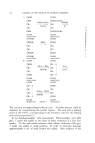
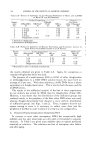
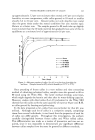
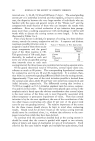
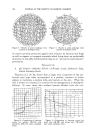
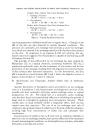
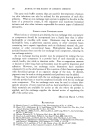
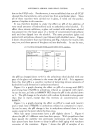
ANHYDROUS AEROSOL HAIR SPRAY SYSTEMS 307 chloric acid. He found that above 30 per cent ethyl alcohol there was an abrupt increase in pH values. This was explained on the basis of an association of the hydrogen and chloride ions according to Bjerrum's theory of ionic associations. LeBas and Day (7) measured the electromotive force in an ethanol- hydrochloric acid-water system. They used a hydrogen and an Ag-AgC1 electrode. The most significant change in e.m.f. occurred when small amounts of water were added to the pure ethyl alcohol-hydrochloric acid solyen t system. Cruse (8) states that if nonaqueous solutions are used, an additional factor is that the activity coefficients, as defined by Debye-Hiickel, depend proportionately all the more on the concentration as the dielectric constants of the solvent diminishes, as confirmed by measurements made by McInnes (9) in solutions of hydrochloric acid in water, ethanol and methanol. DII•LECTRI C CONSTANTS Water 78. 54 Methyl Alcohol 32. 63 Ethyl Alcohol 24. 30 N=Propyl Alcohol 20. 1 Figure 10. Figure 10 shows the dielectric constants of water, methanol, ethanol and N-propyl alcohol. When many pH measurements have been made in anhydrous ethanol, there is a tendency toward drifting of the measuring needle on the meter. It is therefore necessary to condition the glass electrode periodically in water. The need for some adsorbed water on the glass surfaces is well known (2), although with some lithium glasses less seems to be necessary for reproducible functioning than with the Mclnnes-Dole glass. Con- sequently, periodic soaking in water is less frequently required. Ac- cording to Dole (10), use of a glass electrode in media where the activity coefficient of water is considerably less than unity will give rise to inherent errors. However, this has been disputed by Izmailov (11) and Wynne- Jones (12) and their respective co-workers. The latter measured the e.m.f. values of cells incorporating Mclnnes-Dole glass electrodes: Pt H= [HC1. solvent Iglass electrode

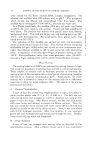
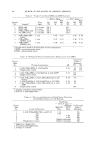
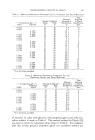
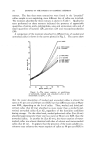
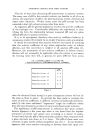
308 JOURNAL OF THE SOCIETY OF COSMETIC CHEMISTS The hydrochloric acid concentrations varied from 0.01N to 0.1N in ethanol-water mixtures. The e.m.f. values were compared with ones obtained on aqueous solutions with the same cell: the deviations from these for corresponding solutions were found to be extremely small, and much less than those predicted by the Dole theory. Now that the apparatus manufacturers can supply instruments with which the smallest direct currents can be amplified with sufficient accuracy and to an adequate extent, the glass electrode has been applied very widely as an indicator, in spite of the fact that it requires calibration and exhibits, in addition to all the basic errors involved in pH measurement, further errors peculiar to itself. Even though in organic media pH values may lie above as well as below the corresponding values in aqueous solution, there is now available a wealth of experimental and practical material concerning electrometric titrations with the glass electrode (13). This is in spite of the fact that its use (pH) in anhydrous media has been warned against from time to time and even deprecated as fundamentally unsound (14). A practical application of the measurement of pH of carbon sludges in nonaqueous systems was the finding that these values correlated with sulfur cure effects in rubber-carbon black systems. Figure 11 shows that •M in lVollowin S Liquid: Mothyl Ethyl Isopropyl Carbon W&tor Alcohol Alcohol Alcohol Micronon W-6 4. Z 3. 9 3. 7 3. 0 Furnoz 8. ß 7. S 6. 9 S. 8 Stitoz B 9. Z 10. 3 9. S 8. Z St&toz 93 ß. ß 7. 7 7. 2 &. & Giston ß. ß 8. I 7. 3 &. S Figure 11.--pH of carbon sludges in water and alcohols. the nonaqueous (alcoholic) sludge gave pronounced pH effects. Alcohols of higher molecular weights gave lower pH readings (15). Many other practical applications suggest themselves, for example alcoholic solutions of some detergents showing a pH lower than a figure set by experience or tests have corrosion properties which may be con- veniently indexed by the pH value. Stability of organic compounds could be measured in anhydrous media from pH change much more readily than in aqueous systems. Relationships between topical irritation and pH values in anhydrous systems have not been reported, although extensive work has been done in aqueous systems.
Purchased for the exclusive use of nofirst nolast (unknown)
From: SCC Media Library & Resource Center (library.scconline.org)