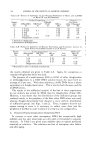
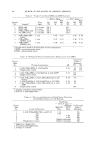
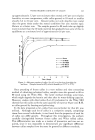
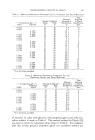
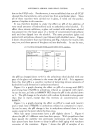
WATER HOLDING CAPACITY OF CALLUS 275 TABLE 9--MoisTURE SORPTION OF DRIED MIXTURES OF CALLUS WITH SELECTED ADDITIVES AT 60% R.H. AT ROOM TEMPERATURE Additive ---Moisture Absorbed at Equilibrium, %• Increase in Lyophilized Vacuum Dried Water Absorbed -•--at --34øC. ...... at R.T. ß ,•over Control, %• Calcu- Calcu- Lyophil- Vacuum Found lated Found lated ized Dried None (control callus) 10.10 10.50 Glycerol 9.40 lii•0f 9.95 Amino acids* 10.00 11.07 10.45 11 Sodium lactate 12.65 15.72 12.55 16 Urea 10.50 9.12 Sodium chloride 10.45 9.12 li160 Polypeptidest 10.60 10.95 11.37 11 Mucopolysaccharide:[: 10.60 10.24 10.85 10 40 nil nil O5 25.3 19.5 3.9 3.5 '518 28 5.0 8.3 57 5.0 3.3 * Hy-Case, casein hydrolysate (Sheffield Chemical Co.). •' Polypeptide 37, partial leather hydrolysate (Maywood Division, Stepan Chemical Co.). :[: Gastric Mucin. •f Based on mixtures containing 94% callus and 6% glycerol (cf. footnote page 274). water uptake of callus only slightly over that of the control sample. How- ever, it is of interest to note that sodium chloride and urea show approx- imately a 15 per cent increase in moisture uptake over calculated values. At the present, it is not known if these materials are actually potentiating moisture sorption of callus or whether these crystalline materials, on drying, rupture or alter callus and thereby change its water-holding capacity. This series of experiments also disclosed that drying of lyophilized callus in vacuo at 60øC. did not remove any water from the tissue. On the other hand, drying in vacuo at 60øC. of callus that had been stored over P•O• until constant weight was achieved removed about 2.5 per cent additional water. III. Discussion Rigorous interpretation of all the data presented above requires con- sideration of two limitations: As would be expected, the results from dif- ferent lots of plantar callus cannot be compared with each other. Instead, each group of experimental results presented in the tables or graphs above must be considered separately. Secondly, most samples of callus were dried to constant weight at room temperature over P20•. Most other investigators used less efficient desiccants, sulfuric acid (2, 3) or calcium chloride (11) being the commonest. Belatedly, it was realized that con- stancy of weight is not evidence for the anhydrous nature of callus. In- stead, callus dried in vacuo at room temperature over P205 contains about 2.5 per cent of water. This water is removed from wet callus during lyophilization or drying in vacuo at 60øC. Fortunately, the suspected presence of this water in "dry" callus is not important since, in accordance with the first limitation, comparison is made only between samples having the same moisture content at the beginning of each experiment.

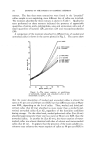
276 JOURNAL OF THE SOCIETY OF COSMETIC CHEMISTS The unexpected presence of water in "dry" callus is probably related to the findings of Watt and Kennett (37), Feughelman and Watt (38), and Algie and Watt (39) with wool fibers. These investigators found that the equilibrium dry weight of wool fibers dried in vacuo is a function of their prior water sorption history. The lowest "dry" weight is obtained by in vacuo drying of fibers which have been saturated with water. Maximum "dry" weight values are obtained by drying fibers that have been stored at relative humidity between 5 per cent and 80 per cent R.H. Presumably, the rate of drying, i.e., the time during which keratin is exposed to inter- mediate humidities, affects its final water content. Apparently, the water in keratin samples stored at intermediate relative humidities is strongly bound and cannot be removed completely, even by heating in vacuo at 140 ø C. (39). Our data demonstrates that the rate of moisture sorption is a function of the surface area and of the quantity of humectant and/,or callus exposed. Therefore, in our studies, all samples were allowed to reach equilibrium, which is independent of both surface and quantity, permitting precise calculations of the "theoretical" sorption of mixtures of callus and humectant. Our results show that the moisture absorbed by mixtures of large quantities of glycerol with callus is strictly an additive function of the water sorption properties of glycerol and callus. This finding is not in accordance with the data of Flesch (22), who reported that glycerol po- tentiated water absorption by callus. This difference may arise from the fact that Flesch determined the water uptake of sample which had not reached equilibrium. Flesch's calculations are based on a sample of glycerol that had absorbed approximately 130 per cent of water at 100 per cent R.H. Our data shows that glycerol exposed to a relative humidity of only 90 per cent absorbs 177 per cent of water at equilibrium, in close agreement with published data (24). Furthermore, glycerol exposed to an atmosphere of 100 per cent relative humidity will absorb more than nine times its weight of water (24). In our work, it required thirty-six days for a 175 rag. sample of glycerol stored in a container with a cross sectional area of 314.2 min. 2 to reach equilibrium at 90 per cent R.H. On the other hand, Flesch terminated his observations after eight days exposure at 100 per cent R.H., before equilibrium had been reached. Flesch noted the absence of potentiation at low R.H.'s, attributing it to the low moisture-holding capacity of callus. It is possible, however, that Flesch's samples, exposed at low humidities, reached equilibrium. His results under these conditions, therefore, confirm our findings. Admittedly, a glycerol q- callus mixture in the ratio of 2: 1 or 3: 1 will absorb a considerable quantity of water at high R.H.'s, literally bathing the callus in a mixture of glycerol and water. However, at low R.H's this mechanism is inoperative. Instead, glycerol will probably absorb moisture
Purchased for the exclusive use of nofirst nolast (unknown)
From: SCC Media Library & Resource Center (library.scconline.org)