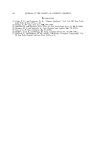
RESINS AND THEIR APPLICATION TO DRUG AND.•COSMETIC PRODUCTS 299 (10) Eugere, E. J., Lynch, V. D., and Thoms, R. K., Univ. Conn., School of Pharmacy, "The Antitrichomonal Activity of Ion Exchange Resins," private communication. (11) Eugere, E. J., Lynch, V. D., and Thoms, R. K., Univ. Conn. School of Pharmacy, "The Inhibitory Effect of an Ion Exchange Resin," private communication. (12) Richardson, G. S., and Purdy, R. H., Surg. Forum, 11,329 (1960). (13) Thurmon, F. M., U.S. Patent 2,838,440 (1958). (14) Thurmon, F. M., U.S. Patent 2,919,230 (1959). (15) Thurmon, F. M., U.S. Patent 2,883,324 (1959) (16) Thurmon, F. M., U.S. Patent 2,764,518 (1956). (17) Thurmon, F. M., U.S. Patent 2,857,311 (1958). (18) Thurmon, F. M., U.S. Patent 2,684,321 (1954). (19) Thurmon, F. M., U.S. Patent 2,653,902 (1953).

IMPORTANCE OF pH IN ANHYDROUS AEROSOL HAIR SPRAY SYSTEMS By MoRRs J. Roo'r* Presented May 8, 1962, New York City HYDROOEN •ON CONCENTRATION or activity is of importance in a large number of reactions and processes. Sorensen (1) in 1909 introduced the pH notation to avoid unwieldy decimal or power expressions. He defined pH as pH = --log•0C•+ C•+ = 10-v• We now know that a hydrogen ion's effectiveness in solution, i.e., its ability to carry electricity, act as proton donor, etc., depends on the solvent and also what is in the solution around the proton. We, therefore, find that hydrogen ions in weak solutions are more active in this respect than in strong solutions. The nearby presence of a large number of hydrogen ions sets up strong electric repulsive fields of force in the vicinity of any particular hydrogen ion which interfere with its activity. Therefore, what is important in producing acidity is not the actual hydrogen ion concentration. It is this concentration multiplied by a correction factor known as the activity coefficient of the ion. The product is called the hydrogen ion activity, and can be represented as follows: C•+ = 3' C•+ where q/is the molal activity coefficient. Therefore, according to definition, pH as actually measured by a glass electrode is as follows: 1 pHa = log Cvt•+ The pH is generally determined by measuring the e.m.f. of a circuit composed of two half cells, the reference calomel electrode and the glass electrode. The relation is given by the Nernst expression: 2.3026 RT E = E•d F log C•+ * G. Barr Co., Div. Pittsburgh Railways Co., Chicago 9, 111. 300
Purchased for the exclusive use of nofirst nolast (unknown)
From: SCC Media Library & Resource Center (library.scconline.org)