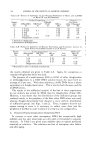
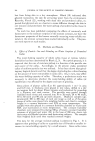
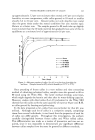
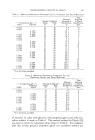
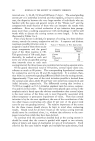
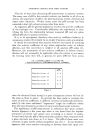
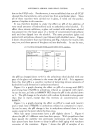
INTERPRETATION OF EYE IRRITATION TESTS 285 each of the three tissues graded at each of the six time intervals for every one of the five animals and are averaged at the bottom of the table. There would seem to be little doubt that this product is an eye irritant but the problem of assigning some distinct and succinct "irritation rating" which would quickly not only translate the over-all irritating response into a simple, readily apprehended form, but also enable comparison with results on other products, still remains. Over the years we have developed a rating system at our laboratories designed to help solve this problem. After completion of a given test the scores are analyzed and a simple, descriptive rating is assigned. At first glance, the process of analysis itself appears somewhat complex but, in essence, the basic criteria for assignment of a given rating are the extent of irritation, its persistence and the over-all consistency of the data. In our classification system, as in the actual scoring system itself, special emphasis is focused upon corneal injury and correspondingly less upon conjunctival and iridial irritation. However, we also take into account persistence TABLE 6--DESCRIPTIVE EYE IRRITATION RATINGS Class Num- Descriptive ber Rating Symbol 0 Nonirritating N 1 Practically nonirritat- PN •ng 2 Minimally irritating M• 3 Mildly irritating M2 4 Moderately irritating M• 5 Severely irritating S 6 Extremely irritating E 7 Maximally irritating Mx and consistence of response. As a result of classification, a product is assigned one of eight possible de- scriptive eye irritation ratings. These are shown in Table 6. Comparatively few cosmetic prod- ucts (or, for that matter, any other general class of products) have been assigned over the years to the "Non- Irritating" category and the same applies to the "Maximally Irritat- ing" class. Actually, cosmetic for- mulations as a whole, both experimental and commercial, tend to fall into one of the middle four classes. Some of our clients use the "Moderately Irritating" category as a "cut-off point" and reject all experimental formulations showing eye irritation greater than this from further con- sideration. The rating system we use is carried out in a series of three steps. The first two steps are shown in Table 7. Going back to the example in Table 5, the result of carrying out the first two steps in classification is the assignment of a tentative rating of "Moderately Irritating." The highest mean total score is 48.4 and this occurs at the one-hour point. The incidence of this score plus or minus five points is 100 per cent (five out of five rabbits), well over the 40 per cent requirement of Step 1. The value of 48.4 falls within the 25-50 point range for the "Moderately Irritating" class. The next step is shown in Table 8. The purpose of this third step is to

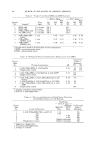
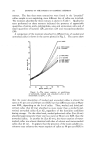
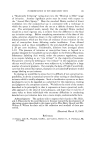
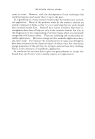
286 JOURNAL OF THE SOCIETY OF COSMETIC CHEMISTS TABLE 7--CLASSIFICATION OF COMPOUNDS BASED ON EYE IRRITATION PROPERTIES (STEPS 1 AND 2) Step ! Find the maximum, mean total score for all three tissues occurring within the first 96 hr. following instillation for which the incidence of this score plus or minus 5 points is at least 40 per cent. Step 2 Choose an initial or tentative rating on the basis of the score found in step 1 as follows: Score from step 0.0 to 0.5 points 0.5 to 2.5 points 2 5 to 15 points 15 to 25 points 25 to 50 points 50 to 80 points 80 to 100 points 100 to 110 points Tentative eye irritation rating Nonirritating Practically nonirritating Minimally irritating Mildly ir•'itating Moderately irritating Severely irritating Extremely irritating Maximally irritating For borderline scores choose the higher rating ensure that certain requirements are met before permitting a tenlalive rating (developed from Steps 1 and 2) to become a final rating. In the example cited (Table 5) the tentative rating selected was "moder- ately irritating." This class is symbolized by "M•" in Table 8 and it is seen that two requirements must be met before this tentative rating may become final. The first requirement is that the mean total score for the seven-day scoring interval may not exceed 20 points if the rating is to be maintained. The second requirement pertains to the incidence of the individual rabbit scores. The requirement states that individual total TABLE 8--CLasSIFICATION OF COMPOUNDS BASED ON EYE IRRITATION PROPERTIES (STEP 3) Tentative Rating Requirement for Maintenance N MTS24 = 0 for MTS24 0, raise one level PN As for N M• MTS4s = 0 for MTS4s 0, raise one level M2 MTS90 = 0 for MTSga 0, raise one level Ma (1) MTS _ 20 for MTS 20, raise one level (2) ITSs _ 10 (60%) if not true then no rab- bit may show ITSs 30 otherwise raise one level S (1) As for Ma except use MTSs _ 40 (2) As for Ma except use ITSz _ 30 (60%) and 60 for high E (1) As for Ma except use MTS _ 80 (2) As for Ma except nse ITS• _ 60 (60%) and 100 for high Mx (1) MTS 80 (60%) for MTSf _ 80, lower one level (2) ITS 60 (60%) otherwise lower one level Symbols: MTS = Mean total score. ITS = Individual rabbit total score. Subscripts denote scoring interval: 24, 48 or 96 hr. f = final score (7 days).
Purchased for the exclusive use of nofirst nolast (unknown)
From: SCC Media Library & Resource Center (library.scconline.org)