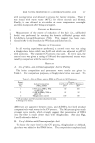
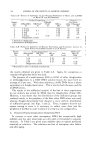
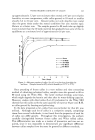
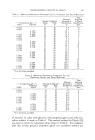
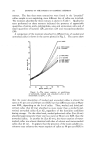
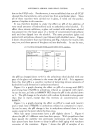
WATER HOLDING CAPACITY OF CALLUS 273 some cases. However, enhancement of this type is not observable at lower R.H.'s (60 per cent or less). D. lt/ater Sorption of Substances I4/hich Occur Naturally in Skin and Their Effect on Callus Spier and Pascher (4-9), Szakall, et al. (12, 13), Flesch and Esoda (31), Dowling and Naylor (32), Roe, et al. (33), Matoltsy and Balsamo (34, 35) and Bolliger and Gross (36) have studied the composition of the water- soluble fraction of back scrapings, callus, skin strippings and scalp flakes. While in most instances these inves- TABLE 7--WAwv. Sov. vvso• or WAVEU SOLUBLE CALLUS EXTP. AeTS AT 60% R.H. A'r 23 ø m 2øC. Extract Derived from Water Absorbed, % Pounded callus (from Lot #2 23.2 ww + 5 ww combined) Wiley milled--water extracted 23.3 (from Lot #3 ww) Wiley Milled--solvent/water 22.0 extracted (from Lot #3 sw) TABLE 8--MoIsTURE SORPTION OF SELEOTED "NAvt•aAL" CALLt'S COMPONENTS AT 60% R.H. aT 23 ø + 2øC. Component Moisture Sorption at Equilibrium, %. Amino acidst 19.5 Sodium lactate 66.0 Urea nil Sodium chloride nil Polypeptides:• 18.3 Mucopolysaccharide:f 1 l. 2 Glycerol 33.8 Propylene glycol 31.9 * Average of two samples, calculated on dry weight of material. t Hy-Case, casein hydrolysate, Sheffield Chemical Co. $ Polypeptide 37, partial leather hydrol- ysate, Maywood Div., Stepan Chemical Co. •f Gastric Mucin. tigators did not attempt to make a complete analysis, there is good qualitative agreement concerning the nature of the bulk of the water- soluble components (section C above). The major constituents include amino acids, factares, urea, inorganic salts and water-soluble polypeptides, and their ability to absorb moisture seems to have con- siderable practicalimportance. Al- though penroses, hexoses, hexos- amines, mucopolysaccharides, uric acid, creatinine, guanine, purines, citrates and formates were also iden- tified, their concentration appears to be too low to have an appreciable effect on moisture absorption. It seemed of considerable interest to evaluate the hygroscopicity of these materials. It seemed still more im- portant to determine whether the addition of one of these naturally occurring substances could alter the water sorption of washed callus. Samples of mixed amino acids,* sodium lactate, urea, sodium chloride water-soluble polypeptides,t and gastric mucin (representing a muco- polysaccharide) were dried to constant weight in a vacuum desiccator at room temperature over P20•. These materials were then stored in a constant relative humidity chamber at 60 per cent R.H. at room tem- perature until they reached constant weight. * Hycase, a casein hydrolysate, Sheffield Chemical Co. t Polypeptide 37, a leather hydrolysate, Maywood Div., Stepan Chemical Co.

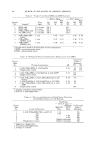
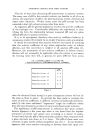
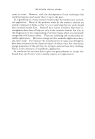
274 JOURNAL OF THE SOCIETY OF COSMETIC CHEMISTS In order to study the effect of these additives on the water sorption of callus, 40 mesh pounded callus (Lot #6 ww) was thoroughly washed with distilled water at room temperature, as previously described, until the washings gave negative ninhydrin and biuret tests. The callus was dried to constant weight in a vacuum desiccator over P205 and subdivided into aliquots. Duplicates of each aliquot were treated with 10 per cent by weight of one of the following additives: glycerol, amino acids, poly- peptides, gastric mucin, sodium lactate, urea and sodium chloride. E.no. ugh distilled water was added to the callus to facilitate wetting and m•xmg. A control sample was also prepared, using callus and water alone. One set of samples was lyophilized at -34 ø C., and the other set was dried to constant weight in a vacuum desiccator at room temperature over P205. Each mixture was then screened through a 40 mesh screen, and the samples of each mixture and of each drying method were further dried to constant weight at 60 ø C. under vacuum. These samples were then placed in a constant relative humidity cham- ber at 60 per cent R.H. at room temperature until they reached constant weight. The amounts of water absorbed by each of the "synthetic" substitutes of naturally occurring skin components and the water sorption of glycerol and propylene glycol under the same conditions are shown in Table 8. It is noted that sodium lactate absorbs far greater quantities of water than any of the other major water-soluble components of the stratum comeurn. This material also absorbs more water than glycerol or propylene glycol under the same conditions. The results of water sorption studies at equilibrium of mixtures of washed callus and the indicated additives are presented in Table 9. The calculated values were obtained as above, following the method of Flesch (22). Since each sample contained 91 per cent of callus and 9 per cent of anhydrous additive, the moisture sorption of the mixtures can be compared with each other. The last two columns of Table 9 were calculated from the following formula to facilitate this comparison: 100 X [% absorbed by mixture - % absorbed by callus] % absorbed by callus -- % increase in water absorbed Sodium lactate, even when present at only 10 per cent of callus weight, greatly increases the water sorption of callus. However, the water sorption found for the callus-lactate mixture was much lower than the theoretical value. Glycerol, at this low concentration, interferes with and reduces the moisture sorption of callus. Although glycerol was found to be volatile,* this conclusion is still true because the samples studied at 60 per cent R.H. still contained 94 per cent callus and 6 per cent glycerol. Sodium chloride, amino acids, urea, polypeptides and a mucopolysaccharide increase the * It was observed that a portion of the glycerol is lost in the vacuum drying techniques used in preparing the callus + glycerol mixtures. The correction for this loss, which yields callus + glycerol mixtures containing 94 per cent of callus and 6 per cent of glycerol, has been made in the calculated moisture absorption value in Table 9.
Purchased for the exclusive use of nofirst nolast (unknown)
From: SCC Media Library & Resource Center (library.scconline.org)