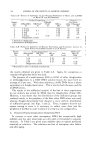
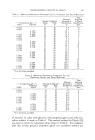
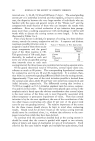
INTERPRETATION OF EYE IRRITATION TESTS 287 scores for at least 60 per cent of the rabbits should be 10 points or less and in no case may any individual rabbit's total score exceed 30. If either or both of these two requirements are not met (the one relating to the mean total score and the other to the individual Zola/scores for the rabbits) then the tentative rating must be raised one level and the higher level becomes the final razing. With the above in mind the example cited in Table 5 may now be classi- fied for a final rating. It will be seen at once that the first requirement for maintaining the tentative assignment of "Moderately Irritating" is not fulfilled, namely, the mean total score at the seven-day point exceeds 20 points. Actually it is not necessary to proceed any further and the final rating becomes '•Severely Irritating," the next-highest class. However, it may be noted in passing that the second requirement is also not met. Not only are the individual total scores at seven days for all five rabbits (100 per cent) greater than 10 but the score for Rabbit No. 2 actually exceeds 30. The final rating of "Severely Irritating" more properly describes the irritancy produced by this product than would the phrase "Moderately Irritating." First of all, a high order of irritation was produced during the first hour, the magnitude being over 40 per cent of the theoretical maximum. Secondly, the degree of irritation had not changed noticeably by the twenty-four-hour point and decreased only slowly thereafter. Even at the end of seven days, iridial irritation was still maximum for all rabbits and conjunctival irritation had not dropped even 50 per cent relative to the one-hour value. It is true that corneal scores did drop to practically one-third of the one-hour value and that there was good evidence that no permanent eye injury would result. However, a product producing ir- ritation on this scale and for this time length could scarcely be described as only a "moderate eye irritant." The foregoing, rather detailed analysis has been developed as an aid to both our clients and to ourselves. Although at first sight apparently laborious, familiarity through practice readily enables an investigator to classify irritants quite rapidly, within a matter of seconds for most compounds. The system is by no means foolproof. It has been altered several times in the last few years and will undoubtedly be modified again. It is, nevertheless, a practical, workable system yielding results that enable product inter-comparisons to be made both more quickly and easily as opposed to comparisons of raw eye irritation scoring data. Before proceeding to illustrate the range of eye irritation typical of some general types of cosmetic products, it is worth observing that the test we have been discussing is not to be thought of as one whose results are necessarily the exact equivalent of those which might be expected following actual accidental contact of the test agent with the human eye. The basic test we have discussed is, comparatively speaking, a very strin-

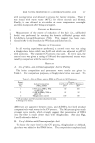
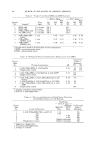
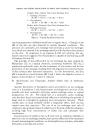
288 JOURNAL OF THE SOCIETY OF COSMETIC CHEMISTS gent one and eye irritation following human ocular contact may be consider- ably reduced in intensity depending upon the particular circumstances involved. In a sense, we are attempting, via this rather rigorous rabbit test, to assess the maximum ocular irritation which might be produced in man. Assessment of the practical hazard is another matter and follows from knowledge of additional factors, particularly the applicable use condi- tions. In any case, however, the practical industrial hazard should never be evaluated so/ely under what might be termed the purely practical conditions of use any more than a new drug is studied toxicologically in lower animals only under the dosage conditions of intended human use. For safety's sake, the effect of abnormally high amounts of the drug must be known and, by the same token, an estimation of maximum eye irritation should be elicited on a cosmetic product. Once this is known, modifications of the basic stringent test may be made as applicable,to render it less rigorous and to assess more realistically the irritation which may be anticipated under actual use conditions. In particular, rinsing the treated eyes with water at specified time intervals following instillation may be quite critical. In many cases of course, additional testing may not be necessary and the "practical hazard" can be estimated based upon the results of the more rigorous test alone and logical considerations drawn therefrom. The results of applying our classification system to a sampling of each of three general types of cosmetic products are shown in Table 9. These data were abstracted from our records over the past eighteen months. We did not analyze all of the data at our disposal but rather took only a sampling from each category for illustrative purposes. However, the results provide a •easonably good idea of the range of eye irritation pro- duced by the product types. As may be seen, undiluted products fall for the most part into "Moder- ately Irritating" category (M3). The effect of dilution is illustrated by the "Anti-Dandruff Rinses, Shampoos and Sprays" where dilution brings T^a•,E 9--EYE IRRITATION DATA ON COSMETIC PRODUCTS General Type of Product Number Class Tested Mean Eye Irritation Data Per Cent Free of Descriptive Irritation Rating At 24 Hr. I. Anti-Dandruff Rinses, Shampoos and Sprays A. Tested undiluted B. Tested diluted II. Shampoos III. Aerosol Hair Sprays A. Draize instillation (undiluted) B. Spray instillation (undiluted) 41 4.2 21 2.4 77 4.2 22 4.5 13 3.5 MR+ 5 Mt to M2 28 MR+ 4 Ma to S 0 M,, to Ma 0
Purchased for the exclusive use of nofirst nolast (unknown)
From: SCC Media Library & Resource Center (library.scconline.org)