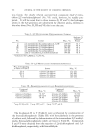
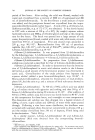
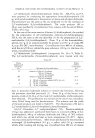
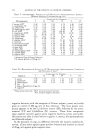
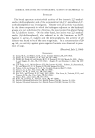
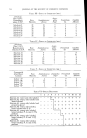
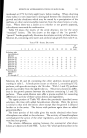
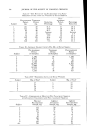
CHEMICAl. STRUCTURE AND ANTIMICROBIAL ACTIVITY OF BIS-PHENOLS 721 2,2'-Melhy/enebis (bromodich/orophe•o/s) (Table II). IIA, IVA, and VA were prepared by condensing the appropriate bromodichlorophenols (50 g.) with paraformaldehyde in the presence of oleum and ethylene dichloride. The procedure was the same as the one employed (1) for the synthesis of 2,2'-methylenebis (4,5,6-trichlorophenol). The crude products (49 to 50 g.) were purified by crystallization from toluene with the aid of Filtrol. Yields: 29 to 31 g. In the case of the more reactive 4-bromo-3,5-dichlorophenol, the method for the preparation of 2,2'-methylenebis (4-bromo-3,5-dichlorophenol), III A, was the same as the one described (1) for the preparation of 2,2'- methyleneNs (3,4,5-trichlorophenol). From 72 g. of the bromodichloro- phenol, 16.7 g. of an acetone-insoluble by-product and 49.7 g. of crude, III A, m.p. 201-202 ø, were obtained. Crystallization from 400 ml. of toluene, with the aid of Filtrol, yielded the pure substance (32.2 g.) in the form of a white, crystalline powder. 2,2'-Methylenehis (dich/orophenols) (compounds No. II to V, Table I). The 2,2'-methylenebis (bromodichlorophenols) were treated with zinc TABi, E IV Crude Yields Compounds of Pure (22-23 g.) Compounds No. Solvents for Crystallization (g.) II mixture of 100 ml. of toluene 16.7 100 mi. of hexane 50 mi. of p-dioxane III mixture of 220 ml. of toluene 15.4 110 ml. of hexane IV 1) 150 mi. of aqueous alcohol (60% by vol.) 11.2 2) 225 ml. ofhexane V 1) 75 mi. of toluene 9.8 2) 25 mi. of methanol dust in potassium hydroxide solution to remove the bromines, following the procedure described previously (1). From 34 g. of the bromo com- pounds, yields of 22-23 g. of the crude 2,2'-methylenebis (dichlorophenols) were obtained. The purification was carried out by one or two crystalliza- tions, Filtrol being used for decolorization. The solvents and the yields of the pure products are listed in Table IV. The chlorination of II led to 2,2'-methylenebis (3,4,6-trichlorophenol), hexachlorophene. 3,¾,¾',5'- Tetrachloro - 2,2' - methylenedipheno/ (VI). Paraformaldehyde (7.6 g.) was added over a period of three hours to a mixture of 80 g. of 3,4- dichlorophenol, 160 g. of ethylene dichloride and 100 g. of 78% sulfuric acid which was stirred and kept at room temperature (25-28ø). Agita- tion was continued for 18 hours. After steam distillation for the removal of unchanged 3,4-dichlorophenol (4.3 g.), a yellow solid (76 g.) remained which, after washing and drying, was crystallized from 280 ml. of toluene

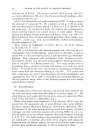
722 JOURNAL OF THE SOCIETY OF COSMETIC CHEMISTS with the aid of Filtrol. The product obtained (26.6 g., m.p. 190-195 ø) was recrystallized from 280 mi. of the ethylene dichloride yielding a white, crystalline powder (16.2 g.). 3,4,4',$',6,6'-Hexach/oro-2,2'-methy/enedipheno/(VII). In order to prove the structure of compound No. VI, a solution of 2.3 g. in 30 mi. acetic acid was chlorinated by slowly adding a solution of 1 g. of chlorine in 50 mi. acetic acid. At the end of 4 hours, the solution was concentrated to about one-third volume and a small amount of water added. The pre- cipitate was filtered, washed with water and dried 2.8 g. m.p. 148-151 ø Recrystallization from ethylene dichloride gave fine, white needles, m.p. 162-163ø mixed m.p. with 2,2'-methylenebis (3,4,6-trichlorophenol), hexachlorophene 135-142 ø. Anal. Calcd. for CjaH602Cla: C, 38.76 H, 1.5 C1, 52.32. Found: C, 38.71 H, 1.6 C1.52.13. As VII is not identical with hexachlorophene and could not be 2,2'- methylenebis (4,5,6-trichlorophenol) which melts at 220-222 ø, it was as- sumed that it is the asymmetrical 3,4,4',5',6,6'-hexachloro-2,2'-methylene- diphenol. This substance was synthesized from 2-hydroxy-3,5,6-tri- chlorobenzyl alcohol (11) and 2,3,4-trichlorophenol, following the proce- dure of example 1 of a British patent (12). The crude product was re- crystallized from a mixture of hexane and toluene (2:1) with the aid of Filtrol. It melted at 161-162 ø and showed no melting point depression when mixed with the substance melting at 162-163 ø . This proves that both compounds are 3,4,4',5',6,6'-hexachloro-2,2'-methylenediphenol and consequently, that VI is 3,4,4',5'-tetrachloro-2,2'-methylenediphenol, as the 6,6'-positions being ortho to the hydroxyl groups are most readily substituted by chlorine. Microbiological. The preparation of the stock solutions, the twofold serial dilutions and the solid and liquid media were described in a previous paper (1). The serial dilutions were made with the aid of an automatic apparatus (Dilu- mat © , Fisher Scientific Co., Bloomfield, N.J.). Where solid media were employed, 25 mi. aliquots (48øC) were dis- pensed into the appropriate sets of serial dilution tubes using a Brewer automatic pipette (Baltimore Biological Laboratories, Baltimore, Md.). The contents of the tubes were poured into sterile Petri plates the hard- ened agar was then surface-inoculated with one drop (0.007 mi.) of a cul- ture by means of an Accu-Drop dispenser (Scientific Products, Flushing, L. I., N.Y.). The liquid medium was inoculated in bulk at the rate of 0.5 mi. culture per 1. of medium after which 25 mi. aliquots were aseptically dispensed with the Brewer pipette into the serial dilution tubes and the contents then transferred aseptically to 125 mi. Erlenmeyer flasks.
Purchased for the exclusive use of nofirst nolast (unknown)
From: SCC Media Library & Resource Center (library.scconline.org)