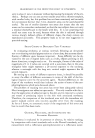
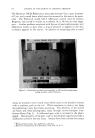
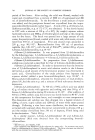
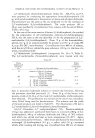
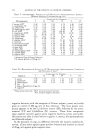
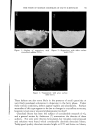
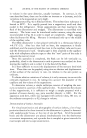
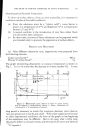
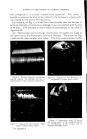
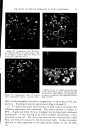
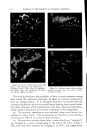
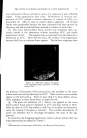
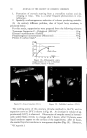
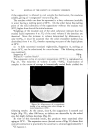
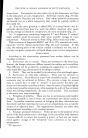
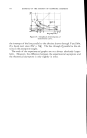
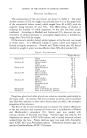
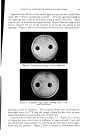
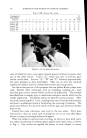
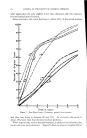
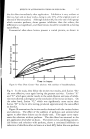
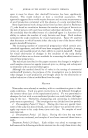
THE STUDY OF SURFACE ANOMALIES OF FATTY SUBSTANCES 735 Figure 10. -Suppository after 48 hcurs the circinate defects are always black they are analogous to those found by Vaeck (5) in the use of chocolate (12X). Figure 11. Suppository after 72 hours black excrescences always develop (12X). Figure 12 and 13.--Suppository after :240 hours white forms appear very fine crystals are involved these defects are excrescences, not holes, as shown by the tangential view of Fig. 13 (12X). light and photographed normally or tangentially to the surface of the sup- pository. The observations are reproduced in Figs. 6 through 15. (c) To specify the origin and formation of these surface anomalies, the following experiment was conducted: The above mixture is melted at 80øC. A glass rod (diam. 10 mm.) is dipped into the liquid and withdrawn immediately. A thin coating of fat which solidifies immediately is thus deposited on the rod. The rod is then inserted into a hermetically sealed flask, and the latter is placed in the thermostatic bath. Surface anomalies identical to those appearing on the suppositories appear on the rod (Fig. 16).

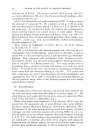
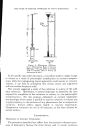
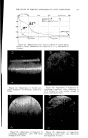
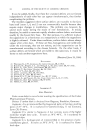
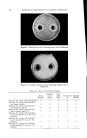
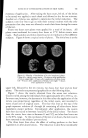
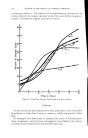
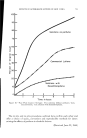
736 JOURNAL OF THE SOCIETY OF COSMETIC CHEMISTS Figure 14 and 15. Suppository after 648 hours the formation of excrescences is completed (12X) 40X (Fig. 1.5) magnifica- tion shows that the proportion of white crystals has slightly increased. Figure 16.--Surface defects of fat solidified rapidly on glass rods: (a) after 3 hours (b) after 17 hours. This finding eliminates the possibility of fluid or pasty exudates coming from inside the substance examined, for glass at constant temperature does not change volume. It is, therefore, necessary to consider that the circinate ring defects are due to crystallization starting from crystal nuclei. It is likely that part of the liquid phase of the fatty substance crystallizes, which would correspond to an increase in hardness of the suppository. (d) The previous experiments were repeated, using cocoa butter con- taining no carbon black. The excrescences are identical to the previous ones but more difiqcult to see due to their whiteness. (e) The previous mixture (cocoa butter--carbon black) was "tempered," i.e., brought to a state corresponding to the end of the curve of Fig. 5. The mass was then softened by bringing it to 28øC, and suppositories
Purchased for the exclusive use of nofirst nolast (unknown)
From: SCC Media Library & Resource Center (library.scconline.org)