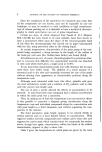
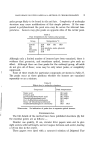
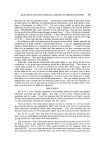
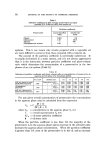
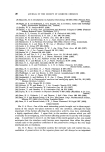
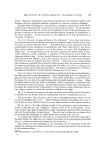
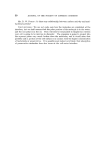
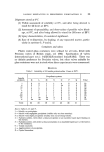
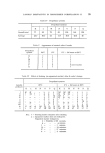
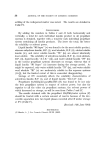
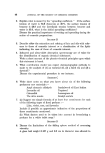
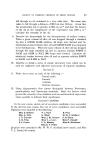
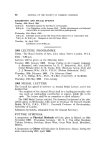
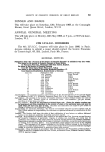
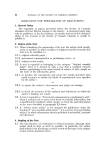
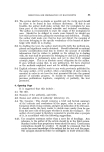
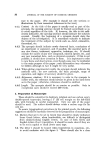
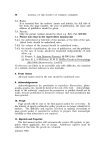
18 JOURNAL OF THE SOCIETY OF COSMETIC CHEMISTS Table I Partition coefficient at 25øC of some preservatives in liquid paraffin (S.G. 0.830 to 0.870) and arachis oil Preservative Phenol Chlorocresol Thymol Phenylmercuric acetate Partition coefficient Liquid paraffin/ water 0.067 1.53 0.23 Arachis oil/ water 5.6 116.7 447 systems. This is one reason why creams prepared with a vegetable oil are more difficult to preserve than those prepared with a mineral oil. The concept of the partition coefficient is universally understood. It is usually determined in a static system, and it is not always appreciated that it is the interaction between partition coefficient and phase-volume ratio which determines the concentration of a preservative in the two phases of an o/w system (Table II). Table II Influence of partition coefficient and phase-volume ratio on concentration of preservative in aqueous and oil phase of a two- )base system Køw at 25 ø Oil/water ratio 0.2 1.0 2.5 5.0 10.0 , 0.4% w/v phenol in liquid Preservative in oil % 0.031 0.050 0.080 0.080 0.176 paraffin/water dispersions 0.067 ,, ,, water % 0.474 0.750 1.199 1.799 2,636 -- 1% hypothetical .... oil % 1.000 1.000 1.000 1.000 1,000 preservative 1.000 ,, ,, water % 1.000 1.000 1.000 1.000 1.000 4.0% w/v chlorocresol in ,, ,, oil % 22.96 7.93 5.60 4.79 4.40 arachis oil/water dispersions 116.7 ,, ,, water % 0.197 0,068 0.048 0.0411 0.038 For any given overall concentration of preservative the concentration in the aqueous phase may be calculated from the expression cw =c (0+l) (Køw0 + 1) where C w = concentration in the aqueous phase % w/v C ---- overall concentration % w/v Køw = oil:water partition coefficient 0 -- oil:water ratio When the partition coefficient is less than 1.0, the majority of the preservative is in the aqueous phase and an increase in the oil:water ratio increases the aqueous phase concentration. When the partition coefficient is greater than 1.0, most of the preservative is in the oil, and an increase

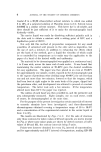
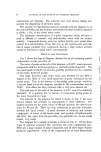
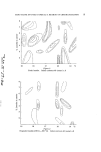
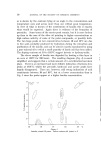
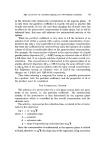
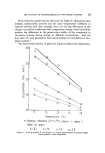
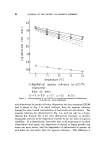
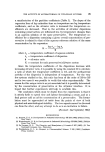
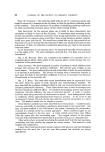
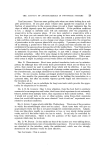
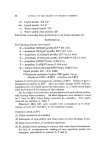
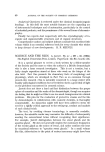
THE ACTIVITY OF ANTIBACTERIALS IN TWO-PHASE SYSTEMS 19 in the oil:water ratio reduces the concentration in the aqueous phase. It is only when the partition coefficient is exactly 1.0-and in practice this is only very rarely, if ever, the case-that changing the oil:water ratio has no effect on the preservative concentration in either phase, but as will be indicated later, this may still influence the antimicrobial activity of the system. When the partition coefficient is very close to 1.0 the inclusion of an amount of oil within a system with a given overall concentration of pre- servative has only a very small effect on the aqueous phase concentration, but when the coefficient is far removed from unity the inclusion of a similar volume of oil has a considerable effect on the aqueous phase concentration. For example, the concentration of phenol in the aqueous phase of a liquid paraffin/water dispersion (Køw = 0.067) having an oil:water ratio of 10.0:1.0 is 6.6 times that of an aqueous solution of phenol of the same overall con- centration. The concentration of chlorocresol in the aqueous phase of an arachis oil/water dispersion (Køw = 116.7) having the same oil:water ratio ' that of the aqueous solution with the same overall concentration. is only m For dispersion having an oil:water ratio of 0.2:1.0 the corresponding changes are 1.2-fold and 1/20.4-fold respectively. Thus when selecting a compound for study as a possible preservative for a product, both the partition coefficient, and the proportion of oil in the product must be considered. THE INTERF^CIAL F^CTOR The selection of a preservative for a two-phase system fixes one para- meter of the system, i.e. the partition coefficient. The antimicrobial activity of the preservative is then determined by the aqueous phase concentration which is controlled by the overall concentration and the oil:water ratio. The activity, expressed as the extinction time, is related to the oil:water ratio by the expression ogt = where t = extinction time : A = constant 0 = oil:water ratio p = slope of regression log extinction time on • Since the concentration of antibacterial in the aqueous phase is related to 0 and, therefore, to •½/O, the slope of p of the regression of log extinction
Purchased for the exclusive use of nofirst nolast (unknown)
From: SCC Media Library & Resource Center (library.scconline.org)