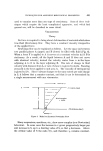
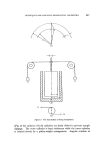
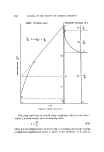
THIN-LAYER CHROMATOGRAPHIC TECHNI•)UES IN RESIDUE ANALYSIS 471 means of preparing pure specimens of substances available in limited quantity. Where larger samples are required the usual 250 • thick layer is inadequate as its acceptable load is limited. Increasing this thickness to 1 mm or more assists considerably (31), but many 20 x 20 cm chromatoplates must be developed to obtain reasonable quantities, accept- able loads being 5 to 25 mg/1 mm thickness of adsorbent. Equipment has now been described (32) which employs carrier plates 1 m long by 20 cm wide on which layers up to 4 mm thick can be spread, either by a moving spreader of increased capacity or by "casting" the layer in situ within a framework. Apparatus using carrier plates 40 x 20 cm has been advocated by Stahl (33). In practice 2 mm thick layers have been found to possess optimum properties in respect of ease of preparation, adhesion of the layer and uniformity of resolution. Samples are applied as a streak along one edge of the chromatoplate and up to 5 such plates may be developed at one time in a stainless-steel tank multiple runs are frequently necessary to obtain suitable resolution. Fluorescent indicators are used as visualization agents since they do not affect the separated compounds. The observed bands are marked under UV illumination, scraped from the carrier plate and extracted with a suitable solvent to recover the purified specimen. In this way very pure materials can be obtained, up to 1 g per chromatoplate being a practical amount provided that good resolution from associated impurities is obtained. When using thin-layer chromatoplates for pesticide preparative purposes on a micro-scale, with a view to subsequent electron-capture gas-chromato- graphic examination, it is preferable to pre-extract the adsorbent with ether to remove interfering impurities before spreading the layer. Several solvents may be used to elute the pesticide from the layer adsorbent after developing the chromatogram. In general, hexane is the solvent of choice for organo-chlorine pesticides, while for the elution of organophosphorus pesticides dichloromethane has been found preferable, recoveries ranging from 70 to 100% at levels from 10 to 80 •g (34). Wedge-layer chromatography The advantages of the greater acceptable load of thick preparative chromatoplates and the high R F values and greater resolution of thin (100 •) layers have been combined in the properties of wedge-layer chromatoplates which were designed for residue clean-up purposes (35). In this develop- ment the cross-section of the spread layer is not uniform but it is wedge- shaped, tapering from 2 mm to less than 100 •. Such layers are spread

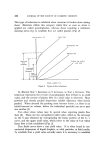
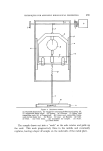
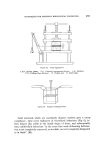
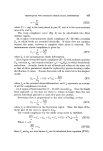
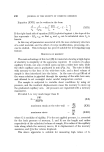
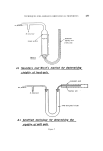
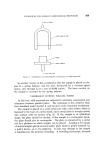
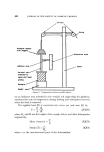
472 JOURNAL OF THE SOCIETY OF COSMETIC CHEMISTS by simple adaption of commercial layering apparatus. For the Desaga spreader a Perspex trapezium, 210 mm long with vertical sides of 40 and 38 mm, replaces the normal calibrated applicator plate. Other models of spreader are more simply adapted by adjusting the smoothing edge to feeler gauges of different thickness at either end, a sloping edge being thus ensured. In use the sample extract is applied as a streak parallel to the edge of the chromatoplate at which the layer is thickest and about 2 cm from it. After a further period of activation to ensure maximum clean-up the chromatogram is developed by the ascending-solvent techniques in the usual way. The use of this technique in the determination of traces of dinoseb has been described (36) the procedure has also been shown to be suitable for organo-chlorine and organo-phosphorus pesticides whose R•, values on silica gel are normally at least 0.50 when developed with a fairly non-polar solvent. This system is particularly of value where the ratio of co-extractives to pesticide residues is high. Wedge-layer chromatoplates composed of silica gel G, alumina G and kieselguhr G and mixtures of any two of these materials have been prepared and examined for pesticide residue analysis. Mixtures of silica gel with either alumina or kieselguhr were prone to cracking across the wedge, though this was without any marked effect upon their chromatographic properties. Alumina and kieselguhr appeared to be of closer physical properties and mixtures of these materials did not show this cracking they also showed useful adsorptive characteristics. Multi-band chromatography The use of multi-band or paneMayered chromatoplates has proved very useful both for diagnostic and for clean-up purposes (37). By inserting close-fitting partitions of suitable materials, e.g. PTFE, cork, aluminium, etc., into the body of the spreading apparatus it is possible to prepare chromatoplates composed of 2, 3 or 4 parallel panels of different adsorbents. Suitable positioning of the partitions enable panels of various widths to be layered on appropriate areas of the carrier plate. The fluid mixes of adsorbent are prepared in the usual way and are poured simultaneously into the required compartment, the assistance of a second operator being required if more than two panels are to be layered. Panel-layered plates can obviously be developed in two distinct ways. By spotting the sample and a known standard onto each of the panels and developing vertically up the bands, a useful diagnostic system is
Purchased for the exclusive use of nofirst nolast (unknown)
From: SCC Media Library & Resource Center (library.scconline.org)