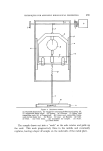
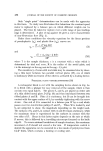
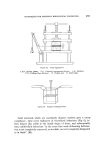
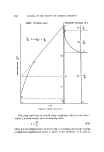
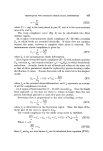
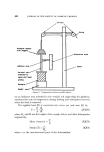
THIN-LAYER CHROMATOGRAPHIC TECHNIQUES IN RESIDUE ANALYSIS 473 apparent. In this way it is possible to compare R F values on several adsorbents developed in one mobile solvent under identical conditions of time, temperature, solvent-vapour equilibrium, etc. Including a known dyestuff, with both sample and standard, as a reference material makes it possible to correct R F values for any hold-up due to co-extractives. Under these conditions relationships between the corrected R F values on, say, three different adsorbents may be taken as indicative of the identity of the unknown compound, this being more positive than using one adsorbent only. The second manner of use, i.e. development across the panels, adds to the usefulness of these chromatoplates. Sequential elution from a highly adsorptive layer onto a less active panel enhances the general resolution of compounds and is valuable for clean-up purposes. An opposite effect is observed when developing from an adsorbent of low activity to a more adsorptive material. This similarly has uses in limiting the likely position of unknown compounds on the chromatoplate, a tight band being formed at the junction of the two adsorbents. Thus by suitable choice of the composition and positioning of the individual panels, separations can be enhanced or condensed at will. A combination of these two modes of operation also has useful prop- erties. By choice of a suitable mobile solvent it is possible to separate the pesticides from co-extractives by development along a silica gel panel. By turning the plate through 90 degrees and developing in a more polar solvent on to an alumina panel, mixtures of pesticides can be separated in a clean state. Gradient-layer chromatography A novel variant of the "moving-spreader" layer applicator has been introduced by Stahl (38). With this apparatus it is possible to prepare layers of uniform thickness which are graded from pure adsorbent A at one side to pure adsorbent B at the other, intermediate zones consisting of varying mixtures of the two materials with a 1:1 composition in the centre. By developing the chromatoplate from reagent A to reagent B, separations may be enhanced or minimized according to which adsorbent is the more active. In this way its action is somewhat similar to a bi- partite multiband-plate prepared as described above, although it shows considerably less versatility in that only two adsorbents are used. How- ever, its main use would appear to be as a research tool in investigating the retention characteristics of mixtures of two adsorbents in varying

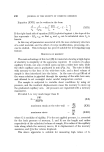
474 JOURNAL OF THE SOCIETY OF COSMETIC CHEMISTS ratio, by applying a series of spots of the material under examination across the plate from reagent A to reagent B and developing in such a way that each spot migrates along a lane of constant composition. By examination of such chromatograms a suitable admixture may be chosen which will effect the desired separation. Preparation and application of sample extract Extraction and clean-up Thin-layer chromatographic procedures are, in general, much more tolerant of co-extracted materials than are paper or gas-liquid chromato- graphic systems. The intrinsic clean-up properties of the layer materials most frequently employed, silica gel and alumina, render minimal the amount of purification of the extract required. Morley and Chiba (39) have proposed a method for the direct thin-layer chromatography of organo-chlorine pesticide residues in some plant extracts without prior clean-up, samples showing possible pesticide content then being further examined by gas-liquid chromatography. This system simplifies the pro- cedure greatly, eliminates some possible sources of pesticidal loss and extraneous contamination, and allows the rapid screening of a large number of samples. Unfortunately its application is rather limited although the introduction of an acetonitrile-hexane partition procedure as a clean-up improved the chromatoplate's background and allowed the method to be used for a wider range of compounds. For samples of vegetable origin, the extraction and clean-up procedure of Goodwin, Goulden and Reynolds (40) is often suitable when organo- chlorine pesticides are under examination. Extraction with acetone followed by partition into hexane, after adding sodium sulphate solution, yields a solution sufficiently clean for gas-liquid or paper chromatography and well suited for application to a thin-layer chromatoplate. When examining samples of waxy vegetables or ripe fruit in this way, the extracts are not suitable for the former two techniques but may still be used for thin-layer chromatography. Organo-phosphorus pesticide residues may be suitably extracted from vegetable tissue with a mixture of ethyl methyl ketone and hexane (3 + 2 V/v ) (41). Dinitrophenol herbicides have similarly been extracted with ethyl methyl ketone: ether, 3 q- 2 (36). For the efficient extraction of pesticides from fatty materials a solvent such as hexane is essential. This, of course, also dissolves a considerable amount of the fat and although thin-layer chromatography is fairly tolerant of vegetable co-extractives, fatty or waxy materials may affect
Purchased for the exclusive use of nofirst nolast (unknown)
From: SCC Media Library & Resource Center (library.scconline.org)