J. Soc. Cosmetic Chemists, 18,575 589 (Sept. 16, 1967) Torsional Properties of Hair Relation to Permanent Waving and Setting in HERMAN BOGATY, B.S.* Presented November 30, 1966, New York City Synopsis--Hair on the head frequently exhibits the form of a helical coil. The physics of ideal coils are described the performance of hair curls in the waving and setting context is qualitatively analogous to the engineering spring theory in respect to the effects of fiber diameter, coil radius, and torsional stiffness of the hair. Torsional properties of waved and unwaved single fibers were studied by two methods and over a wide range of humidities results are given. Torsional stiffness and mechanical creep of hair are shown to be very sensitive to moisture. Predictions from spring theory are in general agreement with ex- perience with hair, although the complex geometry of a hair coil and the deviation of hair from ideal elastic behavior prevent a quantitative treatment. INTRODUCTION A considerable amount of scientific progress has been made in the understanding of hair as a chemical and biological material, and a good deal of this knowledge has been utilized in sound technological developments such as permanent waving. While the chemist has under- taken to study hair waving in terms of chemical reactions, the consumer has practiced it widely because of the desirable alteration in physical properties in producing an effective foundation for setting and styling and for enhancing the physical stability of her style. This paper presents one means for viewing the physics of some aspects of the waving and setting process. It is intended to suggest that * The Toni Co., Chicago, Ill. 60654. 575

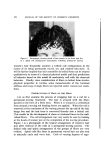
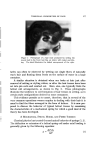
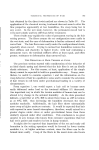
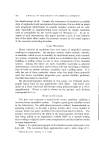
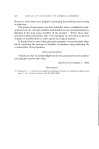
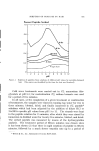
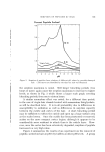
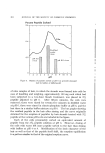
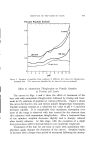
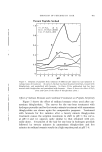
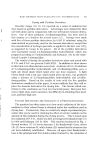
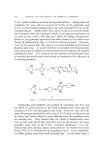
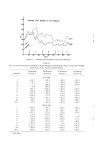
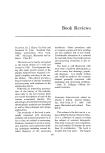
576 JOURNAL OF THE SOCIETY OF COSMETIC CHEMISTS Figure i. Photograph showing detail of hair tresses in the front hair line in a spiral coil arrangement immediately following permanent waving women's hair frequently assumes a helical coil configuration in the course of its being permanent waved, set, and combed into style. It will be further implied that hair assemblies in helical form can be treated qualitatively in terms of a classical physical model and that predictions of behavior based on this model fit moderately well with the observed behavior. Finally, since consideration of fibers in helical form involve physical properties in torsion, some measurements of the torsional stiffness and creep of single fibers are reported under various test condi- tions. OBSERVATIONS OF HAIR ON THE HEAD Let us first examine the process of wrapping hair on a rod for a permanent-waving treatment. The hair is arrayed with the fibers parallel in the form of a little tress. When it is wound in a cylindrical form around a waving rod bending forces are applied. When the rod is removed at the conclusion of the waving process the tip end of the hair hangs free and the hair tress is converted thereby into a helical coil. This results in the development of shear or torsional forces in the indi- vidual fibers. The coil arrangement can very easily be seen by looking at the heads of women just at the completion of the waving procedure. Figure 1 is a photograph of the typical arrangement of women's hair just after removal of the rods in a permanent-waving process. The helical coils and spiral arrangement of the groups of fibers are very evident. Spiral coils like these in permanent waved hair are also seen in naturally curly and wavy hair. Coils of varying degrees of regu-
Purchased for the exclusive use of nofirst nolast (unknown)
From: SCC Media Library & Resource Center (library.scconline.org)