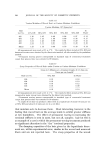
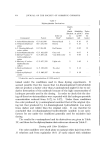
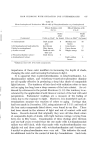
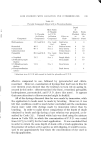
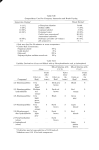
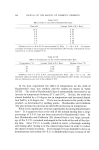
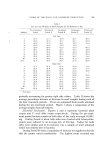
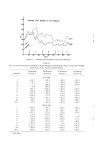
TORSIONAL PROPERTIES OF HAiR 585 hair obtained by the direct twist method are shown in Table IV. The application of the chemical waving treatment does not seem to alter the flow properties appreciably at low humidities, the creep being low in any event. In the wet state, however, the permanent-waved hair is even more plastic and less stiff than before treatment. These results may explain the value of permanent waving in the hair setting process. The fibers assume the set configuration more easily in the wet state, and the ease of deformation is further enhanced with wet waved hair. The hair flows more easily under the confiõurational strain, especially when waved. Drying to normal low humidities restores the fiber stiffness and elasticity to higher levels with hair containing a permanent wave, the torsional stiffness offers at least equal, and often greater, resistance to deformation than unwaved hair. THE BEHAVIOR OF HAIR TRESSES AS COILS The previous section started with consideration of the behavior of an ideal elastic spring and showed that the hair fiber is not an ideally elastic substance. For this reason, at least, application of the simple theory cannot be expected to hold in a quantitative way. It may, none- theless, be useful to examine equation 1 and the information on the creep behavior of hair in a qualitative sense and to consider the extension of hair tresses in coil form under gravitational loading in a variety of circumstances. From equation 1, one would expect a hair coil to become more easily deformed under load as the torsional stiffness (G) decreased. One important way in which the torsion modulus of human hair can be altered is by change in the ambient humidity. As the data presented indicate, a hair fiber at 40% RH is about three times as stiff in torsion as at 90•0 RH thus increasing the humidity decreases the shear modulus markedly. Additionally, the hair fiber shows substantially more creep at higher moisture contents. It would be expected that hair coils exposed in more humid atmospheres, therefore, would extend to a greater degree under stress or under gravitational forces than those similarly exposed under drier conditions. This conclusion is no great surprise to any woman who knows from extensive experience that her hair set is poorer and tends to be lost in damp weather. It might also be expected that imposition of the set and ready coil formation in the setting operation would be favored by lower torsion modulus, i.e., at higher moisture content, since the fibers can be de- formed more easily. Creep of the fibers in the moist state also favors

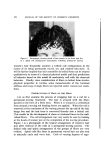
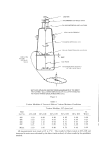
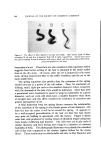
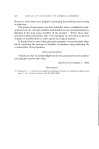
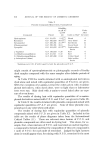
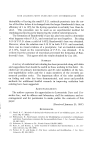
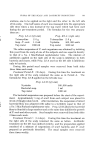
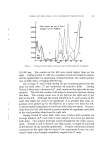
JOURNAL OF Till, SOCIETY OF COSMETIC CHEMISTS ß A B C Figure 6. The effect of fiber diameter on hair coil length. Itair tresses made of fibers averaging 70, 55 and 42/z in diameter from left to right, respectively. Tresses were set in pin curls averaging 16 mm in diameter with water, dried, and thcn suspended at 65% R.H., and photographed at one hour. formation of a set. These facts are also consistent with experience which suggests that better setting of the hair is obtained in the moist rather than in the dry state. Of course, after the set is imparted in the moist state, drying restores the fiber to the stiffer condition and the set to the more stable form. The spring equations also predict that the extension of the spring should increase as a power of the coil radius. Thus, for maximum set holding, small, tight pin curls or the smallest diameter rollers consistent with the demands of the hair style would be indicated. Since hair with a permanent wave treatment is easier to wrap in conformity to a given diameter, such set curls will often have a smaller diameter than those of straight hair, and this effect would favor resistance to extension and greater permanence of set. A final deduction from the spring theory concerns the relationship of the extension of the spring to the fourth power of hair diameter--the finer the hair the easier it will be to extend the spring. It appears to be a well-accepted generalization of the hair art that fine hair shows very poor set holding in agreement x•:ith the theory. Figure 6 shows some hair coils produced by setting tresses of identical length using hair from heads of differing hair fineness. The coils were set in pin curls of similar diameter and after drying were hung in a chamber at constant humidity of 65%. The photograph illustrates very plainly the extended coil of fine hair compared to the shorter, tighter helices for the coarse fibers. These results may be attributable not only to fiber diameter and
Purchased for the exclusive use of nofirst nolast (unknown)
From: SCC Media Library & Resource Center (library.scconline.org)