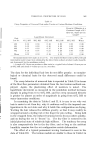
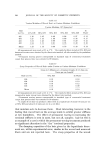
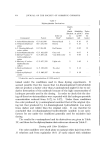
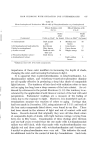
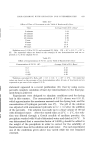
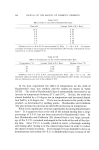
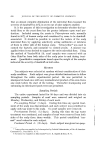
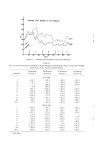
TORSIONAL I'ROl'ERTIES OF HAIR ,587 Table V The Effects of Fiber Diameter on Torsional Properties of Hair Fibers by Direct Twist Method Hair Lot S403 Hair Lot PF _ Fine Coarse Fine Coarse Cross section, cm 2 X 10 -6 31 Torsion modulus, dyne/cm '2 X 10 tø At 65% RH 0.96 Immersed in water 0.22 Creep at a couple of 3.1 dyne-cin in 5 minutes, turns/cm At 65% RH 0.025 Immersed in water 0.11 48 1 O1 0 25 00l 0 06 24 56 ß , . 26 O. 24 0 12 ß , . 0.05 to possible effects of torsional stiffness but to creep as a function of diameter. Some relevant data are shown in Table V. In the previous single fiber results the test fibers were sorted out so that hairs of similar diameter were used for measurement. In the present case fibers from the same head but differing in cross section were employed. The data show no real differences in modulus between coarse and fine fibers of the same lots. It should be recalled, however, that the modulus describes the property of a unit volume of substance a fine hair presents less material to resist stress and is therefore more easily deformable than a coarse fiber of the same modulus. The tendency for creep also seems to be influenced by fiber fineness. The precision of the results at 65% RH is not very high so that it is uncertain whether fine fibers really creep more under these conditions. Under moist conditions, however, the creep rate for fine fibers is clearly greater than for coarse, as shown in Table V. The lower intrinsic stiff- ness and the tendency for greater creep would be consistent with the poorer retention of set of fine hair. This appears to be the situation in practice with fine adult or children's hair. I)ISCUSSION AND CONCLUSION The presentation above has emphasized the existence and behavior of helical coils. From this one is led to attempt analysis of setting and styling behavior in terms of classical theory of mechanical springs. While the theory holds for ideal materials and circumstances the depar- ture from ideality does not appear to rule out the qualitative relations that the theory suggests. One of the implications of the spring theory is that torsional forces are important in the behavior of hair coils. Measurement of the tor-

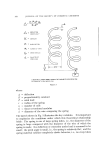
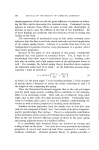
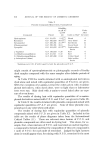
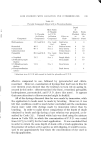
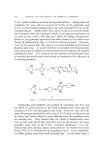
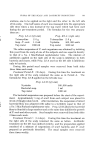
588 JOURNAL OF THE SOCIETY OF COSMETIC CHEMISTS sional properties of hair reveals the great influence of moisture in soften- ing the fiber and in increasing the torsional creep. Permanent waving appears to enhance these effects of water on hair and, surprisingly, to increase in many cases the stiffness of the hair at low humidities. All of these findings are consistent with the behavior of hair in setting and styling on the head. The observation of mechanical creep in hair under torsional stress indicates that the fiber is not truly elastic and rules out strict application of the simple spring theory. Indeed, it is certain that loss of the set configuration in practice involves creep phenomena to a greater extent than elastic properties. Because of the point of view adopted in this paper, considerable emphasis has been placed on torsional forces. Yet, it must be ac- knowledged that other types of mechanical forces, e.g., bending, come into play in reality and could explain some of the phenomena about as well. For example, the helical spring theory described above requires the deflection under load to be small. As the deflection becomes large, equation 1 must be altered to: (cos •' a sin •' a• /x = K'Pr% •, GI• q- EI ,I (4) in which a is the pitch angle, E is the bending modulus, I is the moment of inertia about a diameter or about the center (subscript p) and L is the length of wire composing the spring. Thus, the theoretical treatment suggests that as the coil gets longer and the pitch angle greater, bending forces contribute to the deforma- bility to an increasing extent. Hair coils are of relatively large pitch angle, and, as they relax, the angle increases further. Presumably also, creep in bending takes place so that for complete understanding the viscous as well as elastic properties in bending need elucidation. Another obvious departure from the simple view is that hair tress coils are not composed of single "wire" but consist of an array of approxi- mately parallel single fiber springs. There is a substantial contribution to the mechanics of the system of frictional forces between the individual fibers in the coil between different groups of fibers in the same spring and among adjacent tresses of a fin/shed coiffure. It is concluded that torsional forces are involved in waving and setting of hair on the head. New data have been presented on torsional properties of waved and unwaved hair fibers exposed to a variety of moisture conditions. Classical physical theory of springs provides a
Purchased for the exclusive use of nofirst nolast (unknown)
From: SCC Media Library & Resource Center (library.scconline.org)