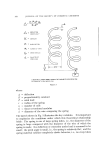
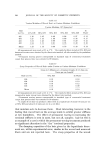
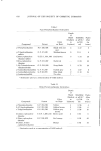
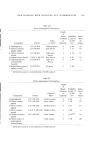
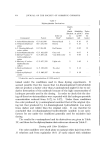
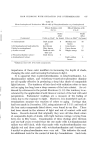
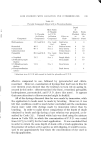
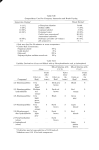
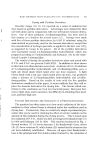
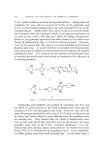
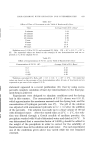
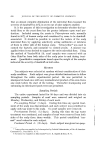
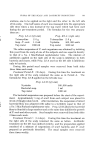
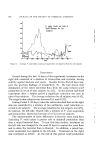
HAIR COLORING WITH OXIDATION DYE INTERMEDIATES 621 Dyeing with Pyridine Derivatives Recently Lange (10, 13, 14) reported on a series of oxidation hair dyes based on pyridine derivatives. Advantages were claimed for their use both alone and in conjunction with the well-known benzene deriva- tives. One of these products, 2,6-diaminopyridine, has been used in this country as a drabber for several years (15). Dyeings were made with five of these pyridine derivatives (in 0.025 M solutions) using the same method as previously used for the benzene derivatives, except that the concentration of hydrogen peroxide, as applied to the hair, was 1.8%, as suggested by Lange in his patent. All of the pyridine derivatives were purchased except 2,5-diaminopyridine hydrochloride, which was prepared according to Tschitschibabin and Kirsanow (16) by the reduc- tion of 2-amino-5-nitropyridine. The results of dyeing the pyridine derivatives alone and mixed with P.P.D. and P.A.P. are given in Table XIII. In addition to those shown in this table two other mixtures were dyed. A mixture of 0.01 M solutions of 2,5-diaminopyridine hydrochloride and 2,6-diaminopyridine gave a light ash blond shade which faded after one hour exposure. A light brown shade with a red east, which faded after one hour, was produced using a mixture of 2,5-diaminopyridine hydrochloride and 2,6-dihy- droxypyridine. Based on the results of tests with the five pyridine derivatives considered in this paper, it seems unlikely that they will re- place the benzene derivatives for dyeing hair. The factors which con- tribute to this conclusion are their low tinctorial power, their poor fast- ness to light alone and in mixtures, the difficulty in obtaining these prod- ucts, and their high cost. FACTORS INFLUENCING THE OXIDATION OF p-PHENYLENEDIAMINE The question has often arisen as to how much oxidation of the inter- mediates to their colored forms is obtained under the conditions used in dyeing hair. Fortunately, there is a relatively simple experimental pro- cedure that can be used for studying the effect of certain variables on the amount of this oxidation during the dyeing process. This is based upon the oxidation of P.P.D., which was first investigated by Bandrowski (17) in 1894 and Erdmann (18) in 1904. This reaction is pictured in Fig. 1. Several workers (17-19) favor structure I for Bandrowski's base, others (20, 21) favor structure II, while Austin (22) states that the structure has not been definitely established. However, all agree that Bandrowski's base is the principal and first stable product formed by the oxidation of

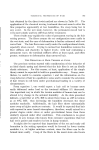
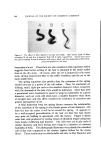
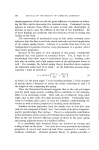
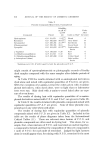
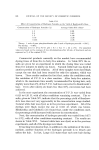
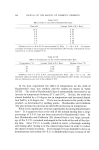
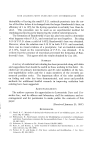
622 JOURNAL OF THE SOCIETY OF COSMETIC CHEMISTS P.P.D. under conditions used for dyeing hair and furs. Heiduschka and Goldstein (23) were able to account for 93.8% of the originally used P.P.D. by determining Bandrowski's base and unchanged P.P.D. in the reaction mixture. Bandrowski's base can be treated as a solvent-soluble dye and used to dye hair a dark grey shade, or an aqueous suspension can be used to dye wool a fast blue-grey shade at boiling temperature. However, it is generally agreed that an azine, formed by the further oxi- dation of Bandrowski's base, is the final coloring material. However, Cox (24) has shown that this azine is even more insoluble in water than Bandrowski's base. It would therefore be included with Bandrowski's base when using an analytical method based on the formation of material insoluble in water. It is evident that the amount of Bandrowski's base or insoluble material formed can be used as a measure of the efficiency of the dyeing operation. NH NH2 • 3 • 0• NH,• NH H2 NH• ¸o 3 ' NH• I NH,• NHz II Figure 1. Proposed structures for Bandrowski's base Heiduschka and Goldstein (23) studied the oxidation of P.P.D. and the effect of various factors on the yield of Bandrowski's base and the amount of P.P.D. left unchanged in the bath. However, they used one mole of hydrogen peroxide for each mole of P.P.D and a treatment time of twenty-four hours, which is vastly different from the conditions used for coloring hair. They showed that the yields of Bandrowski's base were at best only about 30% and that, even in the presence of excess peroxide, some 50% of the P.P.D. remained unchanged. Cox (24) showed that after dyeing copper moralanted fur for twenty-four hours about 15% P.P.D. remained in the unoxidized state. These conditions, too, differ greatly from those used in dyeing hair. On the other hand, a
Purchased for the exclusive use of nofirst nolast (unknown)
From: SCC Media Library & Resource Center (library.scconline.org)