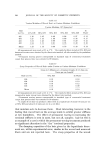
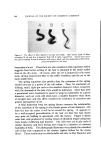
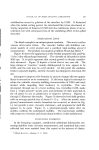
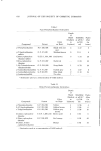
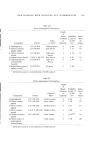
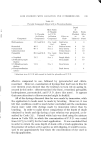
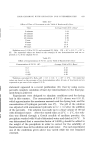
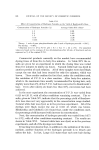
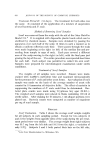
HAIR COLORING WITH OXIDATION DYE INTERMEDIATES 619 Table X I Phenolic Compounds Mixed with p-Phenylenediamine Depth Mole Ratio of of Phenolic Shade Fades % Phenolic to P.P.D. (Darkest After (in Fusion in Fusion Color on to (in Compound Compound) Compound Hair • Lightest) hours) Hydroquinone 75.5 and 50.4 Resorcinol 49. ,5 Pyrocatechol 60.4 Chlororesorcinol . . . Pyrogallol 69.9 and 53.8 a-Naphthol 72.7 1,5-Dihydroxynaph- . . . thalene 2,7-Dihydroxynaph- 74.8 thalene p-Phenylenediamine . . . (alone) 3 to 1 and Light grey 4 4 1 to 1 brown 1 to 1 Golden brown 6 14 3 to 2 Grey brown ,5 12 ... Yellow brown 7 10 2 to 1 and Grey brown 8 4 ltol 2 to 1 Purple black 1 10 ... Grey purple 2 10 2 to 1 Grey brown 3 2 Dark brown ... 4 Solutions were 0.01 M with regard to both the phenoli½ and P.P.D. effective compound to use, followed by pyrocatechol and chloro- resorcinol. However, examination of dyeings that had been in files for over thirteen years showed that the tendency to turn red on ageing in- creased in this order: chlororesorcinol (the least), resorcinol, pyrogallol, hydroquinone, pyrocatechol, and P.P.D. alone (the most). It appears that more attention to chlororesorcinol might be fruitful. All of the dyeings discussed thus far were made by immersion, while the application to heads must be made by brushing. However, it was felt that conditions could be much better controlled and the conclusions drawn more valid with dyeings made by immersion rather than by brushing. In order to make direct comparisons of the depth of shade obtained by brush and dip dyeing a base solution was prepared, as de- scribed by Cook (12). Natural white hair was dyed using the mixture shown in Table XII, in which the concentration of P.P.D. was varied from 0.1 lC•o to 0.66c•0 for the brush application. It was conduded that in order to obtain the same depth of shade with a brush application (in the presence of surface active agents) as with dipping, it would be neces- sary to use approximately four times the concentration of dye used in the dip application.

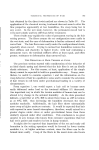
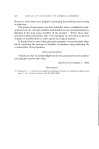
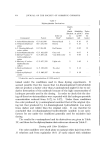
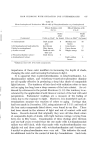
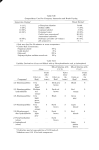
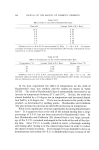
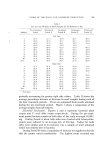
Table XII Compositions Used for Company Immersion and Brush Dyeing Immersion Dyeing a Brush Dyeing a 0.11% 0 20% l0 00% 40 00% ß . ß . 5o 00% 97 p-Phcnylcne diamine Varied Sodium sulfite 0.20% Isopropyl alcohol 5.00% Deionized water 14.00% Cook's base concentrate b 26.00% Ammonium hydroxide 5.00 • Hydrogen peroxide (20 volume) 50.00% pH adjusted to 9.7 Hair was dyed for 30 minutes at room temperature. Cook's Base Concentrate: Propylene glycol 100 g Cetyl alcohol 20 g Oleic acid 300 g Polyoxyethylene sorbitan monoleate 100 g Table XIII Pyridine Derivatives Alone and Mixed with p-Phenylenediamine and p-Aminophenol Compound Mixed Solution with Mixed Solution with Alone P.P.D. P.A.P. Color on Hair a Fades Fades Fades After After After (in Color on (in Color on (in hours) Hair b hours) Hair • hours) 2,3-Diaminopyridine 2,5- Diaminopyridin e hydrochloride 2,6- Diaminopyridine 3,4- Diaminopyridine 2,6-Dihydroxypyri- dine hydrochloride p-Phenylenediamine (alone) p-Aminophenol (alone) Very light blond Medium red orange Very light green blond Very light orange Very light grey ß . , 3 Dark grey 3 Blond 6 brown 6 Dark red 4 Red 5 brown orange 1 Black 2 Green 1 grey Dark 3 brown Dark 3 Brown Dark 4 brown ...... Light 5 blonde Red 9 blonde Light golden brown Derivative used at concentration of 0.025 moles/1. Solutions were 0.01 M in both components.
Purchased for the exclusive use of nofirst nolast (unknown)
From: SCC Media Library & Resource Center (library.scconline.org)