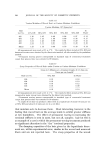
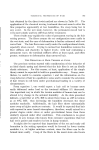
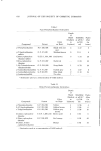
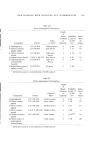
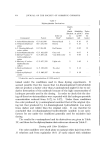
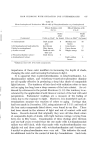
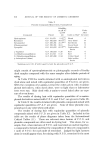
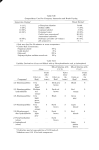
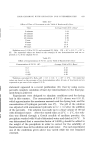
HAIR COLORING WITH OXIDATION DYE INTERMEDIATES 625 ! ß method that does not permit the simultaneous bleaching of melanin is hopelessly at a disadvantage when compared with the oxidative hair dyeing methods of today. In this experiment equivalent solutions were prepared except that the P.P.D. was eliminated. Natural dark brown hair was treated in these solutions in order to determine the amount of bleaching achieved. The color, as expected, became progressively lighter as the concentration of hydrogen peroxide was increased, with practically no bleaching occurring when the concentration was only 0.375%. It was found that the percentage yield of Bandrowski's base increased as the concentration of hydrogen peroxide was increased. However, under these conditions--at a concentration of 4.5% hydrogen peroxide, which is the most that can be used without substantial damage to the hair--the yield was only 8.86%. Heiduschka and Goldstein (23) also found that the yield of Bandrowski's base increased with increase in the concentration of hydrogen peroxide. It is interesting to note that, in the fur trade, the concentration of hydrogen peroxide is based upon the concentration of dye. The rule is that, in dyeing without a mordant, 15 ml of 3% hydrogen peroxide is used for each gram of dye. Since a 1.08% solution of P.P.D. was used in this experiment, this would mean that for each 100 ml of solution 16.2 ml of 3% hydrogen peroxide or a concentration of about 0.5% would be required. On the theory that one mole of hydrogen peroxide is required for each mole of P.P.D., as used by Heiduschka and Goldstein (23), the theoretical concentration of hydrogen peroxide would be 0.34%. Since the concentration of P.P.D. used in this experiment is approxi- mately the maximum amount used in dyeing hair, it is evident that when the concentration of hydrogen peroxide in the solution is 3% the amount used is almost nine times that required by theory and almost six times the amount that would be used in accordance with fur trade practice. The above facts suggest that a critical study on hair and heads, especially for dark shades, using hydrogen peroxide at concentrations less than 3% might be fruitful. In the next experiment the effect of pH, after the addition of the peroxide, on the yield of Bandrowski's base was determined. The re- suits are shown in Table XVII. All of the dyeings on natural white hair were black. Substantial bleaching of the natural dark brown hair was obtained in the pH range 9.3 to 10.0, with much less bleaching at pH 7.0 and 5.7. A maximum yield of Bandrowski's base of 6.52% was ob- tained at a pH of 9.8, with the yield decreasing slightly at higher pH values and substantially at lower pH's to a low of 0.59% at pH 5.7.

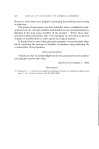
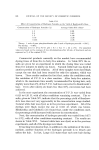
626 JOURNAL OF THE SOCIETY OF COSMETIC CHEMISTS Table XVII Effect of pH on the yield of Bandrowski's Base Final pH Average Yield of B.'s Base a 10.0 99 98 96 93 70 57 5.54 5.87 6.52 6.11 4.75 2.26 O. 59 a Solutions were 0.1 M in P.P.D. and contained 3% H202. T = 25 -k 2øC. The numeri- cal values are based on the averages of two determinations after 45 min. of treatment and are expressed as % of the original P.P.D. Table XVIII Effect of Temperature on the Yield of Bandrowski's Base Temperature (øC) Average Yield of B.'s Base a Melting Point (øC) 25 5.03 236 35 9.83 236 50 18.9 237 a Solutions were 0.1 M in P.P.D. and contained 3% H20•. pH = 9.7 =k 0.2. The numerical values are based on the averages of two determination after 45 min. of treatment and are expressed as per cent of the original P.P.D. In the next experiment the effect of temperature on the yield of Bandrowski's base was studied, and the results are shown in Table XVIII. The yield of Bandrowski's base is substantially increased by an increase in temperature between 25 øC and 50 øC. In fact, the yield was almost doubled by a 10-degree rise in temperature and increased almost four fold by a 25-degree rise. There was no decrease in the purity of the product, as determined by melting points. Heiduschka and Goldstein (23) also obtained an increase in yield with an increase in temperature. What is the significance of these experiments involving Bandrowski's base? It is apparent that at the end of the normal dyeing time a large percentage of P.P.D. has not been converted to Bandrowski's base. In fact, Heiduschka and Goldstein (23) showed that a very large percent- age of the P.P.D. remained unchanged in the bath at the end of the dye- ing time. Since P.P.D. is readily soluble in water, a thorough washing and rinsing after dyeing is of the utmost importance in order to reduce the chance of toxic reactions. Even though it is not desirable to have an instantaneous conversion of P.P.D. to Bandrowski's base, because of the
Purchased for the exclusive use of nofirst nolast (unknown)
From: SCC Media Library & Resource Center (library.scconline.org)