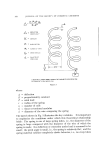
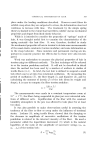
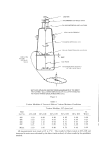
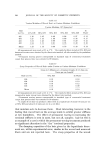
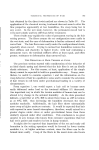
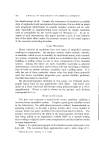
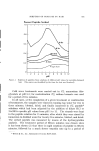
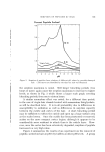
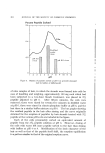
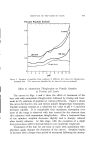
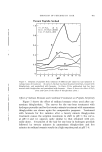
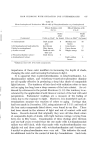
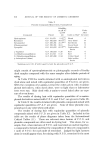
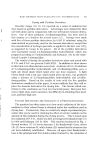
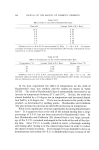
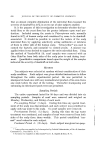
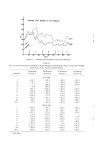
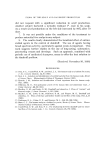
COUNTER SYNCHRONOUS SLOW SPEED MOTOR PIN VISE SUPPORTING WIRE ANO FLEER i3ELL JAR (SJPPORTED) fU•GSTEN REFERENCE INDICA FI:•G PIN AND CIRC'JLAR oeCALE CJLLAR CON:tECTI IG 'WIRE A:4J 713,• TEST YOKE PREVENTING ROTAI-IU:i OF T tE E,4D OF FltlrZR SKETCH OF APPARATUS USED FOR TORSION MEASUREMENTS BY THE DIRECT TWIST METHOD. SMALL SKETCH SHOWS DETAIL OF COLLARNITltlNglCATI IG PIN PASSING THROUGH CIRCULAR-MEASURING SCALE. Figure Table I Torsion Modulus of Unwaved Hair at Various Moisture Conditions Torsion Modulus, 10 m dynes/cm 2 Hair In Lot No. 41% RH 58• RH 65% RH 81% RH g3• RH Water 405 1 . 13 O. 98 O. 83 O. 65 O. 39 O. 20 404 1.13 1.01 0.91 0.71 0.45 0.21 403 1.22 1 . 12 O, 94 O. 77 O. 47 O. 24 402 1.27 1,11 O. 89 O. 79 O. 38 O. 22 Mean 1.19 1.06 O, 89 O, 73 O. 42 O. 22 All measurements were made at 21 4- iøC. The results for fibers tested at 65•0 RH and immersed in water were obtained by the direct twist method, all other results by the pendulum method.

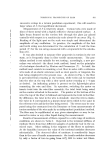
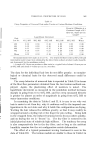
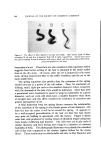
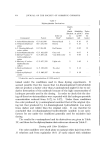
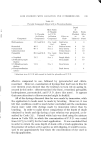
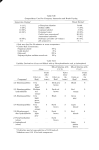
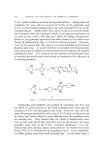
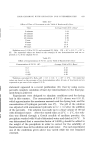
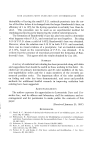
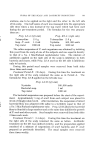
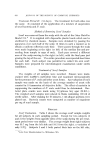
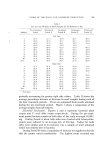
TORSIONAL PROPERTIES OF HAIR 583 Hair Lot No. Table I I Creep Properties of Unwaved Hair under Torsion at Various Moisture Conditions __ _ Creep in 5 Minutes at a Constant Couple of 3.1 dyne-era, Turns per cm Length a Logarithmic Decrement In 41% RH 58% RH 81% RH 93% RH 65% RH Water 405 O. 13 O. 13 0.19 O. 26 O. O1 O. 08 404 O. 12 O. 13 O. 16 O. 22 O. O1 0.08 403 O. 11 0.12 O. 17 0.24 0.01 0.08 402 O. 13 O. 14 0.21 0.29 0.01 0.08 Mean O. 12 O. 13 O. 18 O. 25 O. O1 O. 08 All measurements were made at 21 4- 1 øC. The results for fibers tested at 65% RH and immersed in water (creep) were obtained by the direct twist method, all other results (logarith- mic decrement) by the pendulum method. a A couple of 3.1 dyne-cm produces a fiber twist in a typical hair of about 0.5 turn per cm at 65% RH and about 3-4 turns per cm in a wet fiber. The data for the individual hair lots do not differ greatly no morpho- logical or chemical basis for the observed small differences could be found. The creep behavior of unwaved hair is reported in Table II in terms of the fiber flow parameters obtained from the two torsion methods em- ployed. Again, the plasticizing effect of moisture is noted. The logarithmic decrement as measured in the pendulum method increases sharply in going from 41 to 93% RH, and the creep measured directly is greater by almost an order of magnitude in going from 65% RH to water-immersion conditions. In examining the data in Tables I and II, it is easy to see why wet hair is easier to set than dry, why it conforms well to the imposed con- figuration in the wet state and why it holds this configuration on drying. Wetting the hair reduces the stiffness greatly, so that it may readily be wrapped around a styling rod or the finger for pin curling. Being held in the wrapped form, the induced torsional stress decays rather quickly, and on drying the set is "frozen" in. The dry fiber is restored to its initial physical state of relatively high stiffness. The tendency for creep is also comparatively low in the dry fiber, and so long as the ambient humidity remains low the set configuration resists deformation. The effect of a typical permanent waving treatment is seen in the data of Table III. The torsion moduli are similar to those in Table I in
Purchased for the exclusive use of nofirst nolast (unknown)
From: SCC Media Library & Resource Center (library.scconline.org)