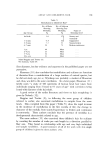
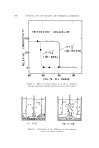
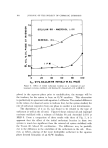
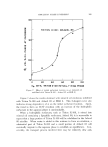
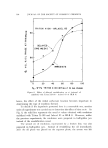
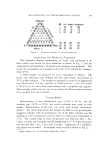
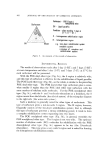
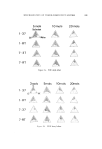
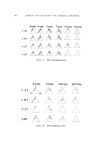
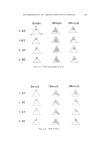
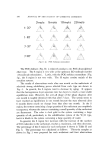
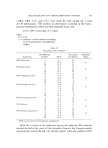
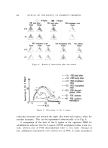
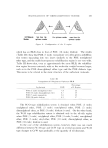
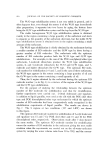
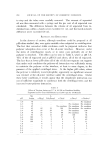
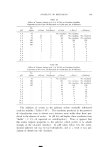
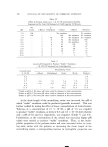
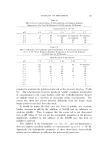
SOLUBILIZATION OF THREE-COMPONENT SVSTEM 213 The optimum number of ethylene oxide molecules for solubilization exists for each surfactant, and the S region becomes the widest when a surfactant with the optimum EO molecule number is used. The S region is shifted toward the left side when a surfactant with a smaller number of EO molecules than the optimum number is used, and toward the right side when a surfactant with a larger number is used. The S region consists mainly of the W/O type solubilization systems in the former, and mainly of the O/• type in the latter. The S region using surfactant with the optimum EO molecule number consists of a mixture of W/O and O/W types. In general, the W/O type solubilization system shows a poor stability. The steric structure of the surfactant molecule affects the solubilizing power considerably. POE (10 mols) dinonylphenyl ether has approxi- mately the same HLB as that of POE (5 mols) nonylphenyl ether, but the former gives the S region 2.3 times as wide as that of the latter. Similarly, POE (18 mols) diolcate gives the S region 2 times as wide as that of POE (7 mols) monooleate even though both surfactants have approximately the same HLB. The experiments using liquid paraffin, 2-octyl dodecanol, and squalane indicate that the optimum HLB for solubilization is larger than that for emulsification by 1 to 3. ACKNOWLEDGMENT The authors wish to express their sincere thanks to Mr. Yooichi Miya, Director, Shiseido Chemical Research Laboratory, for his advice on preparing this manuscript. (Received August 20, 1968) REFERENCES (1) Mitsui, T., Tahara, S., and Machida, Y., Studies on the emulsification of liquid paraffin using a statistical experimental design, Proc. Sci. Sec. Toilet Goods Assoc., 46, 73-84 (Dec. 1966). (2) Kawakami, Y., Surface active agent, Science (Japan), 23, 546 (1953).

J..%c. Cosmetic Chemists, 20, '215-'2'23 (March 4, 1969) Effect of Neutralizing Amine on Stability of Emulsions Prepared with Carboxy Vinyl Polymers the N. D. WEINER, Ph.D.,* A. K. SHAH, M. S.,* J. L. KANIG, Ph.D.,* and A. FELMEISTER, Ph.D.' ' Synopsis The influence of chain length and concentration of neutralizing amine on the stability of carboxy vinyl polymer stabilized emulsions was studied. Stability was based on the per cent of oil released under centrifugation at 13,000 rpm. Whereas the short chain length butylamines and the longer chain length amines (C s or higher) generally yielded poor emulsions, hexylamine and 2-ethylhexylamine gave stable emulsions over a wide pit range. The stability of these emulsions is discussed in terms of orientation of the polymer at the droplet-continuous phase interface. The degree of adsorption seems to le dependent on the 1)•fiy•m'r conformation and hydrophilic-lilmphilic balance. i NTRODU CTION Stirface active cmulsifiers that orient at the droplet continuous phase interface and that produce a more or less rigid film serve to reduce markedly the rate of coalescence. They prevent the droplets of the internal phase from losing their discreteness, even upon close approach. It should be noted that these surface active agents may not influence the rate of cream- ing to any significant degree. Some hydrophilic polymers which act by modifying the rheological properties of the dispersion medium, i.e., viscosity and yield value, may further increase the stability of such emulsions. These polymers act by decreasing the rate of creaming without, in many instances, influencing directly the rate of coalescence. * College of Pharmaceutical Sciences, Columbia University, New York, N.Y. 10(/23. •' Rutgers The State University, College of Pharmacy, Newark, N.J. 07104. 215
Purchased for the exclusive use of nofirst nolast (unknown)
From: SCC Media Library & Resource Center (library.scconline.org)