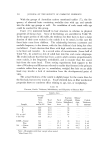
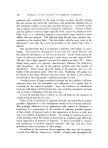
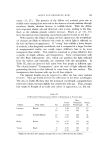
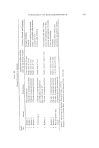
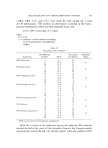
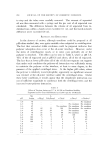
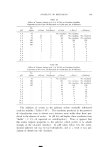
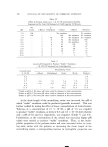
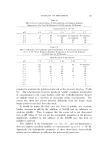
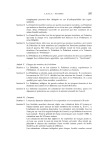
164 JOURNAL OF THE SOCIETY OF COSMETIC CHEMISTS With the groups of Australian natives mentioned earlier (7), the fre- quency of observed hairs containing medullas rises with age and extends into the older age groups as well. No correlation of scale count with age could be asserted for this group. Fourt (15) interested himself in hair structure in relation to physical properties of human hair. Some of his findings are assembled in Table VI. In the upper portion of this table, the tendency for finer hairs to have a large fraction of their cross section in the cuticle is to be noted in this case the finest hairs come from children. The relationship between coarseness and medulla frequency is also shown, with the fine children's hair being less often medullated. Fourt observes that fibers with high cuticle-to-cortex ratio tend to be finer and rounder. In a second series of measurements (lower half of Table VI), he sorted two lots of adult hair into fine and coarse subgroups. His results indicate that fine hair from a given adult contains proportionately more cuticle, is less frequently medullated, and is rounder than the coarse hair from the same head. These sorting experiments lend support to the view of Wynkoop and Hausman referred to earlier that fineness is the primary correlate rather than age per se nonetheless, vestigial fine hair on an adult head may involve a lack of maturation from the developmental point of view. The actual thickness of the cuticle is slightly larger for the coarse than for the fine hair, but not very much so. Fourt's limited data on fiber mechanical properties show no consistent effect relating to age, size, or morphology. Table VI Fineness, Cuticle Thickness, Medullation, and Ellipticity of Human Hair • Sample Cuticle Area Average Cross- Fraction Minor/ Sect. % of % of of Sample Major Area, Cross Cortex Medullated, Axis, mm 2 X 10⁵ Sect. Area Cuticle Thickness, microns A 610 16.6 .... 66 B 448 18.9 .... 32 C 435 19.0 .... 34 2« yr. girl 325 21.4 .... 16 6mo. boy 136 26.3 .... 4 RMH--Coarse 331 .... 18.7 20 Fine 143 .... 27.2 0 146 --Coarse 568 .... 16.3 91 Fine 210 .... 21.8 16 70.1 91.9 64.7 79.6 2.60 2.42 2.96 2.35 Note: All samples adult hair except where noted. aAfter Fourt (15).

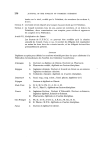
ADULT AND CHILDREN'S HAIR 165 CHEMICAL DIFFERENCES RELATING TO AGE Cystine and Sulfur Content An early paper (16) describes the results of elemental analyses on a variety of hair types. This work reports Caucasian adult hair to be richer in sulfur and nitrogen and poorer in oxygen content than children's hair. This paper is so poorly done and the methods are so uncertain that its credibility is very dubious. Wilson and Lewis (17) conclude that no relation can be demonstrated between cystine content of the hair and age of the subject, although "we cannot fail to be impressed by the apparent tendency . . . for cystine in adult hair to be slightly lower .... " More recent work (18) reports measurements of cystine, cysteine, nitrogen, and sulfur with no consistent relation with age. In contrast, Japanese workers (19) published data which revealed wide variation but some trend to declining cystine contents with age of the group. To add to the confusion on this point, it might be noted that hair of young, nonhuman mammals (cows and chimpanzees) reportedly (20) has lower cystine levels than that of adults. Also, some of the published work (18, 21-23) suggests an association of cystine with hair color the more heavily pigmented fibers usually exhibit higher cystine levels. As will be shown later, children's hair is lighter in color on the average, and if this secondary correlation exists, then one would expect children's hair to be lower in cystine and sulfur. This welter of inconsistency merely indicates large and expected biological variability. Most of the work done has simply been inadequate in method- ology and in sampling scope to ascertain the existence of a relationship, if present. Furthermore, it seems probable that factors other than age--e.g., diet and hormonal patterns--would have a strong influence on some of these chemical characteristics. Fatty Materials Associated with Scalp Hair It is well known that changes in oily secretions associated with skin and hair are related to age, e.g., the increase in secretion associated with puberty. A number of workers (24, 25) have published data indicating that children exhibit hair of lower fat content than adults. The chemical character of the fat is also different: cholesterol and cholesterol esters are at higher levels, and squalene, free fatty acids, and wax esters are at lower levels in cl•ildren than in adults. These differences are undoubtedly related to hormonal effects.
Purchased for the exclusive use of nofirst nolast (unknown)
From: SCC Media Library & Resource Center (library.scconline.org)