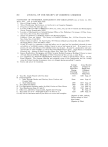
794 JOURNAL OF THE SOCIETY OF COSMETIC CHEMISTS Society of Cosmetic Chemists Announces Scholarship Grants The Board of Directors of the Society of Cosmetic Chemists has announced an initial disbursement of $4500 in scholarship grants to further education in cosmetic science. Seven colleges and universities will share these funds. Recipients are: Columbia University College of Pharmaceutical Sciences, New York, N. Y., Dr. Joseph Kanig, Dean Massachusetts College of Pharmacy, Boston, Mass., Dr. Harold Silverman, Professor of Pharmacy Roosevelt University, Chicago, II1., Dr. Walter Guthman, Chair- man, Dept. of Chemistry St. John's University College of Pharmacy, Jamaica, N. Y., Dr. John Sciarra, Director, Graduate Division St. Louis College of Pharmacy, St. Louis, Mo., Dr. Joseph E. Haberle, Director of Pharmaceutical Sciences West Virginia University School of Pharmacy, Morgantown, W. Va., Dr. Paul Zanowiak, Assoc. Professor of Pharmaceutics Each of these schools presently offers at least one course on some facet of cosmetic science. The funds are to be expended at the discre- tion of the supervising faculty member indicated.

J. Soc. Cosmetic Chemists, 20, 795-805 (Dec. 9, 1969) Bubble Formation in Hydroalcoholic Gels TONG JOE LIN, Ph.D.* Presented before the California Chapter, September 30, 1968, Los Angeles Synopsis--Formation of troublesome gas bubbles in cosmetic gels and viscous emulsions has been generally regarded as due to the entrainment of surrounding air during the processing of the products. It is proposed that, in the absence of external entrainment, gas bubbles can form in many cosmetic products through internal generation of gases. The internal genera- tion of a gas may be due to a chemical reaction involving evolution of a gaseous substance or a physical change involving a change in the solubility of the dissolved gas. The latter is believed to be responsible for gas bubble formation in many hydroalcoholic gels. A method of eliminating bubble formation due to such a mechanism is discussed. INTRODUCTION Presence of air bubbles in cosmetic preparations is generally un- desirable for various reasons. The trapped air can create pin holes and poor appearance in lipsticks or promote undesirable oxidation. The presence of air in creams or fluid make-ups can make the product texture appear coarse or can lower the specific gravity of the product to affect the net weight. It is known that the presence of excessive air bubbles in an emulsion can cause the emulsifier molecules to adsorb at the air-emul- sion interface and. deplete the emulsifier needed at the oil-water inter- face, resulting in poor emulsion stability (1). Control of aeration is a difficult problem in manufacturing many cosmetic products. Particu- larly if the product is viscous or has a high yield value, the trapped air may not escape and may remain in the product indefinitely (2). * Max Factor & Co., Hollywood, Calif. 90028. Present address: Chemical Works, 19 Fu Shin Road, Section 4, Taichung, Taiwan. 795 Shen Hsiang Tang
Purchased for the exclusive use of nofirst nolast (unknown)
From: SCC Media Library & Resource Center (library.scconline.org)