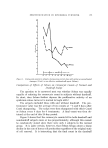
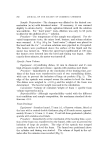
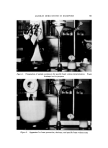
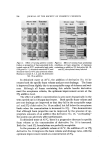
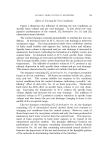
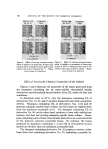
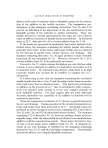
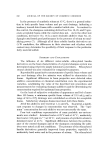
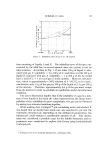
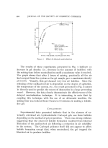
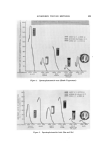
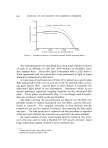
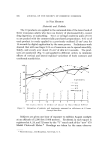
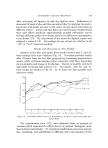
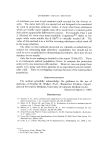
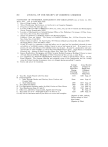
SUNSCREEN TESTING METHODS 819 after surveying all squares to find the lightest area. Reflectance is measured through a blue and then an amber filter by applying the meter- ing device with gentle pressure to the center of each square four times in different orders. Amber and blue filters are used because Daniels found that such filters produced approximately parallel reflectance curves through different grades of erythema and that red filters are unresponsive to erythema (10). By adjustment of the meter the lightest square was assigned a value of 100. All readings for one subject are relative to his "100" or "best" sunscreen readings. Results and Discussion in Vivo Method Analysis of the blue and amber filter results showed that $- and 24- hour readings have least variation (Fig. 10). Variation probably results after 24 hours from the fact that progressively increasing pigmentation occurs, while erythema remains rather consistent until then, depending on wavelengths and dosage of irradiation. Barely perceptible and short ultraviolet erythema fade earliest (11). For clarity, only 24- and 72- hour results are shown in Fig. 10. At 72 hours the lines parallel each other less closely. I00 80 v v 60 •0 2O Figure 10. B-24 A-24 ------ A-72 B -72 / / i I L I F I I I • 9 4 5 3 I0 2 1 8 7 6 Ten Sunscreens in Order of Least ta Most Mean Affect Individual patient curves of reflectance at 24 and 72 hours using blue and amber filters The experimental error (5%) was estimated from an analysis of variance which separated the effects due to (a) patient (biological varia- tion between individuals) (b) treatment (individual sunscreens spread- ing, combining, and solubilizing at different rates and amounts of the

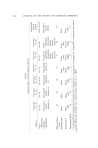
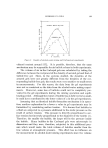
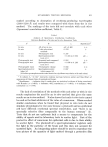
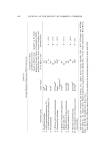
820 JOURNAL OF THE SOCIETY OF COSMETIC CHEMISTS skin) and (c) interactions (different patients reacting to treatment some- what differently, as seen in Fig. 9). The statistical significance of effects was determined by "F" tests in the analysis of variance. All three effects (patient, treatment, inter- action) were very significant (P 0.0005) i.e., even with the small sample size, the results are almost certainly not due to chance. A sidenote is the result of a compiled ranking of protection by seven resident physicians in dermatologic training. Their composite rank was significantly correlated with the reflectometer findings using Spear- man's test (Table I). There are several methods and instruments to test light absorbers. Blum's impression that the unaided eye is more sensitive and accurate than photography (12) conflicts with Rottier's recent statement that visual readings of minimal erythema doses may vary by 25% even for experienced examiners (13). Since, in the final judgement, skin redness proves the lack of effectiveness of sunscreens, instrumentation for accu- rate recording of erythema is needed. The precision of the reflectometer method is shown by the mean rankings of protection recorded by amber and blue filters at 8, 24, and 72 hours. There is less than a 1% possibility that similar ranks could have been achieved by chance (Table I). The reflectometer readings parallel the biology of erythema. For example, 8- and 24-hour erythema measurements are more consistent than the 72-hour erythema, conforming to the known facts that melanin pigmentation begins and light erythema fades by 24 hours (13, 14). A final assessment of the ability of reflectometer readings to correspond to what the eye sees is confirmed by the compiled rankings of protection of seven dermatologists. To minimize variation, sunscreens should be tested in a setting of uniform application. Tests employing the "usage situation" or the "practical application" imply that unequal quantities of sun protectant may be applied. Since protection is related to quantity, the application, method, and amount of substance per area must be constant because film thickness determines protection and such thickness is difficult to measure by present day biological methods. An exact quantity of sunscreen per area that would give a relatively thin film was purposely used so as to obtain a recordable and comparable erythema after one hour's noon, summer sun (about 3 MED's) (11, 15). Investigators have claimed 50 MED's protection from some agents. This means that more than 16 hours of noon sun would be needed to produce erythema, ruling out the sun as a light source for the experiment (16). Artificial sources break
Purchased for the exclusive use of nofirst nolast (unknown)
From: SCC Media Library & Resource Center (library.scconline.org)