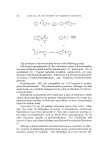
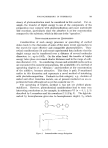
766 JOURNAL OF THE SOCIETY OF COSMETIC CHEMISTS undergoes very rapid intersystem crossing to the corresponding triplet, TB. The latter is efficiently quenched by the naphthalene part of the molecule, even though the two parts of the molecule are not conjugated in the classical sense. TN then decays to ground state. On the other hand, light absorbed by the naphthalene part gives rise to naphthalene singlet, SN, which is efficiently quenched by the benzophenone to give benzophenone singlet, SB. The latter goes over to the triplet and the process is repeated. Products of this type which carry their own energy disposal systems may represent photostabilizers of the future. SUMMARY Mechanisms of photostabilization are discussed in terms of current photochemical theories. Energy transfer processes are reviewed in the light of potential use in cosmetic applications. (Received February 13, 1969) REFERENCES (1) Vinson, L. J., B orselli, V. F., and Singer, E. J., Realistic methods for determining photo- sensitization potential of topical agents, Am. Perfumer Cosmetics, 83, 37 (May, 1968). (2) Strobel, A., and Inserra, J. J., The use of U.V. absorbers in cosmetic products, Ibid., 83, 25 (December, 1968). (3) Rottier, P. B., Biologic problems concerning sunscreens, J. Soc. Cosmetic Chemists, 19, 85 (1968). (4) Calvert, J., and Pitts, J. N., Jr. Photochemistry, John Wiley & Sons, Inc., New York, N.Y., 1966. (5) Turro, N.J., Molecular Photochemistry, W. A. Benjamin, Inc., New York, N.Y., 1965. (6) Yang, N. C., Zwicker, E. F., and Grossweiner, L. I., The role of n-r* triplet in photo- chemical enolization of o-benzylbenzophenone, J. Am. Chem. Soc., 85, 2671 (1963). (7) Miller, S. B., Lappin, G. R., and Tholstrup, C. E., Ultraviolet absorbers, Modern Plastics Encyclopedia, 45, (14A), 442 (1968). (8) Sandher, M. R., Hedaya, E., and Trecker, D. J., Mechanistic studies of the Photo-Fries reaction, J. Am. Chem. Soc., 90, 7249 (1968). (9) F6rster, T., Transfer mechanisms of electronic excitation, Discussions Faraday Soc., 27, 1 (1959). (10) Rauh, R. D., Evans, T. 1•., and Leermakers, P. A., Intramolecular energy transfer in some indole alkaloids and related donor-acceptor systems, J. Am. Chem. Soc., 90, 6897 (1968). (11) Leermakers, 1 . A., Byers, G. W., Lamola A. A., and Hammond, G. S., Intramolecular electronic energy transfer between nonconjugated chromophores in some model com- pounds, Ibid., 85, 2670 (1963) Ibid., 87, 2322 (1965).

J. Soc. Cosmetic Chemists, 20, 767-775 (Dec. 9, 1969) The Effect of Selenium Sulfide on Epidermal Turnover of Normal and Dandruff Scalps GERD PLEWIG, M.D. and ALBERT M. KLIGMAN, Ph.D., M.D.* Presented before the •rew York Chapter, January 8, 1969, •rew York City Synopsis--A highly active antidandruff agent, seleniuxn sulfide, was studied with normal and dandruff scalps to test the hypothesis that the excess scaling is due to an overproduction of horny cells and that effective therapy is absolutely dependent on lowering the rate of multi- plication of germinative cells. A new technique to demonstrate an increased production of horny cells in dandruff entailed determination of the corneocyte count, the quantity of horny cells per square centimeter produced over a 4-day period. Use of a selenium sulfide-contain- ing shampoo sharply reduced the corneocyte counts a nomncdicated shaxnpoo reduced the count only slightly. Selenium sulfide was proportionately effective in lowering the corneocyte count of the normal scalp. It was postulated that this agent controls dandruff by its cytostatic capa- bilities. Its principal impact is to reduce cell turnover. Thyroidinc radioautography con- firmed the inhibitory effect of selenium sulfide on epidermopoesis. The labeling index of both the epidermis and the infundibulum of the hair follicles of the normal scalp, not previ- ously described in the literature, was determined. Selenium sulfide was equally effective in diminishing the labeling index of the epidermis and the upper part of the external root sheath of the hair follicles. INTRODUCTION In a previous study from this laboratory (1), preliminary evidence was obtained of increased epidermal turnover (accelerated epidermopoe- sis) in the scalps of subjects with intense dandruff. In a limited series, results showed: (a) an approximate doubling of the mitotic index (b) almost twice the normal amount of radiolabeled cells after the intra- dermal injection of tritiated thymidine (c) histologic loci of parakerato- sis and (d) a lessened transit time of radiolabeled cells through the Malpighian layer. * Department of Dermatology, University of Pennsylvania School of Medicine, Phila- delphia, Pa. 19104. 767
Purchased for the exclusive use of nofirst nolast (unknown)
From: SCC Media Library & Resource Center (library.scconline.org)